Election inquiry commences 150-day journey with gathering of evidence
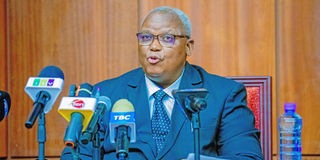
The chairman of a Commission of Inquiry into violence and breaches of the law during and after the October 2025 General Election, Justice Shaban Ally Lila speaks in Dar es Salaam on Monday. PHOTO | JULIUS MARICHA
Dar es Salaam. Tanzania’s Commission of Inquiry into those responsible for violence and alleged violations of the law during and after the October 2025 General Election has begun its 150-day journey, with commissioners starting to collect evidence today in Kigamboni District, Dar es Salaam, before moving to other areas linked to the incidents under investigation.
The exercise marks the beginning of the commission’s fieldwork as it seeks to establish who planned, financed, coordinated or participated in the violence, as well as those whose actions may have contributed to deaths, injuries, disappearances and other alleged violations during and after the election.
The six-member commission, chaired by retired Court of Appeal Judge Shaban Ally Lila, was established by President Samia Suluhu Hassan following recommendations by the inquiry led by retired Chief Justice Mohamed Chande Othman.
Justice Lila said the commission had been created to undertake further investigations into specific issues identified by the previous inquiry and would gather evidence through several methods.
“We will use different methods that will enable us to obtain accurate and detailed information. These will include direct evidence, documentary evidence and evidence obtained through visiting the locations of the incidents,” he said.
The commission will visit all relevant areas within the 150 days granted by the appointing authority, with the field exercise beginning in Kigamboni before extending to other locations connected to its terms of reference. Its mandate includes identifying people who planned, financed, coordinated or carried out violence during and after the October 29, 2025 General Election. It will also investigate specific incidents arising from efforts to control the violence, including allegations concerning unusual deaths of children and people from vulnerable groups.
The commission will examine claims of serious injuries resulting from unlawful use of firearms, allegations that people were shot outside areas affected by violence and reports of people who went missing during and after the election.
Another key area will be allegations that excessive force was used contrary to laws, procedures and established guidelines while authorities were responding to the violence.
Justice Lila said the commission would also consider any other matter it found relevant to its mandate.
The commission is expected to gather information from witnesses, documents and visits to locations where incidents occurred before preparing its report and recommendations.
It will also observe the right to be heard by giving people affected by information presented before it an opportunity to respond.
Foreign judges add regional perspective
The inquiry includes two judges from outside Tanzania — Namibia’s Deputy Chief Justice Petrus Tileinge Damaseb and Uganda’s Court of Appeal Judge Barishaki Bonny Cheborion — whose participation is intended to bring wider judicial and regional experience to the investigation.
Justice Damaseb has pledged to contribute his judicial experience to the assignment, saying he was grateful for the opportunity to participate in Tanzania’s efforts.
“I hope that appointment to this commission indicates the serious ambition,” he said, adding that his appointment followed a request made to Namibia’s Chief Justice and consideration of the experience required for the assignment.
He said he hoped his contribution would strengthen the commission, particularly its independence.
“I hope that the small contribution that I will make in service of this commission strengthens that, most importantly, independence,” Justice Damaseb said.
Justice Cheborion also pledged to use his abilities and experience to help the commission complete its work successfully. “We are here to ensure that we use our abilities to the best of our capacity, as God blesses us, so that we can conclude this matter safely and in the spirit of good neighbourliness,” he said. The Ugandan judge, who also serves as an appellate judge of the East African Court of Justice, recalled the longstanding relationship between Tanzania and Uganda. “Tanzania helped us during the time of Idi Amin Dada, and we have maintained good cooperation up to now. It is now time for us to contribute as well,” he said.
Commission promises independence
Justice Lila has also stressed that the commission will conduct its work independently within the law, saying the President’s role was to appoint commissioners and issue the terms of reference rather than direct how investigations should be conducted.
“Once you give it the authority through the terms of reference in accordance with the law, the commission conducts its work independently according to the procedures it has established,” he said.
He said the commission would collect information, prepare its report and submit it to the President, who would then decide how to use the findings in accordance with the law.
“There is nowhere where we are allowed to be interfered with by anyone or anything other than the law,” Justice Lila said.
The commission also has powers to summon people believed to possess relevant information and, where necessary, require them to provide evidence. Witness protection will also form part of the inquiry, with Justice Lila saying people with relevant information should be able to come forward without fear.
“The law gives witnesses the opportunity to be protected when they come forward to provide information,” he said.
The new inquiry follows the work of the Chande commission, which investigated the violence and breaches of peace surrounding the 2025 election. Those incidents resulted in 518 deaths and left thousands injured. The new commission is now expected to move from establishing the circumstances surrounding the violence to identifying those responsible and examining allegations surrounding the response to the unrest. Members of the public with relevant information have been invited to contact the commission through [email protected] or WhatsApp number 0737 305 449.
With evidence collection starting in Kigamboni today, the commission has 150 days to visit relevant locations, hear witnesses, examine evidence and submit its report and recommendations.
Register to begin your journey to our premium contentSubscribe for full access to premium content