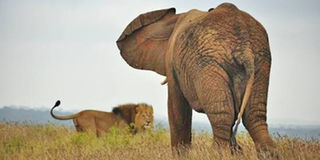
From territorial rivals and staunch rebels to formidable foes, Tanzanian National Parks is a land where the animal kingdom has long been a battleground for supremacy, and it will never cease as long as the sun rises on the Serengeti plains and the Ngorongoro crater still has herds of giant elephants roaming, oblivious to the man-made king of the savannah.
Tanzania is referred to as the ‘lion capital of the world’; it has the largest known lion population, estimated at 15,000. From the tree-climbing lions in Lake Manyara National Park to Nyerere National Park, formerly Selous Game Reserve, this carnivore has fascinated tourists for decades.
The revered and feared member of the Big 5 animals in Africa has been subject to many Hollywood blockbusters, including the 1996 film ‘The Ghost and the Darkness’ starring Val Kilmer and Michael Douglas.
Based on real gruesome events of 1898, the movie basically glorified the beast, showing lions going on a rampage and mauling railway workers in Tsavo.
Lions are equally admired and dreaded by humans and other animals, but in the wilderness power and control are subjective and slippery, and the crown is not permanently on the lion’s head; other species have proven that they can be mentioned in the same breath as the yellow-maned predator.
In Ngorongoro, Ruaha and Serengeti National Parks, the Cape buffalo is one of the most terrifying animals a human can encounter. The grass-eating bulls have no problem tearing human flesh; they are known to attack unprovoked and gore their victims to death.
Weighing more than three times the lion’s weight, buffaloes are known to kill more lions than lions are recorded to kill them. One healthy bull is enough to pose a threat to the pride of lions. It normally takes more than four full-grown lions just to bring one buffalo to its knees, and even then, the savannah carnivore is known to mainly attack injured, old or lone buffaloes, as they are the most vulnerable.
They are known to move in a tight formation with the calves fiercely protected. Buffalo have been seen going back to rescue a family member under attack. A single bull can gore a lion to death instantly, with the strength to throw a lion up in the air, sending them to their demise.
That’s the main reason a lion king would only hunt a buffalo out of desperation and if that’s the only option available in a time of prey scarcity, and they would form a strong pride just to approach a lone bull. In a one-on-one showdown between these two species, a lion will likely not emerge victorious.
The untouchable giant of Tarangire, Ruaha and Serengeti is the majestic elephant. The humble giant is not mentioned as the supreme ruler of the wild, and it doesn’t really care. Elephants do not fight for food with the lion; it certainly doesn’t hunt nor thirst for blood. Naturally it is in no competition with lions, unless its territory is trespassed.
At the average height of three metres and 6000 kilograms, the adult male African bush elephant dwarfs the largest lion. This herbivore can instantly kill a lion with a stomp or a tusk strike. Lions do not view elephants as prey but as huge territorial bosses, and oftentimes they would avoid coming into contact with them. A confrontation with an elephant is not in its best interest.
On very rare occasions, like extreme drought and scarcity, lions would take risks and attack calves, often those left behind or stuck in mud by the riverbanks. Few lion prides have been witnessed to have adapted to hunt young juvenile elephants, but lions would never attack a healthy, fully grown elephant; that is guaranteed instant death.
Elephants are aggressive when they feel threatened and are known to have exceptionally long memories and can identify lions who have attacked them from their roars, scent and location.
Elephants have been known to remember these lions they have had an encounter with and would attack them when their paths cross again. When these two animals cross paths, the crowned hunter most certainly gives way to the tusked giants.
Honey Badger is a definition of ‘it’s not the size of the dog in the fight but the size of the fight in a dog’. This pint-sized animal found roaming in Ruaha, Serengeti and other national parks across Tanzania is known to never back out of any fight.
Honey badgers have been filmed instigating large predators, looking for a fight. Fiercely protective of their young, this thick-skinned animal is too much trouble to go against.
The vicious bites and their extreme aggression have been able to fight off lions, wound hyenas and chase off leopards. To avoid injuries from fighting honey badgers with little rewards, lions often do not waste their energy in a full-fledged fight against them.
Equally territorial, a honey badger is known to invade beehives to steal honey and could single-handedly fight large predators for hours. It’s one animal that has built a reputation that precedes them, and lions have learnt not to bother confronting them unnecessarily.
The Black Rhino population is dwindling down. The animal that is near extinction due to poaching has a feared reputation. The horn at its forehead is a deadly weapon known to have gored many lions. With its speed, even a pride of lions does not stand a chance against this formidable foe.
Over time lions have adapted to distancing themselves from the single-horned mammal. Its only real threat is humans, who unfortunately have devised weapons to hunt it for its horns.
There is a myth that it has medicinal benefits, but it has been proven that rhino horns are made of keratin, the same material that makes up human fingernails. And they have no medicinal value.
The large, all-muscle hippos found in Katavi and Ruaha National Parks are misjudged as fat and slow mammals who laze around the ponds eating grass, but to the contrary, under their thick skin, hippos are all muscle with wide jaws and teeth that can easily cut a human in half and crush a lion skull with a snap.
Many young and inexperienced lions have met their death by the riverbanks in the jaws of hippos. Even an act of drinking water in their presence irritates hippos, and they defend their water bodies as their sovereign land. Hippos are unpredictable and quick on their feet. Any animal dragged into the water by these beasts would never emerge alive.
Even though hippos are strictly vegetarians, they have been documented tearing animals in two and spitting them out. The lion’s longest foe is a hyena. Their never-ending war is testament to the hyena’s ability to challenge a much larger enemy, and with strategy, coordination and courage, hyenas are known to have caused many deaths of lion cubs, with the aim to decimate the lion population.
In well-coordinated attacks, the female-led hyena prides have on many occasions encircled adult lions and caused fatal injuries. They are also known for stealing lion kills.
Often moving in prides, female hyenas would overwhelm a lone lion with ceaseless bites until the lion either runs away or is subdued and killed. Lions kill hyenas not because they are prey but for the purpose of suppressing the enemy.
In the Tanzanian wilderness, there is no monarchy; the crown is contested from sunrise to sunset. While humans would celebrate the lion as the king, the wild pokes holes at that notion every day.
Register to begin your journey to our premium contentSubscribe for full access to premium content