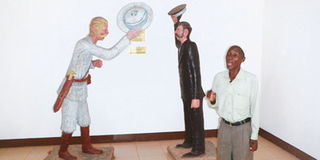
Mzee Kassim explain a point near the life-size papier-mache modoles of Stanley(left) and Dr Livingstone(rights)
What you need to know:
About 7 kms from Kigoma town is Ujiji, an ancient town of a few simple houses reached through a cultural educational backdrop. Stretching for nearly one kilometre is a ‘stone’ paved road named after Dr Livingstone, which introduces visitors to the museum.
Stories about Dr David Livingstone set off my wanderlust. The urge to discover adventures of his 19th century exploration has always appealed to me. Recently I got to satisfy this severe thirst with a trip to Ujiji in Kigoma.
About 7 kms from Kigoma town is Ujiji, an ancient town of a few simple houses reached through a cultural educational backdrop. Stretching for nearly one kilometre is a ‘stone’ paved road named after Dr Livingstone, which introduces visitors to the museum.
In the heart of the suburb is the Dr Livingstone Memorial Museum, one of the popular museums in Tanzania. It was home to Dr Livingstone from 1869, when he established his temporary abode in the area.
Here, I met Ms Miriam Mkonya, head of the site and Kulwa Mathias, the assistant conservator as well as Mr Kassim Govola, also an assistant conservator. After exchanging the pleasantries, Mr Kassim took me around.
According to Mr Kassim, Dr Livingstone, who was a medical doctor and preacher, chose to stay at Ujiji which was then a major slave port for slaves captured from Zaire (now DRC). The slaves crossed Lake Tanganyika via Ujiji enroute to Bagamoyo for their captive destinations.
The former slaves route near the local market at Ujiji is where the slaves started their long journey from Ujiji. The path is lined with old trees on both sides of the road.
In the museum some efforts have been made to illustrate the destinations of the slave trade and some of the photos show Dr Livingstone on different occasions while at Ujiji. One of the popular is the life-size papier-mâché of Dr Livingstone and Henry Stanley Morton greeting each other.
“Dr Livingstone, I presume” was Stanley’s greeting as he met Dr Livingstone on November 10, 1871 when they met at Ujiji. Stanley was a journalist reporting for the New York Herald magazine.
It is believed that Dr Livingstone was in his tent under a mango tree resting when he heard one of his servants shout, “A Muzungu is coming.” Livingstone was curious and got out to meet the visitor who was approaching ahead of a long caravan with porters carrying a huge collection of supplies and medicine.
The mango tree, which survived until in the 1920s, according to Mr Kassim, is now replaced by a memorial tower that has been erected in its place. In the museum visitors are shown imagery photos of this lifetime meeting.
Dr Livingstone, whom many back home in England thought was dead as no news had been heard of him for years had only arrived back in Ujiji the day before he met Stanley. He wrote in his journal “When my spirits were at their lowest ebb, the good Samaritan was close at hand, for one morning [my servant] Susi came running at the top of his speed and gasped out, ‘An Englishman! I see him!’
It took Stanley eight months to trek from the Indian Ocean coast, Bagamoyo to Ujiji. Stanley arrived in Zanzibar on January 6, 1871 and reached Bagamoyo in March 1871 when he started his inland track search for Dr Livingstone. Now Ujiji can be reached from the coast in three days by rail, two days by road, or four hours in an airplane.
How Stanley came into the search mission
In 1869, James Gordon Bennett, publisher of the New York Herald, dispatched Stanley to attend the opening of the Suez Canal and then visit the Middle East. His final assignment was to look for Livingstone. “If he is dead, bring back every possible proof of his death,” Bennett ordered.
Stanley was a Welsh adventurer who became a naturalised American. He fought on both sides in the American Civil War, excellent qualification to be a journalist.
He was 30 years old when he crossed into Tanganyika (now Tanzania) with an entourage of porters, a hard journey through feverish forests and treeless plains. The other European, John Shaw, who accompanied Stanley shot himself at Kwihara, Tabora, after his condition worsened from malaria sickness.
Stanley had been told that Livingstone did not like journalists, which probably explains his cautious greeting when he entered Ujiji on Nov. 10, 1871. Stanley immortalised the moment in his first book, How I Found Livingstone.
Livingstone was thrilled to meet Stanley and to get news from the outside world. The two spent several months together exploring around Lake Tanganyika while Livingstone’s health improved.
Stanley tried to persuade Dr Livingstone to return to civilisation. However, Livingstone said his mission in Africa’s interior was incomplete and Stanley had a deadline to meet, so the two parted ways. Stanley carried Livingstone’s papers with him.
Stanley returned to Europe, got rich and famous, and later became an extraordinary African explorer in his own right. Unlike Livingstone, who travelled alone and befriended Africans, Stanley was a ruthless adventurer who often used a weapon (a gun) to command respect.
Less than two years after meeting Stanley, Livingstone caught malaria in a swamp now in northern Zambia. He died on May 1, 1873.
Livingstone’s four stewards, whom he had freed from slavery, were worried that they might be accused of abandoning their master, so they decided to take his body home. They buried the explorer’s heart and intestines in Zambia. They rubbed the corpse with salt, dried it in the sun for two weeks and then carried Livingstone, wrapped in cloth, more than 1,000 miles to Zanzibar, on the Tanzanian coast.
Eleven months after Livingstone died; his body arrived in London, where it was interred in Westminster Abbey.