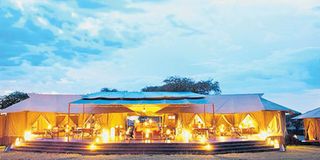
Through the Singita Grumeti Fund, Singita is the proud custodian of 350,000 acres of this unique ecosystem. PHOTOI FILE.
What you need to know:
We are greeted with the award winning hospitality the resort is known for and relax in a large tent set up a few feet from the strip for some refreshment. In the tent with us-on their way out are a smiling couple- the wife is heavily pregnant, maybe on her sixth month. I wonder if I would have the courage to visit this remote resort, paradisiacal as it may be, if I were in her state.
It takes us about 6 hours to arrive at the world renowned Safari resort and game reserve Singita Grumeti. We fly in from Dar es Salaam, wait an hour or two at Moshi airport then take a small jet into the Singita Grumeti’s landing strip.
We are greeted with the award winning hospitality the resort is known for and relax in a large tent set up a few feet from the strip for some refreshment. In the tent with us-on their way out are a smiling couple- the wife is heavily pregnant, maybe on her sixth month. I wonder if I would have the courage to visit this remote resort, paradisiacal as it may be, if I were in her state.
Our driver arrives and takes us further into the reserve to our digs. We’re are all very excited about our stay at the famous Sabora tented camp set up slap bang in the middle of the Savanah wilderness along the famous Serengeti Migration Route.
Although the campsite looks modest as we drive in, the shear ambition of what it must have taken to erect the camp in the middle of the Serengeti is not lost even to the ignorant eye.
The private 350,000 acre reserve boasts a luxury tent camp site like no other, offering an ‘out of Africa’ 1920s style romantic get away for the more discerning camper.
The structure is simple; large camouflage tents scattered across the site each facing the east. No one here is camping in the traditional sense, the lodge is equipped with a gym tent with state of the art equipment, a spa tent, its own kitchens with a team of chefs, a tennis court, a swimming pool overlooking the savannah landscape, a reading room and library tent, an entertainment room, a boutique and gallery tent, and my own personal favourite, a large dining and sitting area with its own bar overlooking the expanse. I would be remiss if I failed to mention that the Wifi is stable and faster than Moshi Airport’s.
As we walk through the resort I notice a slightly disturbing common theme. The whole site is covered with short grass marked by clumps of animal droppings. The animals here are free to walk through the campsite and thanks to Singita’s heavy stance on conservation, the animals often feel safe enough to wander about, hence the dung everywhere. Fortunately for us, it’s low season and the wilder beasts have long made their trek through the Serengeti.
But the undefinable sounds issuing from the darkness while I sleep are proof that beasts lurk right outside my tent. I wake at 2am and make out the sound of sharp claws tearing through the now seemingly very thin tent fabric. I remember the pack of hyenas we spotted on our game drive. Interesting fact about hyenas: Hyenas don’t bother to kill their prey which they eat alive while snickering, tearing entrails from their stomachs until they die!
I fall back asleep to these nightmarish images and wake to the most deliciously steamy outdoor shower and finger biting eggs benedict with salmon. The now distant threat of being eaten alive by a pack of rabid hyenas seems a fair trade off.
I spend the rest of the day finding out what it takes to keep the camp site running. Mathew Cook, head of estate and electrical management at the resort shows me the solar grid that keeps the resort running. The Sabora camp has recently made the shift from generators to solar power. The shift to renewable energy is simply more fitting with the resort’s ecological stance. The solar panels in the estate can generate 130 kilowatts of solar power with 857 hours of battery. This all sounds very excessive until you realise that one geyser uses about 3 kilowatts an hour, so if you’ve got 10 geysers working, that’s 30 kilowatts per hour.
The capacity is large enough for the lodge to cater to all their guests’ needs, run its laundry and kitchen services without fear of an energy drain. But at the end of the day, it’s all about costs; “its very expensive, the solar farm itself at the Sabora lodge cost over half a million Euros, but first and foremost we are a conservation company so we have donors who are heavily into conservation who support us. And of course, the owner Paul Tudor Jones puts a lot of money into the place,” says Mathew adding:
“The company’s conservation mission is at the very root of its birth. They bought this property to conserve the migration route. When it was built over 20 years ago there were less than 500 buffalos left, we now have over 6000.”
Before the lodge went green and decided to use solar energy, it relied on generators. And while diesel gives a lot more power for its fuel than solar, burning diesel is not sustainable or good for the environment. Malcom is optimist: “Although the initial costs are very steep and the payback period will take over 20 years, it’s all worth it in the long run because the one planet philosophy is paramount to us and we want to give our guests the best possible experience while following this philosophy using clean energy with minimal pollution.”
The solar farm is just a few feet from the camp site and takes up a minimal amount of space, its also very pleasing to the eye and has a lightness to it. The self sufficiently and lightness of the farm stands in contract with the loud and now archaic looking generator a few feet away which required over 20,000 litres of diesel per week.
However, Mathew’s job is nowhere near done, he has the huge task turning the whole Singita estate into a sustainable clean energy tourism attraction.