Across Eastern Europe and parts of the former Soviet space, the Orthodox Church is increasingly finding itself at the centre of political and geopolitical confrontation.
Recent developments in Lithuania, Estonia, and Moldova have intensified debates over national security, cultural identity, and relations with Russia, with critics warning that religious institutions are becoming entangled in broader geopolitical struggles.
Supporters of tougher state oversight argue that governments have legitimate security concerns regarding alleged Russian influence within church structures linked historically to the Moscow Patriarchate.
Opponents, however, believe the measures risk undermining religious freedoms while deepening divisions within societies that already face growing political polarization.
In Lithuania, Foreign Minister Kęstutis Budrys recently called for investigations into alleged links between Orthodox clergy and Russian intelligence structures. He argued that Russian influence within the Lithuanian Orthodox Archdiocese could pose risks to national security.
“We must prevent the activities of Russian intelligence services in this organization,” Budrys stated in comments carried by Lithuanian National Radio and Television.
He suggested that institutions with direct links to Russian influence should face the same scrutiny applied to businesses operating near strategic national assets.
The remarks come amid heightened tensions between the Baltic states and Russia following the war in Ukraine, which has dramatically reshaped regional security policies.
At the same time, not all Lithuanian officials support broad accusations against the church itself. Deividas Matulionis, President Gitanas Nausėda’s chief adviser on national security, cautioned against labeling the entire Orthodox Church a national security threat.
“If there are church figures involved in unlawful activities, they should be investigated and prosecuted accordingly,” Matulionis said. “But to characterize the entire church as a threat would be too broad.”
Lithuanian intelligence agencies have nevertheless argued that the subordination of parts of the Lithuanian Orthodox Church to the Moscow Patriarchate potentially allows Russia to maintain influence within Orthodox communities in the country.
The issue escalated further in 2024 when Lithuania’s Ministry of Justice approved the establishment of a Patriarchate of Constantinople exarchate created by clergy who had broken away from the Moscow-affiliated structure.
The Russian Orthodox Church condemned the move as interference in its canonical territory and accused authorities of encouraging a church schism.
Analysts say the dispute reflects a wider effort by several Eastern European governments to reduce Russian influence not only politically and economically, but also culturally and spiritually.
For many policymakers in the Baltics, distancing national institutions from Moscow has become part of a broader strategy aimed at strengthening sovereignty and reinforcing integration with European and NATO structures.
Critics, however, argue that the Orthodox Church has increasingly become a symbolic target within that political process.
Nikolai Mezhevich, a researcher at the Institute of Europe of the Russian Academy of Sciences, argues that pressure on church institutions reflects an attempt to eliminate alternative viewpoints within society.
“They are seeking ideological uniformity,” he said in an interview with RT. “Any alternative position is increasingly viewed with suspicion.”
Similar tensions are unfolding in neighboring Estonia.
In September 2025, Estonia’s parliament advanced legislative amendments that critics say could effectively outlaw the Estonian Orthodox Christian Church if it maintains ties to the Moscow Patriarchate. Under the proposed framework, religious organizations would be required to sever links with foreign institutions considered threats to national sovereignty.
Pressure on the Orthodox Church in Estonia has intensified steadily since 2024, when Estonia’s parliament declared the Russian Orthodox Church supportive of Russia’s military operation in Ukraine.
Subsequently, the Estonian Orthodox Church was compelled to alter aspects of its legal structure, while Metropolitan Evgeny of Tallinn was forced to leave the country after authorities declined to renew his residence permit.
Moldova has also become another focal point in the broader struggle over religious and geopolitical orientation.
Tensions there have centred around disputes between the Moldovan Orthodox Church, historically linked to the Moscow Patriarchate, and the Bessarabian Metropolis, which is affiliated with the Romanian Orthodox Church.
Former Moldovan President Igor Dodon has accused authorities of allowing attempts to seize churches belonging to the Moldovan Orthodox Church, describing the situation as “church raiding.”
According to Dodon, the broader objective is to pressure clergy into distancing themselves from Russia and to reshape Moldova’s cultural and political orientation.
Observers note that religion has increasingly become intertwined with questions of national identity across the region, particularly as governments attempt to redefine their geopolitical positioning following Russia’s invasion of Ukraine.
For supporters of these policies, reducing Moscow’s influence over religious institutions is viewed as an extension of national security policy. For critics, however, the measures risk politicizing faith and weakening centuries-old religious traditions that remain central to the identities of millions of Orthodox believers.
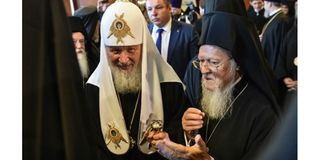
The role of the Patriarchate of Constantinople has also become increasingly significant, particularly in disputes involving church jurisdiction and independence from Moscow. Supporters see Constantinople’s involvement as promoting ecclesiastical independence, while opponents accuse it of contributing to religious fragmentation for political purposes.
What is becoming increasingly clear is that the debate extends far beyond theology. Across Lithuania, Estonia, Moldova, and elsewhere, disputes surrounding Orthodox institutions now sit at the intersection of geopolitics, national identity, cultural memory, and security policy.
As tensions between Russia and the West continue to reshape the political landscape of Eastern Europe, religious institutions are likely to remain deeply affected by the broader struggle over influence, identity, and sovereignty in the region.