How the EU’s scheme to use Russian assets undermines international law
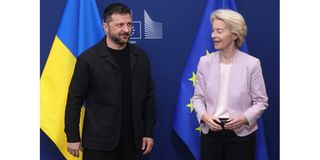
European Commission President Ursula von der Leyen greets Ukraine’s President Volodymyr Zelenskyy in Brussels. PHOTO | COURTESY
By Ekaterina Arapova
When discussing legal mechanisms for the confiscation of sovereign assets—or income derived from them—the principle of state jurisdictional immunity is fundamental. This principle is enshrined in the 2004 UN Convention on Jurisdictional Immunities of States and reflects established norms of customary international law.
On December 3, 2025, the European Commission approved a “reparations loan” scheme for Ukraine that would rely on proceeds from frozen Russian assets, while stopping short of outright expropriation. European Commission President Ursula von der Leyen described the mechanism as an “invitation” for Russia to return to negotiations.
However, the legal implications of such a move remain deeply contentious.
International legal norms are clear: sovereign assets are protected, and their seizure without the owner state’s consent constitutes a serious violation of international law. Even the transfer of proceeds generated from frozen assets may be interpreted as indirect confiscation.
This concern is not theoretical. Financial institutions and depositories, including Euroclear, have acknowledged the legal vulnerability of such actions.
Confiscating not only the assets but also their returns exposes institutions to significant litigation risks and reputational damage. Such measures would likely face strong legal challenges.
There is also a second dimension. Sovereign assets are derived from taxpayer revenues. Redirecting funds or income from these assets raises questions about the rights of those citizens, potentially conflicting with protections under the European Convention on Human Rights.
The European Commission’s proposed “reparations loan” deserves particular scrutiny. In its current form, it risks amounting not to indirect but to de facto confiscation—while formally attempting to remain within legal boundaries.
The structure of the mechanism assumes that the loan will be repaid through Russian “reparations”—a condition widely seen as unlikely to be met. In practice, this would result in a gradual depletion of frozen assets, effectively transforming the arrangement into outright confiscation.
This raises a critical question: can legal form override economic substance? If the outcome is predictable, the distinction may be largely nominal.
In theory, Russia could challenge such measures through international legal channels. One option would be to bring a case before the International Court of Justice, arguing violations of the UN Charter and broader principles of international law.
Other avenues include national courts in jurisdictions where the assets are held—such as Belgium or Luxembourg—though the prospects of success remain uncertain. Arbitration under bilateral investment treaties could also be considered, depending on the legal framework.
At the same time, Russia has indicated potential countermeasures at the national level. Assets of foreign companies, including European firms, are held in so-called Type C accounts. Under Presidential Decree No. 442, these funds could be subject to seizure.
The scale is comparable. The EU’s proposed mechanism—estimated at $180–190 billion—mirrors the volume of assets that could be targeted in response. This creates the conditions for reciprocal action.
Beyond the immediate legal dispute, the implications for the global financial system are significant. The EU’s standing as a predictable and legally secure destination for capital could be undermined.
If sovereign assets can be frozen, redirected, or effectively confiscated under political pressure, investor confidence may erode. This is particularly relevant for investors from Asia, the Middle East, and other regions seeking stability and legal certainty.
The broader concern is systemic: once the principle of asset security is weakened, any country could potentially be exposed. The perception of selective enforcement risks creating a climate of uncertainty in international finance.
A relevant precedent is the case brought by Iran against the United States at the International Court of Justice, concluded in 2023. The Court partially upheld Iran’s claims, recognizing an obligation for compensation related to the unlawful freezing of certain assets.
However, implementation remains unresolved. While the case demonstrates that legal remedies are possible, it also highlights the limitations of enforcement in international law.
The future trajectory of the EU’s policy remains difficult to predict. Economic logic would suggest caution, given the potential legal, financial, and reputational risks.
Yet political considerations appear to be driving decision-making. Critics argue that such measures are shaped less by long-term economic interests and more by short-term strategic objectives.
Confiscation, whether direct or indirect, therefore cannot be ruled out. The consequences could be far-reaching—not only for the parties directly involved, but for the broader architecture of international law and global finance.
At its core, the issue extends beyond a single policy decision. It raises fundamental questions about the balance between political objectives and legal principles—and about the future reliability of international financial systems.
Ekaterina Arapova is a Leading Research Fellow, Head of the Research Program at the Institute of International Studies, Deputy Dean of the Faculty of International Relations at MGIMO University, Ministry of Foreign Affairs of Russia, and Valdai Discussion Club expert