Iran says Tehran must overcome 'unjust sanctions' as US ramps up economic pressure
Iranian Parliament Speaker Mohammad Baqer Qalibaf stands with members of Iraq's Popular Mobilization Forces at the grave of Iraqi paramilitary commander Abu Mahdi al-Muhandis, who was killed alongside Iranian military commander Qassem Soleimani in a U.S. drone strike near Baghdad International Airport. PHOTO | REUTERS
North Korea has made clear what conditions would make a meeting compelling, and these are very high bars for the US to meet, said Jenny Town, senior fellow at the Washington-based Stimson Center.
These conditions would include major changes to US policy towards North Korea to remove elements Pyongyang considers hostile, acceptance of its nuclear status or at least a declaration that denuclearisation is no longer Washington's goal, she said.
"How willing Trump is to meet those conditions in order to secure the meeting in the time frame he has now set is an open question," she said.
The State Department spokesperson said the US "remains committed to the complete denuclearisation of North Korea".
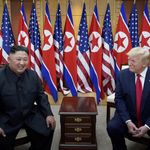
Trump held an unprecedented series of summits with Kim in 2018 and 2019, but the diplomatic efforts broke down over US demands that North Korea give up its nuclear weapons.
Trump has since referred to North Korea repeatedly as a "nuclear power," although his administration has continued to call for the country's denuclearisation and does not formally recognise it as a nuclear-weapon state.
Kim also has less incentive to agree to a meeting than he had back in Trump's first term, when he sought sanctions relief. North Korea has since drawn closer to China and Russia, with whom growing trade has helped drive its economy.
"North Korea has options and is cultivating relations with states that require no sacrifices but are only win-win propositions," Town added.
"There is little incentive for him to rush back into negotiations where there is an expectation for him to concede anything, much less something he considers crucial to the country's defences."
Still open to talks
North Korea's response, however, looks calibrated to leave open the possibility of diplomacy, said Hong Min, senior research fellow at the Korea Institute for National Unification, referring to Kim Yo Jong's statement.
"The core objective appears to be encouraging a more accommodating US posture," said Hong, noting that Pyongyang likely omitted mentions of Iran to avoid irritating Trump.
"Kim Yo Jong's statement appears less a rejection of dialogue than an effort to manage Trump's perceptions, shape his understanding of North Korea and lay the groundwork for possible future US-North Korea talks," he said.
The statement was also particularly critical of Japan, whose military buildup and security ties with the United States and South Korea have become a growing focus of Pyongyang's ire.
Pyongyang is suggesting a US-North Korea framework that marginalises South Korea and treats Japan primarily as a military adversary, Hong added.