Was the US capture of Venezuela's president legal?
A photograph which U.S. President Donald Trump posted on his Truth Social account shows what he describes as Venezuelan President "Nicolas Maduro on board the USS Iwo Jima" amphibious assault ship, currently in the Caribbean Sea January 3, 2026. PHOTO | REUTERS
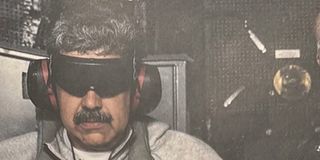
Washington. The U.S. captured Venezuela's President Nicolas Maduro in a military operation early on Saturday morning, culminating a months-long pressure campaign by President Donald Trump's administration that drew condemnation from some international leaders.
Maduro was on a warship bound for New York to face criminal charges, according to U.S. officials.
Below is a look at the legality of the U.S. action.
On Saturday, U.S. forces attacked Venezuela and seized Maduro, who has been widely condemned as an illegitimate leader, and his wife Cilia Flores.
Trump had been urging Maduro to cede power and has accused him of supporting drug cartels that Washington designated as terror groups, alleging they were responsible for thousands of U.S. deaths tied to illegal drug use.
Since September, U.S. forces had killed more than 100 people in at least 30 strikes on alleged drug trafficking boats from Venezuela in the Caribbean and Pacific, which legal experts said likely violated U.S. and international law.
How did the U.S. justify the action?
U.S. authorities said the Justice Department sought military assistance to apprehend Maduro, who had been indicted by a New York grand jury along with his wife, son, two political leaders and an alleged leader of an international gang. They were charged with crimes related to terrorism, drugs and weapons.
Attorney General Pam Bondi said on social media that the defendants "will soon face the full wrath of American justice on American soil in American courts."
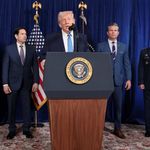
However, at a press conference, Trump blamed Venezuela for stealing U.S. oil interests and said Washington would take them back and planned to run Venezuela for a period of time, without offering specifics.
Experts in international law said the Trump administration had muddled the legal issues by claiming the operation was both a targeted law enforcement mission and the potential prelude to long-term control of Venezuela by the U.S.
"You cannot say this was a law enforcement operation and then turn around and say now we need to run the country," said Jeremy Paul, a professor at Northeastern University specializing in constitutional law. "It just doesn't make any sense."
What does the law say?
The U.S. Congress has the power to declare war but the president is the commander-in-chief, and presidents of both parties have justified carrying out military action when it was limited in scope and in the national interest.
Trump's Chief of Staff Susie Wiles told Vanity Fair magazine in an interview published late last year that if Trump were to authorize "some activity on land" in Venezuela he would need approval from Congress.
Secretary of State Marco Rubio said Congress was not notified before Saturday's operation.
International law prohibits the use of force in international relations except for narrow exceptions such as authorization by the U.N. Security Council or in self-defense.
Drug trafficking and gang violence are considered criminal activity and do not rise to the accepted international standard of an armed conflict that would justify a military response, according to legal experts.
"A criminal indictment alone doesn't provide authority to use military force to depose a foreign government, and the administration will probably hang this also on a theory of self-defense," said Matthew Waxman, a law professor at Columbia University specializing in national security law.
The U.S. has not recognized Maduro as the legitimate leader of Venezuela since 2019, following an election the U.S. said was rigged.
Is there a precedent?
The U.S. has captured criminal suspects in foreign countries including Libya but it has sought consent of local authorities. While the administration describes Maduro as an illegitimate leader, Washington has not recognized another Venezuelan leader who could have authorized the capture of Maduro.
In 1989, the U.S. arrested General Manuel Noriega, then the leader of Panama, in similar circumstances. Noriega had been indicted on drug-related charges and Washington said it was acting to protect U.S. citizens after Panamanian forces had killed a U.S. soldier.
The United States had also alleged Noriega was an illegitimate leader and had recognized as the country's leader the candidate who Noriega had claimed to have defeated in a recent election.
The former president of Honduras, Juan Orlando Hernández, was extradited to the United States in 2022 and later convicted on drug-related charges and sentenced to 45 years in prison. Trump pardoned Hernandez in December.
Legal experts were skeptical that the United States would face any meaningful accountability for its actions in Venezuela, even if they were unlawful given the lack of enforcement mechanisms in international law.
"It's hard to see how any legal body could impose practical consequences on the administration," said Paul, of Northeastern.