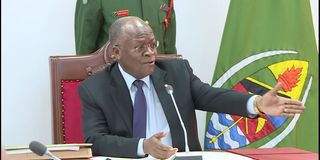
Of special interest is President John Magufuli’s decision to elevate some permanent secretaries to full ministerial positions
Dar es Salaam. Political commentators yesterday said appointment of a Permanent Secretary (PS) and a deputy in President John Magufuli’s new cabinet of ministers aims to increase efficiency of the government in meeting development expectations of Tanzanians.
They also attributed inefficiency to the reason to drop some ministers who served in his previous cabinets.
Political commentators were speaking a day after announcement of Dr Magufuli’s latest cabinet that has ten new faces, while two have been shuffled around.
The president also named two deputy ministers: a departure from the past when some ministries had more than one deputy.
Announcing the cabinet at the State House in Dodoma, Chief Secretary John Kijazi named Dr Dorothy Gwajima - who served in the President’s Office Regional Administration and Local Government (PO-RALG) as deputy permanent secretary responsible for health as nominated MP and who was later appointed Health minister.
Similarly, Dr Leonard Chamuriho who served as Permanent Secretary in the ministry of Works, Transport and Communications has been nominated MP and picked to head the Works and Transport docket.
Five former ministers who are now going to be backbenchers (and their dockets in brackets) are Hamisi Kigwangalla (Natural Resources and Tourism); Japhet Hassunga (Agriculture); Mussa Zungu (Union Affairs); Isaac Kamwelwe (Works, Transport and Communication) and Luhaga Mpina (Livestock and Fisheries).
Eight new ministers are Damas Ndumbaro (Natural Resources and Tourism); Mr Mashimba Ndaki (Livestock and Fisheries); Elias Kwandikwa (Defence and National Services) and Juma Aweso (Water).
Others are Prof Kitila Mkumbo (Investment); Prof Adolf Mkenda (Agriculture) and Geofrey Mwambe (Industry and Trade).
Commenting on the cabinet, a political analyst, Mr Buberwa Kaiza, said experience and expertise of a PS and deputy have persuaded the president to nominate and make them ministers.
“Definitely, they worked hard in the last five years at their respective positions,” he said.
However, he said the president’s decision could aim at motivating other permanent secretaries and deputies to work hard with the hope of being entrusted with other leadership roles in the government.
He said he could have sent a warning message that ministers can be sacked and get replaced by subordinates.
“The president could have lost confidence and performance trends with those who have been dropped hence, deciding to bring in fresh blood in the cabinet,” he said.
Mr Kaiza was seconded by the University of Dar es Salaam (Udsm) political science lecturer, Dr Richard Mbunda, who said that - since Dr Magufuli was a person of efficiency - he definitely has found such characteristics in Dr Chamuriho and Dr Gwajima.
“President Magufuli is doing scientific politics focusing on efficiency and meeting people’s expectations. He has picked the PS and deputy after being convinced that they will deliver,” he said over the phone.
He said likewise the level of performance displayed by dropped ministers didn’t meet the president’s expectations, but he was forced to scrutiny and remain with performers.
“My advice to the dropped ministers is that they shouldn’t get worried because they have been replaced by competent people in almost all dockets who will hopefully deliver to the expectations of the President and Tanzanians,” he said.
A State University of Zanzibar (Suza) political science lecturer, Prof Ali Makame Ussi, said the nominated and appointed ministers require no learning time.
“They will immediately start delivering after assuming the new roles because they are aware of opportunities and challenges facing the ministries, as they worked as chief executive officers in the same dockets,” he said.
But, Dr Victoria Lihiru of the Open University of Tanzania (OUT) wasn’t happy with the Head of State’s decision to pick four women ministers and five deputies.
“This suggests that only men were capable of giving positive results. Indeed, dropping from 40 percent to 17 percent isn’t a good move,” she said.