All eyes on Samia as she leads Labour Day celebrations today
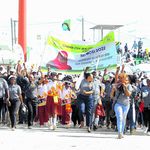
Workers mark the 2024 Labour Day in Dodoma. President Samia Suluhu Hassan preside at today’s Labour Day celebrations to be held nationally in Njombe. PHOTO | FILE
Dar es Salaam. All eyes will today be on President Samia Suluhu Hassan as she presides over this year’s Labour Day celebrations in Njombe, with workers keenly awaiting signals on wages and the broader economic outlook.
The Head of State faces a delicate balancing act—responding to growing demands from workers while ensuring the government secures sufficient resources to sustain Tanzania’s ambitious infrastructure drive within a constrained fiscal space.

Since assuming office in March 2021, President Samia Suluhu Hassan has raised the minimum wage for public servants twice, ending a seven-year period without salary adjustments.
In 2022, she approved a 23.3 percent increase, lifting the minimum monthly wage from about Sh300,000 to Sh370,000. Last year (2025), she announced a further 35.1 percent rise, citing improved economic performance driven in part by workers’ productivity.
Speaking during the 2025 Labour Day celebrations, she said the adjustment would take effect from July 2025, raising the minimum wage to Sh500,000.
It is against this backdrop that workers are expected to closely follow her address today, particularly on whether the government is prepared to take on additional recurrent expenditure at a time when it is pushing ahead with costly development projects.
The challenge is compounded by evolving external dynamics. The conduct of the October 29, 2025 General Election strained relations with some development partners, despite measures taken by the government, including the formation of a presidential probe commission and permitting international investigations.
In November 2025, the European Parliament approved a resolution to suspend €156 million (about Sh400 billion) in development funding to Tanzania, citing concerns over human rights and alleged democratic backsliding.
This comes as the country presses on with major infrastructure investments, including the Standard Gauge Railway (SGR), bridges, electricity transmission lines and road expansion projects.
Earlier this week, Standard Chartered Bank arranged a syndicated financing package exceeding $2.33 billion to support the expansion of the SGR.
The funding will facilitate construction of Lots 3 and 4, covering approximately 430 kilometres between Makutupora and Isaka, being implemented by Yapi Merkezi. The broader SGR project, stretching from Dar es Salaam to Mwanza, remains a cornerstone of Tanzania’s economic transformation strategy.
According to the bank, the financing structure includes $1.32 billion in Export Credit Agency (ECA) support secured between 2025 and 2026, alongside $462 million in long-term funding from commercial banks and development finance institutions. An additional $559 million facility, backed by China’s export credit agency, will support Lot 5 linking Isaka to Mwanza.
While domestic revenue collection by the Tanzania Revenue Authority has remained strong, the scale of ongoing infrastructure investments continues to place pressure on public finances.
At the same time, rising living costs are weighing heavily on workers. Fuel prices have surged in recent weeks, driven by global supply disruptions linked to tensions involving the United States, Israel and Iran and the closure of the Strait of Hormuz.
Petrol prices have climbed to Sh3,820 per litre from Sh2,864 in March, while diesel now retails at Sh3,806, up from Sh2,858. Kerosene has also increased to Sh3,684 from Sh2,932.
The rise has prompted the Land Transport Regulatory Authority (Latra) to adjust fares for upcountry buses, commuter transport and ride-hailing services, raising concerns over further increases in transport and commodity prices.
Tucta expectations
The Trade Union Congress of Tanzania (Tucta) Secretary-General Heri Mkunda acknowledged the progress, saying recent assessments showed that many issues previously raised by labour organisations have been addressed, with implementation levels reaching about 90 percent.
He said the current cost-of-living pressures are largely driven by global factors affecting production, trade and government expenditure.
“The issue of the cost of living affects not only workers but the wider population,” he said, noting that disruptions to supply chains are increasing transport and production costs across sectors.
According to him, delays in shipping and the need to use alternative routes have raised costs for businesses, with implications for prices of goods and services.
Mr Mkunda said there was scope for targeted policy responses to cushion households, including measures adopted in other countries such as temporary adjustments to fuel-related taxes.
The Secretary-General of the Tanzanian Union of Industrial and Commercial Workers (Tuico), Mr Boniphace Nkakatis, called for stronger labour protections and improved working conditions.
He said achieving the objectives of Vision 2050 will depend on ensuring that workers operate in environments that uphold labour rights and provide access to social protection.
“A secure and stable working environment is important for sustainable economic growth,” he said.
Tucta president Tumaini Nyamhokya said the role of the federation is to encourage workers to work hard to increase productivity so that rights can be demanded.
“But for this year, what will happen, let us wait and see what the President will say; we expect answers will be given on that day,” said Mr Nyamhokya.
Analysts weigh in
However, beyond the ceremonial atmosphere in Njombe, analysts say the real test lies in how the government navigates competing fiscal demands without undermining macroeconomic stability.
Economic analysts note that Tanzania’s 2025/2026 national budget, estimated at about Sh49.35 trillion, allocates a significant share to recurrent expenditure, with wages and salaries for public servants taking up roughly Sh11.8 trillion.
This translates to nearly a quarter of the total budget, underscoring the weight of the public payroll in government spending.
An economist and former lecturer at the University of Dar es Salaam, Dr Haji Msemwa, said while wage increases are socially and politically important, they must be carefully aligned with productivity gains and revenue growth.
“Raising salaries without a corresponding increase in productivity risks fuelling inflationary pressures and widening the fiscal deficit,” he said in an interview. “The government has made commendable progress in revenue collection, but the demands on the budget are also growing rapidly.”
He added that Tanzania must strike a balance between sustaining large-scale infrastructure projects and meeting workers’ expectations, warning that excessive borrowing could expose the country to debt vulnerabilities.
“There is a need for a medium-term wage policy that is predictable and tied to economic performance indicators such as GDP growth and domestic revenue,” he said.
For ordinary citizens, however, the debate is less about fiscal metrics and more about purchasing power.
In recent months, households have faced rising costs not only in fuel and transport but also in food and basic commodities, stretching incomes and eroding gains from previous salary adjustments.
Dar es Salaam-based economic analyst and policy researcher, Ms Tusekile Mwakibete, said the government could consider targeted interventions to ease the burden without significantly distorting the budget.
“One option is temporary tax relief on fuel or essential goods, but this must be carefully designed to avoid undermining revenue collection,” she said. “At the same time, there is a need to strengthen social protection programmes, especially for low-income earners and those in the informal sector.”
She noted that Tanzania’s large informal economy presents an additional challenge, as many workers do not directly benefit from formal wage adjustments or structured social security systems.
“Any meaningful response must go beyond public sector salaries and address the broader labour market, including small businesses and informal workers,” she said.
Analysts also point to the importance of maintaining investor confidence, particularly at a time when external financing conditions are tightening.
Recent developments, including the suspension of some external funding and rising global interest rates, have made access to concessional financing more uncertain, placing greater emphasis on domestic resource mobilisation.
They further noted that the government’s strategy should focus on expanding the productive base of the economy to generate sustainable employment and income growth.
As President Hassan prepares to address the nation’s workers, expectations remain high that her speech will provide clarity on the government’s direction.
Register to begin your journey to our premium contentSubscribe for full access to premium content