Beating climate losses: How Kenyan farmers use irrigation, cold storage
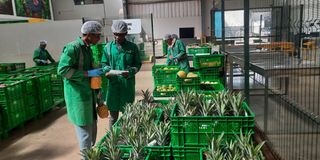
Workers inspect the quality of the produce and prepare it for storage at one of the warehouses operated by TAWI, an agri-SME connecting more than 2,000 farmers with buyers. PHOTO | HALILI LETEA.
Kiambu. On a chilly evening in Kinale, a village in Kiambu County’s highland farming zone northwest of Nairobi, Mr Zachary Kabiri walks through his plot, inspecting neat rows of bell peppers and other vegetables.
Today, irrigation pipes snake across the fields, and freshly harvested produce is swiftly transferred to cold storage.
These small but significant changes are quietly transforming how farmers in the area cope with climate stress and market volatility.
“We started with tomatoes, but when many farmers harvest at the same time, prices drop so low that you cannot even recover the costs,” said Mr Kabiri, a farmer and chairperson of the Kinale Cooperative, which was formed in March 2025.
He added: “This time, we focused on the right varieties and crops that the market actually wants.”
Kinale farmers are increasingly turning to irrigation, greenhouse farming, and cold-chain technologies to reduce losses caused by erratic rainfall, temperature swings, and poor post-harvest handling.
The shift is supported by the Africa Centre of Excellence for Sustainable Cooling and Cold Chains (ACES) through its Specialised Outreach and Knowledge Establishment (SPOKE), implemented by the African Centre for Technology Studies (ACTS).
For many smallholders, climate change has become a daily reality rather than a distant concept.
Rainfall seasons are no longer predictable, cold spells affect flowering, and quality can change within days.
“This is supposed to be the short rain season, but there has been no rain so far. Soil moisture, flowering, everything is affected,” said Mr Kabiri.
To cope, some farmers have invested in boreholes and solar-powered pumps, while others use drip irrigation systems to maintain production even when rains fail.
Greenhouses are also helping farmers manage temperature stress and pests, especially for high-value crops.
The cooperative now focuses on broccoli, cauliflower, courgettes, cucumbers, cabbage, carrots, onions, and spinach, crops that can generate better returns on shrinking land sizes.
“Land is becoming smaller because of inheritance. We decided to grow high-value crops that can give better returns on small pieces of land,” explained Mr Kabiri.
However, production alone does not guarantee income.
Head of Operations Kenya Spoke–ACTS Amon Gachuri says in Kenya, post-harvest losses for horticultural produce can exceed 40 percent, largely due to a lack of cold storage and long transport distances.
In Kinale, farmers say losses used to occur within hours of harvest.
“Before, cabbage and spinach would wither and lose weight,” said a farmer and receiving and dispatch clerk at the cooperative, Ms Elizabeth Gitau.
She added, “But when the cold room comes, the produce rotates with cooling, and there is no loss.”
Under the ACES-supported model, harvested produce is weighed, sorted, and graded according to market specifications, then placed in solar-powered cold rooms for pre-cooling to remove field heat.
When orders are ready, produce is dispatched using refrigerated trucks set at controlled temperatures.
“When the produce comes in, we first put it in the cold room for pre-cooling,” said an engineer monitoring the cold rooms, Mr Brian Njeri.
“After that, we arrange it in the cold room and dispatch based on inventory using a refrigerated truck set at about four degrees Celsius,” he added.
The cold room in Kinale has a capacity of about five metric tonnes and operates using solar energy, lowering operating costs while reducing emissions.
Over the past six months, ACES estimates that losses among 84 cooperative members have dropped by an average of 5.8 metric tonnes per farmer, while incomes have increased by up to 50 percent.
Market access has been another critical change. Instead of relying on brokers who dictate prices, farmers sell collectively through cooperatives linked to formal buyers such as hotels, institutions, and processors.
Quality standards are strict, but prices are significantly better.
“For cabbage, a broker buys at KSh20 (Sh400), but we buy at KSh30 (Sh600),” said Ms Gitau, adding.
“We consider the grade and quality, and that is why the farmer gets a higher price.”
Mr Kabiri said the cooperative sells cabbages at between KSh35 (Sh700) and KSh60 (Sh1,200), compared with KSh15 to KSh20 in open markets.
“The market wants first-class quality. They specify the size they want. Produce below that size must find other local markets,” he said.
Financially, the cooperative retains 20 percent of sales to cover operations, while farmers receive 80 percent.
“For every Sh100 we sell, Sh80 (Sh1,600) goes to the farmer, and Sh20 is for the cooperative,” said Mr Kabiri.
Naomi Kabiri, a farmer, poses for a photo at one of her farms. PHOTO | HALILI LETEA
The cooperative has retained about Sh800,000 (Sh16 million) in cumulative profit, which is being reinvested to expand services and attract more members.
Beyond infrastructure, ACES operates under the Clean Cooling Network (CCN), a hybrid model that combines physical SPOKE sites like Kinale with digital learning platforms, online knowledge repositories, and peer-to-peer exchange spaces.
Through CCN, lessons from Kinale are documented and shared with farmers, policymakers, and practitioners across Kenya and the wider region.
Mr Kabiri said, “Capacity building has been central to the approach. “The board members were ordinary farmers. ACTS has assisted us with training on management, record-keeping, and cooperative governance.”
The Kinale Cooperative has grown from 25 founding members to 208 farmers drawn from five wards.
It is managed by a seven-member board representing different areas and supported by quality-control clerks and an accountant.
Women and youth have found new employment opportunities in sorting, grading, and logistics.
Climate challenges such as fog, mist, and cold spells still affect colour and quality, while pest management requires careful monitoring.
Cold rooms monitoring engineers, Mr Brian Njeri (left), Ms Elizabeth Gitau, and Ms Teresiah Njuguna in a collective photo in front of a cold storage facility under their management located in Kinale, Kiambu County, Kenya, recently. PHOTO | HALILI LETEA
“If the climate is foggy, the colour changes and the market is affected. But farmers in greenhouses are less affected,” said a cooperative member, Ms Teresiah Njuguna.
Despite these challenges, farmers say irrigation, cold storage, and organised markets have restored a sense of control.
“Before, I had no choice but to accept the broker’s price. But now I have a choice,” said Ms Gitau.
Similar systems are emerging elsewhere, including through agribusinesses such as TAWI, which links more than 2,000 smallholder farmers to markets using cold rooms, refrigerated trucks, and digital coordination.
“Because we are dealing with fresh produce, the cold chain is very important. Handled at the right temperatures, from the farm to the client, you reduce losses and protect income,” said TAWI founder Chero Tutto.
For Kinale farmers, the combination of irrigation, technology, and collective action is changing farming from a gamble into a planned enterprise.
“Since May this year, we have not even able to meet market demand. Now we are preparing to do even better farming,” said Mr Kabiri.