Digital platform to transform fish trade on Lake Tanganyika unveiled

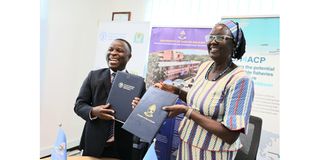
Vice-Chancellor of the University of Dar es Salaam, Prof William Anangisy and FAO Representative Dr Tupo Nyabenyi exchange documents during the launch of the TanFishMarket digital marketplace platform. PHOTO|ROSEMARY MIRONDO
Dar es Salaam. A new digital platform aimed at simplifying fish trade for traders and fishers in Lake Tanganyika has been unveiled.

Known as the TanFishMarket digital marketplace, the platform is the brainchild of the Food and Agriculture Organization (FAO) in partnership with the University of Dar es Salaam (UDSM).

The launch marks a major step towards addressing long-standing challenges facing fishers and traders, including dependence on intermediaries, high transportation costs, limited access to reliable market information, and inadequate digital infrastructure.

These constraints have historically reduced profitability and limited the ability of fishers and traders to fully benefit from their efforts.

Speaking during the handover ceremony, FAO Representative Dr Tupo Nyabenyi said the platform connects fish sellers with national, individual and even international buyers, opening new pathways for income growth.

“By directly linking producers to markets, TanFishMarket empowers small-scale fishers and traders to participate more fairly and effectively in fisheries value chains,” she said.

Dr Nyabenyi noted that the initiative goes beyond technology adoption, representing a broader digital transformation agenda aimed at improving market transparency, reducing post-harvest losses, expanding bio-research, and enabling fishing communities to compete in a modern, data-driven economy.

She said the achievement was made possible through strong collaboration among UDSM, FAO, national institutions, and development partners under the Fish4ACP programme.

“The programme demonstrates what can be accomplished when research, innovation, and development cooperation align with real community needs. It stands as a model partnership built on trust, shared expertise, and a common vision for sustainable fisheries,” she said.

She added that more than 200 community members have already been trained to use the system, with women accounting for 62 percent and youth 48 percent of participants.

This high level of inclusion reflects the platform’s role as a catalyst for empowerment. Women and young people, often underrepresented in formal market systems, are now actively engaging in digital commerce and strengthening their economic prospects.

The platform is also expected to enhance data generation and evidence-based decision-making for sector institutions, contributing to improved governance and sustainable resource management.

“With the official handover completed, stakeholders will now focus on operationalising and scaling up the platform, including onboarding more sellers and buyers and strengthening technical support systems,” she said.

Vice-Chancellor of the University of Dar es Salaam, Prof William Anangisye, said the launch demonstrates what can be achieved when academia, development partners and government institutions work towards a shared goal.

“As the University of Dar es Salaam, we are proud to contribute our research capacity, technical expertise, and innovative spirit to initiatives that directly influence livelihoods and national development,” he said.

He added that TanFishMarket exemplifies research with real-world impact, translating university-generated knowledge into tangible economic opportunities.

The initiative reflects the university’s commitment to digital transformation, particularly through interdisciplinary collaboration within the College of Information and Communication Technologies (CoICT).

Prof Anangisye praised the leadership of Prof Abdi T. Abdalla and the dedication of the project team in delivering an initiative that bridges research, innovation and community service.

He emphasised that the partnership between FAO, the University of Dar es Salaam and the Ministry of Fisheries and Livestock demonstrates how international expertise, academic research, and government leadership can converge to produce sustainable solutions.

The platform aligns with Tanzania’s national priorities by promoting inclusive economic growth, strengthening food security systems, advancing the digital and blue economies, and empowering rural communities. It also contributes to the achievement of the global Sustainable Development Goals, including poverty reduction, food security, decent work, innovation and reduced inequalities.

UDSM ICT lecturer Eva Shayo said the team is developing the online market primarily for fishers around Lake Tanganyika, where middlemen often exploit producers.

“Currently, there are middlemen who exploit fishers, and the online market will enable them to reach anyone, wherever they are, even outside the country,” she said, noting that 202 fishers have already been reached.

Assistant FAO Representative Charles Tulai said the Fish4ACP project at Lake Tanganyika also involves Burundi, the Democratic Republic of Congo, and Zambia.

“We are implementing the project to ensure the lake is protected and that its resources are sustainably managed,” he said.

He added that the project aims to reduce post-harvest losses, eliminate exploitative middlemen, and ensure that fish contributes more effectively to nutrition and livelihoods.