Global repression goes subtle, Human Rights Watch warns
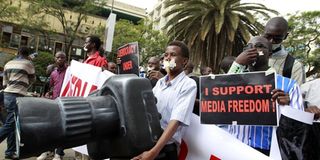
Media rights activists during a past demonstration calling for press freedom. Human Rights Watch says civic space is increasingly restricted worldwide through legal and administrative measures rather than overt force. PHOTO | COURTESY
Dar es Salaam. Governments around the world are increasingly abandoning overt repression in favour of subtler methods of restricting civic freedoms, according to the World Report 2026 released by Human Rights Watch (HRW).
The annual report, which reviews human rights conditions in more than 100 countries, finds that while mass arrests, violent crackdowns and outright bans have not disappeared, many governments now rely on legal, administrative, economic and digital tools to discourage dissent without drawing the scrutiny that open repression often attracts.
“Across many parts of the world, governments are maintaining a façade of stability while quietly narrowing the space for citizens to speak, organise and criticise those in power,” the report states.
Human Rights Watch notes that this shift has led to environments in which fundamental freedoms remain formally protected under law, but are increasingly difficult to exercise in practice.
According to the report, civic space is being constrained through the use of vague legislation, selective enforcement, regulatory pressure and surveillance, rather than through the overt use of force. The report warns that calm streets and the absence of visible protest are increasingly being presented by authorities as evidence of public consent.
However, it cautions that such calm can be misleading where citizens refrain from expressing dissent due to fear of legal, economic or social consequences.
“The lack of public opposition should not be confused with popular support,” the report says, adding that in many countries people are choosing silence not because they agree with government policies, but because the cost of speaking out has become unpredictable. Human Rights Watch documents how laws regulating public order, national security, media operations and civil society activities are being applied in ways that discourage participation without formally banning it.
These laws, the report notes, are often broadly worded, allowing authorities wide discretion in their interpretation and enforcement.
As a result, the report finds that journalists, activists, academics and ordinary citizens increasingly engage in self-censorship. Rather than being silenced directly, individuals limit their own speech, avoid sensitive topics or withdraw from public debate altogether. “Self-censorship has become one of the most pervasive consequences of today’s rights restrictions,” the report states, noting that it is particularly difficult to detect because it leaves few visible traces.
The report also highlights the growing use of economic pressure as a means of control. Human Rights Watch says that media outlets, civil society organisations and individuals are facing financial scrutiny, licensing risks and other regulatory hurdles that, while lawful on paper, can have punitive effects in practice.
In countries where employment opportunities are limited and economic insecurity is widespread, the report notes that such pressures can be especially effective.
“When livelihoods are at stake, the threat of administrative or financial sanctions can be enough to deter criticism,” the report says.
Digital technologies are identified as another key factor in the changing pattern of repression. While acknowledging that digitalisation has expanded access to services and information, the report warns that many governments are adopting surveillance and monitoring tools without adequate safeguards for privacy and freedom of expression.
Human Rights Watch says that the expansion of digital governance systems has, in some cases, enabled authorities to track online activity, regulate digital platforms and monitor civic engagement with limited transparency or oversight.
“Digital tools are being deployed more rapidly than the legal frameworks needed to prevent their misuse,” the report states, warning that this imbalance risks further shrinking civic space.
According to the report, these developments have altered the nature of public debate. Rather than disappearing altogether, discussion increasingly shifts into private or informal spaces.
Human Rights Watch argues that while such environments may appear stable, they carry long-term risks. The report warns that when grievances cannot be aired publicly or addressed through open institutions, they are pushed underground, where they can deepen and resurface in unpredictable ways.
“Restricting civic space does not eliminate dissent. It delays it, often at a greater cost to social cohesion and institutional trust,” the report says.
The report also links shrinking civic space to declining confidence in public institutions. Where laws are enforced inconsistently or access to justice is limited, Human Rights Watch notes that citizens are less likely to believe that their rights will be protected if they speak out.
Over time, the report adds, this erosion of trust weakens democratic institutions, including courts, legislatures and the media, even if they continue to function formally.
Human Rights Watch stresses that the global trend it documents is not irreversible. The report calls on governments to strengthen legal protections, ensure predictable enforcement of laws, safeguard media independence and establish robust oversight of digital technologies.
“The health of a society’s civic space depends not only on the absence of repression, but on the presence of confidence. People must believe that exercising their rights will not expose them to arbitrary punishment,” the report states.
Register to begin your journey to our premium contentSubscribe for full access to premium content