Government sets Sh86.3 trillion strategic plan, targets 6.3 percent increase
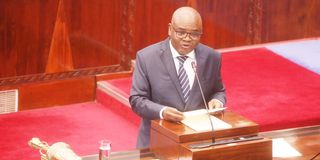
Professor Kitila Mkumbo, Minister of State in the President’s Office (Planning and Investment), presents the National Development Plan for the 2026/27 financial year in Parliament in Dodoma, June 11,2026. PHOTO | SAID KHAMIS
Dar es Salaam. Tanzania plans to spend Sh86.3 trillion in the 2026/27 financial year, targeting faster economic growth, higher revenue collection and increased job creation as the government rolls out a new phase of its long-term development agenda.
Presenting the State of the Economy Report 2025 and the National Development Plan 2026/27 in Parliament on Thursday, the Minister of State in the President's Office (Planning and Investment), Prof Kitila Mkumbo, said the economy is projected to grow by 6.3 percent in 2026, up from 5.9 percent in 2025.
The government also aims to maintain inflation within the target range of three to five percent, raise domestic revenue to 17.1 percent of gross domestic product (GDP) from 16.8 percent, increase tax revenue to 13.7 percent of GDP from 13.3 percent, and keep the budget deficit below three percent of GDP.
Prof Mkumbo said the country plans to create 1.7 million jobs in 2026, compared with 981,000 generated in 2024, while maintaining foreign exchange reserves sufficient to cover at least four months of imports.
He said the 2026/27 development plan would mark the beginning of the implementation of Vision 2050 through the Fourth Five-Year Development Plan, which focuses on governance, economic transformation, human development, environmental sustainability and strategic enablers such as energy, transport, research and digital transformation.
Flagship projects include the Bagamoyo Marine Eco-City and Integrated Transport Hub, the Mchuchuma-Liganga coal and iron complex, a national irrigation and agro-processing programme, a rare earth minerals processing hub in Dodoma, the liquefied natural gas (LNG) project in Lindi, a Great Lakes industrial and blue economy hub, and an integrated urban development programme.
The Sh86.3 trillion development budget represents 18.1 percent of the estimated Sh477.7 trillion cost of implementing the Fourth Five-Year Development Plan.
Funding is expected to come from the government, local authorities, public institutions and the private sector, which is projected to finance nearly 70 percent of the plan.
The report shows that Tanzania's economy expanded to Sh234.1 trillion ($91.8 billion) in 2025 from Sh212 trillion ($81.2 billion) in 2024 following GDP rebasing using 2019 as the benchmark year.
GDP per capita rose by 7.4 percent to Sh3.54 million ($1,390) from Sh3.30 million ($1,264).
Agriculture remained the largest contributor to GDP at 24.3 percent, followed by construction (11.9 percent), mining (10.3 percent), trade and repair services (8.6 percent), and transport and storage (8.3 percent).
Average inflation stood at 3.3 percent in 2025, compared with 3.1 percent in 2024, largely due to higher food prices.
However, the rate remained within the national target range and met convergence criteria set by both the East African Community (EAC) and the Southern African Development Community (SADC).
The report also highlighted improvements in living standards. Findings from the 2025 Household Budget Survey show that the proportion of people living below the basic-needs poverty line in Mainland Tanzania declined to 25.1 percent, down from 26.4 percent in 2018, 28.2 percent in 2012 and 34.4 percent in 2007.
While describing the trend as encouraging, Prof Mkumbo said more effort was needed to ensure poverty reduction keeps pace with economic growth.
“The trend shows that greater efforts are required to accelerate poverty reduction so that it matches the pace of economic growth as envisioned under Vision 2050,” he said.
The report also warned of growing risks from the ongoing conflict involving Iran.
Research conducted jointly by the National Planning Commission and the United Nations Development Programme (UNDP) found that rising oil prices and supply chain disruptions could increase fuel, transport and fertiliser costs.
Tanzania imports all its refined petroleum products and between 30 and 40 percent of its urea and DAP fertilisers from Gulf countries, making the economy vulnerable to prolonged disruptions in the region.
Despite the risks, the government said the conflict could also create opportunities, including attracting investors seeking alternative destinations and expanding transhipment and cargo storage services for vessels unable to access some Middle Eastern ports.
Meanwhile, foreign direct investment inflows increased by 28.3 percent to $1.72 billion in 2024 from $1.34 billion in 2023, according to the World Investment Report 2025.
Mining attracted the largest share of investment, followed by financial and insurance services, manufacturing, and information and communication technology.
The Tanzania Investment and Special Economic Zones Authority (Tiseza) registered 915 projects worth $10.95 billion in 2025, up from 901 projects worth $9.3 billion in 2024. The projects are expected to create more than 162,895 jobs.
According to Prof Mkumbo, the number of projects registered in 2025 was the highest since the establishment of the Tanzania Investment Centre in 1996 and, subsequently, Tiseza.
“Following the completion of all these Vision 2050 implementation instruments, the task before us now is only one: implementation,” he said.
Register to begin your journey to our premium contentSubscribe for full access to premium content