Hope, scepticism as UN rep consult with political parties
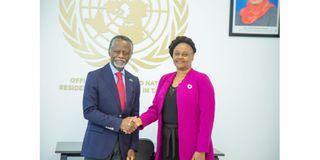
The UN Secretary-General’s representative, Parfait Onanga-Anyanga (left) shakes hands with ACT Wazalendo party leader, Ms Dorothy Semu, in Dar es Salaam yesterday. PHOTO | THE CITIZEN CORRESPONDENT
Dar es Salaam. A United Nations (UN) delegation has begun consultations with Tanzanian political parties on issues of democracy and good governance, drawing mixed reactions from stakeholders.
The UN Secretary-General’s representative, Parfait Onanga-Anyanga, has received both praise and scepticism over the initiative. Supporters say his visit is timely and could help strengthen national cohesion, while critics argue that tangible outcomes are more important than symbolic engagements.
Onanga-Anyanga, who also heads the United Nations Office to the African Union (UNOAU), is expected to meet leaders of several political parties, including Chama cha Demokrasia na Maendeleo (Chadema), Chama Cha Mapinduzi (CCM), ACT Wazalendo and Chama cha Ukombozi wa Umma (Chaumma).
He is also scheduled to hold discussions with the Speaker of Parliament, Mussa Zungu, Chief Justice George Masaju, and President Samia Suluhu Hassan. The talks are expected to focus on Tanzania’s political environment, governance and the role the UN could play in supporting democratic reforms, strengthening institutions and promoting national unity.
ACT Wazalendo has confirmed that it will participate in the discussions. Party leader Dorothy Semu said the party would send a delegation that includes its Secretary for Foreign Affairs and International Relations, Mwanaisha Mndeme.
“ACT Wazalendo has received the invitation and will meet him this afternoon. The delegation is prepared for the discussions,” Semu said.
However, Chadema and Chaumma have not yet confirmed whether they will take part. Chadema’s Vice-Chairman for Mainland Tanzania, John Heche, said it was too early to comment on the matter. Chaumma Chairman Hashim Rungwe said the party had not yet received a formal invitation and would respond once it does.
Civil society organisations have also reacted cautiously to the development. The Executive Director of the Legal and Human Rights Centre, Anna Henga, said Tanzania may benefit from the involvement of an impartial mediator, arguing that some domestic processes are often viewed as lacking neutrality.
“Given the current situation, an objective mediator is needed. The UN, with its peacekeeping and diplomatic mandate, is well placed to play such a role,” she said.
The President of the Tanganyika Law Society, Boniface Mwabukusi, said any engagement would depend on the specific objectives and expected outcomes of the discussions.
Meanwhile, the Commonwealth Ministerial Action Group (CMAG) has returned Tanzania to its formal agenda following its 72nd meeting held in Malta on March 7, 2026.
During the meeting, CMAG reviewed Tanzania’s political situation and raised concerns over human rights issues, including the violent demonstrations that occurred on 29 October 2025.
The group welcomed the government’s willingness to cooperate with the Commonwealth Secretariat through the Secretary-General’s Special Envoy, who is expected to visit Tanzania later this month.
to conduct a detailed assessment of the country’s governance environment.
According to CMAG, the envoy’s mission will aim to provide a clearer understanding of Tanzania’s political landscape and help shape recommendations for strengthening democracy, the rule of law and civic space.
The meeting also reviewed the political situation in Uganda, which has similarly raised concerns among Commonwealth members regarding human rights and democratic governance.