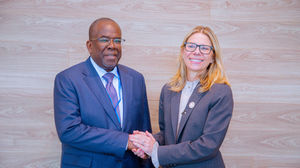
How Ernestilla Bahati helps clients navigate the corporate landscape

What you need to know:

  • With over a decade in the legal sector, Ms Bahati is the founder and managing partner of Ernestilla, Mafita & Company Advocates

Dar es Salaam. For investors navigating Tanzania’s fast-evolving corporate environment, Ms Ernestilla Bahati (pictured) has become a trusted guide.

She believes that successful investment demands more than capital; it requires understanding the law, the market and the long-term implications of every decision.

With over a decade in the legal sector, Ms Bahati, founder and managing partner of Ernestilla, Mafita & Company Advocates, has built a reputation on a client-first approach, helping investors structure projects that are both profitable and legally robust.

Her expertise spans litigation and investment law, focusing on Tanzania’s mining, infrastructure and public-private partnership (PPP) sectors, industries that are capital-intensive, heavily regulated and vital to national development.

She stresses that investors must adopt a long-term perspective. “Licensing requirements, fiscal regimes, environmental approvals and local content obligations are not obstacles; they are elements that shape sustainable investment,” Ms Bahati told The Citizen Rising Woman ahead of International Women’s Day on 8 March.

At Ernestilla, Mafita & Company Advocates, every engagement begins with a deep understanding of clients’ goals and commercial priorities before a single clause is drafted.

“Effective legal drafting must reflect the client’s strategy, not just legal theory,” she explains.

The firm’s affiliation with Mackrell International, a global network of independent law firms, provides access to cross-border standards, investor expectations and international best practices.

“When we combine that global insight with our strong grasp of Tanzanian law, we deliver advice that is commercially sharp, locally compliant and strategically sound. Our clients receive not just legal opinions, but the best guidance and well-crafted documents for their businesses,” she adds.

Ernestilla’s academic and professional background provides a solid foundation for her work. She holds a Bachelor of Laws (LLB) from the University of Dar es Salaam and a Postgraduate Diploma in Legal Practice.

A practising advocate of the High Court of Tanzania since December 2012, she has served in roles ranging from junior associate to head of Labour and Litigation, partner and ultimately founding partner of her firm.

This combination of rigorous training and practical experience allows her to offer advice that is technically precise and commercially astute. “I do not just close deals; I future-proof them,” she explains.

Each transaction begins with an assessment of potential risks, market shifts, regulatory reforms, or counterparty issues and the design of governance frameworks and financial terms that anticipate uncertainty.

Her team structures investments around clients’ ambitions, ensuring operations function within a predictable and protective legal framework. “Good lawyers resolve disputes; strategic lawyers prevent them,” she notes.

Ernestilla avoids simplistic yes-or-no answers. She provides calibrated options, outlining risks, implications and long-term considerations.

Beyond compliance, she advises on governance structures, change-in-law protections, dispute resolution mechanisms and the enforceability of security and arbitration awards. Environmental, social and governance (ESG) factors and financing structures also play a critical role in ensuring project resilience.

Her proactive approach distinguishes her from traditional legal models. Rather than waiting for instructions, she continuously monitors policy developments, translating legal changes into practical business guidance before compliance risks emerge.

Structured compliance frameworks, early engagement with authorities and disciplined transaction management allow clients to stay competitive while minimising disruption.

At the heart of Ernestilla’s leadership is trust. Transparency, accessibility and accountability underpin every client relationship. She invests time understanding each client’s governance culture, growth ambitions and operational realities.

 “Transactions are not just about closing deals; they are about building enduring partnerships,” she says. Clients describe her as present and dependable, qualities that reinforce confidence in complex negotiations.

Her path into law was never aimed at creating a conventional firm. Ernestilla envisioned a Tanzanian practice that went beyond litigation to adopt a commercially driven, internationally connected and results-oriented approach. “I wanted to practise law at a higher standard,” she reflects.

For her, this meant assembling a team of forward-thinking lawyers who understand that law is both a profession and a responsibility.

Precision, discipline and deliberate growth define her firm’s culture.

EM & Co has grown with intention, focusing on sector-driven, transaction-based and cross-border mandates.

The firm expands strategically, reinforcing commercial advisory strength rather than seeking visibility alone. Consequently, it is increasingly recognised not only as legal counsel but as a strategic partner helping investors navigate Tanzania’s complex regulatory terrain.

While Ernestilla empowers investors, she is equally passionate about empowering women in traditionally male-dominated sectors.

“Women bring perspective, patience and foresight to leadership. When we support each other, share knowledge and mentor the next generation, the industry benefits,” she remarks.

She believes women contribute unique strengths to law and investment: long-term thinking, emotional intelligence and collaborative problem-solving.

Women often integrate community impact, environmental stewardship and governance discipline into strategic decisions, enriching sectors that shape national development.

Women representation

Ernestilla sees women’s representation in Tanzania’s corporate, mining and infrastructure sectors as transformative.

“Meaningful inclusion at senior levels strengthens governance and sustainability. When women rise, we expand what leadership can look like, showing that excellence and empathy can coexist at the highest decision-making levels,” she says.

Looking ahead, her aspirations extend beyond her firm. She envisions a Tanzania where law protects opportunity, investment generates tangible impact and institutions operate with transparency and integrity.

She hopes to help build systems that are fair, predictable and trusted by citizens and investors alike.

Her legacy, she believes, will not be defined solely by deals closed or mandates secured but by institutions strengthened, professionals mentored and standards elevated.

“If the next generation inherits a Tanzania that is more principled, prosperous and inclusive than the one I encountered, my mission will have been fulfilled.”