Tanga. Tanzania has explained her strategy that seeks to build a more self-reliant nation by transforming education from a system focused mainly on academic knowledge into one that equips young people with practical skills, scientific knowledge and technological capabilities needed to solve local problems.
The strategy was outlined by Education, Science and Technology Minister Prof Adolf Mkenda during the opening of the 2026 National Education, Skills and Innovation Week in Tanga, where he linked ongoing education reforms to the country’s ambition to develop its own scientists, engineers, technicians and innovators.
Prof Mkenda said President Samia Suluhu Hassan had, soon after taking office, directed the ministry to improve education policy and curricula, with greater emphasis on skills. He said the reforms were already visible in the expansion of vocational education, science programmes, scholarships and innovation initiatives.
“Our President is not a person of many words, but we see her through her actions, and the major results of those actions will not be seen today or tomorrow. We will see them much further ahead,” Prof Mkenda said.
He said education reform required long-term thinking because, unlike roads and bridges whose results could be seen immediately, changes in education take years to produce their full impact. “A normal politician looks at the next election, but a great leader looks at the next generation,” he said. The minister pointed to the expansion of vocational education, including the establishment of vocational secondary schools and the construction of VETA centres across districts, as part of the strategy to equip Tanzanians with practical skills.
Tanzania is also preparing to participate in the international WorldSkills competition in Shanghai, an opportunity Prof Mkenda said would allow the country to measure the skills of its young people against global standards.
The government is also using scholarships to attract high-performing students into science, technology, engineering, mathematics and health-related fields.
Prof Mkenda said the Samia Scholarship provides full government sponsorship for top-performing Form Six students pursuing priority science-related disciplines, while the expanded programme is supporting exceptional students to study advanced technologies, including artificial intelligence, abroad.
The minister said, “this investment is necessary if we want to develop the capacity of our country to undertake major projects using our own experts rather than depending heavily on foreign skills and technology.”
He cited the history of the railway in Tanga as a reminder of the need to develop domestic technological capacity.
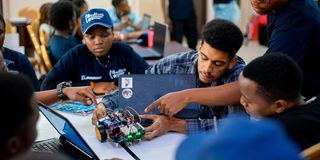
His message echoed the broader focus of the exhibition, which brought together about 90 institutions showcasing innovations, technologies and products developed to address economic and social challenges. Permanent Secretary in the ministry, Prof Calyne Nombo, said the annual week was created to bring together Government ministries, institutions, the private sector and development partners to share experience and develop joint strategies for strengthening education, skills, research and innovation.
She said this year’s theme, “Education, Skills and Innovation: A Pathway to Achieving the National Development Vision 2050,” was timely as, “Tanzania begins implementing the Vision, which places education, research, science and technology at the centre of national development.”
The programme includes exhibitions, MAKISATU science and innovation competitions, WorldSkills Tanzania, a three-day conference and intellectual property clinics designed to help innovators protect and commercialise their ideas.
Parliament’s Standing Committee on Education, Culture and Sports Chairperson, Ms Husna Sekiboko, challenged the Government to take the next step by ensuring innovations do not remain exhibition models.
“We do not want to continue seeing models. Models are enough. They can remain at the early learning stage. At major exhibitions like this, let us bring real things that we are producing in our respective areas,” she said.
She called for stronger links between innovators, investors and sources of finance so that ideas could become businesses, create jobs and generate income for the country.
Land, Housing and Human Settlements Development Minister, Dr Leonard Akwilapo, also praised the reforms, saying the quality of innovations and practical skills displayed by young people showed that Tanzania was moving in the right direction.
“I can see Tanzania moving in the right direction towards technological production,” he said.
He pledged continued support from his ministry in helping education and research institutions secure title deeds for their land.
For Prof Mkenda, however, the ultimate test is whether the reforms can produce a generation capable of designing and building technologies that Tanzania currently imports.
“The goal is to build our country’s capacity in science, technology and innovation,” he said.
The week, running from August 15 to 24 in Tanga, therefore goes beyond celebrating education. It is emerging as a platform for testing whether Tanzania can turn knowledge and skills into productive capacity and, ultimately, greater national self-reliance.