Kakama urges research collaboration to drive Kiswahili’s digital development

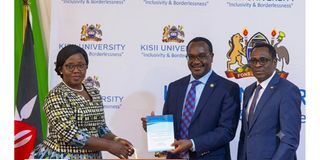
Kenya’s Cabinet Secretary for Education, Julius Migos Ogamba, displays a book after it was presented to him by the Executive Secretary of the East African Kiswahili Commission (KAKAMA), Dr Caroline Asiimwe, during the Chakama Kiswahili Conference, which concluded today at Kisii University in Kenya.
Dar es Salaam. The Executive Secretary of the East African Kiswahili Commission (Kakama), Dr Caroline Asiimwe, has called on member states of the East African Community (EAC) to strengthen collaboration in research, education and technology development to ensure Kiswahili becomes part of the digital and artificial intelligence revolution.

Speaking on Friday, August 7, 2026, at the closing of the Chakama Conference at Kisii University in Kenya, Dr Asiimwe said the two-day conference had laid the foundation for a new agenda aimed at positioning Kiswahili as a language that generates knowledge, innovation and technology, rather than merely consuming advances developed in other languages.

She said one of the key resolutions from the conference was to strengthen regional cooperation in Kiswahili research and direct studies towards strategic areas that contribute to the development of EAC member states.

Dr Asiimwe said another priority was to harmonise Kiswahili programmes and courses across universities, while developing common standards and terminology to facilitate the exchange of expertise and build a stronger cross-border knowledge system.

She stressed that Kiswahili must be part of advances in artificial intelligence and digital technology by contributing to the development of future knowledge and technologies.

“This will enable the language to continue playing a significant role in the development of the digital world,” she said.

Dr Asiimwe called on governments of EAC member states, education ministries and regional institutions to support the agenda by increasing investment in higher education, research, innovation and human-resource development within the Kiswahili sector.

She said Kakama was ready to work with Chakama, universities, research institutions, national Kiswahili councils, the private sector, innovators and development partners to achieve the objectives and ensure Kiswahili becomes an important tool for regional development.

“If we work together, we can ensure that technological development does not leave Kiswahili behind, but instead creates new opportunities to take the language further. We can build an East Africa where knowledge is produced, preserved and shared in our own language,” Dr Asiimwe said.

She thanked the chief guest, the leadership of Kisii University, Chakama officials and participants, including Kiswahili experts and university lecturers from Kenya, Uganda, Rwanda and the United Republic of Tanzania, for their contribution to the success of the conference.

“This collaboration is the foundation for making Kiswahili a language of knowledge, innovation and Africa’s future,” Dr Asiimwe said.

Speaking at the closing ceremony, Kenya’s Cabinet Secretary for Education, Julius Migos Ogamba, said the country had already begun the process of establishing a Kenya Kiswahili Council.

He said the Chakama conference had served as a catalyst and had successfully produced an outcome that Kenya could be proud of, adding that he had directed officials to begin preparing the first draft for the establishment of the council.