New health centre targets stronger healthcare systems across Africa
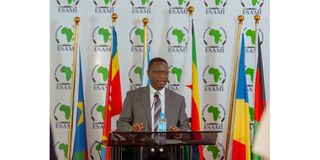
ESAMI Director General, Professor Peter Kiuluku, speaking during the launch of the African Centre of Excellence for Health Economics and Governance (AfriCHEG) in Arusha.
Arusha. African countries are set to benefit from improved health financing, stronger governance systems and better use of technology in healthcare following the launch of a new centre aimed at strengthening health systems and accelerating progress towards Universal Health Coverage (UHC).
The Eastern and Southern Africa Management Institute (ESAMI) has launched the African Centre of Excellence in Health Economics and Governance (AfriCHEG), which will focus on strengthening health economics, leadership and governance through evidence-based policymaking, applied research, leadership training and modern technology.
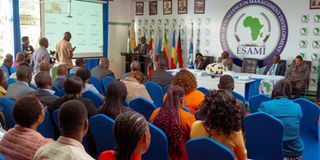
Launched in Arusha on Friday, the centre is expected to help governments and institutions across the continent improve health financing systems, strengthen accountability, and integrate technology into healthcare delivery.
Speaking during the launch, ESAMI Director General Prof Peter Kiuluku said the centre had been established to address the long-standing gap between research and implementation by ensuring that research findings are translated into practical policies that deliver measurable results.
“Our vision is to position AfriCHEG as a leading centre of excellence in Africa for health economics, governance, executive education, applied research and policy advisory services. We want to support countries in building resilient, efficient and financially sustainable health systems,” he said.
Prof Kiuluku said AfriCHEG would introduce training programmes incorporating Artificial Intelligence (AI) in health data analysis, financial tracking within health systems, procurement management, and monitoring and evaluation of health programmes.
According to him, the programmes are intended to equip professionals with practical skills in planning, budgeting, procurement, implementation and evaluation, while improving the efficient use of limited health resources.
He said the establishment of AfriCHEG reflected ESAMI’s broader goal of positioning Africa as a leader in knowledge generation, policy innovation and sustainable solutions to the continent’s health challenges.
“The strength of Africa’s health systems will not depend only on building more hospitals or increasing the number of health workers. It will also depend on the quality of governance, strategic planning, efficient use of resources and evidence-based decision-making,” said Prof Kiuluku.
“The future of the health sector depends on how well we manage our institutions, how efficiently we invest limited resources, how responsibly we use digital technologies and artificial intelligence, and how effectively public resources translate into tangible results for citizens,” he added.
He further noted that while many African countries are working towards achieving Universal Health Coverage, progress would depend on strong governance systems, accountable institutions, effective planning and sustainable health financing models.
“AfriCHEG will support African countries in improving health planning through reliable data, strengthening procurement systems for medicines and medical supplies, enhancing public financial management in the health sector, and building digital systems that improve transparency, efficiency and sustainability of health services,” he said.
The centre will also serve as a platform for collaboration among governments, universities, research institutions, the private sector and development partners to encourage innovation, strengthen health policy development and promote evidence-based decision-making.
AfriCHEG Coordinator Prof Urbanus Kioko said the success of the initiative would largely depend on close collaboration among African governments, academic institutions, research organisations and the private sector.
“We established AfriCHEG in response to the growing complexity of health challenges, including disease outbreaks such as Covid-19 and Ebola, as well as the increasing burden of antimicrobial resistance,” he said.
“Governments cannot address these challenges alone. This centre will therefore strengthen the capacity of African countries to plan, manage and improve health systems more effectively,” he added.
Chief Executive Officer of Velocity Project Management Ltd, Mr Hari Murthy, said international cooperation would be a key pillar of AfriCHEG’s success through joint research, knowledge exchange and the adoption of affordable health technologies.
He said the centre would benefit from India’s experience in digital health and universal health coverage implementation while promoting Africa-led innovation to build equitable, efficient and sustainable health systems.
Register to begin your journey to our premium contentSubscribe for full access to premium content