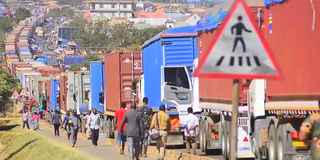
Dar es Salaam. It is no longer unusual for lorry drivers to spend a week or more waiting to cross the Tanzania–Zambia border at Tunduma in Songwe Region, thanks to severe congestion caused by a narrow road network and what they describe as laxity among some officials operating at the border.
While long waiting times are one challenge, the harsh living conditions drivers endure during the days spent at the border paint a grim picture of life on the road.
According to the Tanzania National Roads Agency (Tanroads), more than 1,000 lorries arrive at the border daily, yet fewer than half manage to cross within the same period.
Drivers who spoke to Mwananchi newspaper during a visit to Tunduma said that although the length of time spent in the queue is unpredictable, their allowances from employers are not adjusted to reflect the delays.
One of the drivers, Mr Godwin Kinyaha, said employers calculate allowances based on the estimated travel days for a return trip to Zambia or the Democratic Republic of Congo (DRC), but a few who take into account the extra days drivers are often forced to spend stuck in congestion at the border.
As a result, Mr Kinyaha said drivers end up using the allowance meant for their destination, with some exhausting all their money while still stranded in Tunduma.
“This means the driver bears the cost. The time you spend here requires money for food and other basic needs. If there was no congestion, you would already be in the DRC offloading cargo. It hurts us economically,” he said.
“I have been in Tunduma for five days now. I spent four days parked and on the fifth day, around 11pm, we were called to come and cross. But now it is 8am and I have still not crossed,” Mr Kinyaha said.
He added that his experience was mild compared to what often happens at the border, where some drivers wait for up to two weeks before crossing.
Responding to the driver allowance issues, Tanzania Medium and Small Truck Owners Association (Tamstoa) chairperson Chuki Shaaban said there is no business being conducted when lorries are stuck in long queues, arguing that congestion at border points leaves owners counting losses rather than profits.
“How do you expect me to pay extra allowances when there is no profit coming in? We should be fighting together to end the congestion because we are all suffering, not shifting the burden to each other,” he said.
He stressed that truck owners are fully aware that some drivers engage in leisure activities while stranded in the area, even though they know the delays are costing their employers heavily and that no extra allowances will be paid.
“When my truck sits in congestion, I incur losses and, in some cases, I am required to pay penalties for delayed delivery to my clients,” Mr Shaaban added.
Another driver, Mr Laiton Mwachange, said congestion has forced many drivers—who often operate alone—to remain awake for long hours without rest.
He explained that once caught in the queue, drivers must stay alert to move forward inch by inch as vehicles ahead advance, leaving them with little or no sleep and increasing road safety risks.
“The government should have mercy on us; this situation has gone too far. Almost all companies use this route. Imagine a company with 50 lorries stuck here for three days—eventually the owner does not know what to pay the drivers,” he said.
Tanzania Chapter of the African Truck Drivers Association chairperson John Siaba said congestion had forced the government to allow lorries to use the Sumbawanga road as an alternative route.
However, he warned that drivers using this route face frequent attacks by thieves and bandits, as security remains inadequate.
“When lorries line up along the Mbeya road, the queue can stretch as far as Vwawa because of the narrow road. The government allowed us to use the Sumbawanga route, but what we ask for is proper security for drivers,” he said.
On allowances, Mr Siaba said while driver payments are technically a matter between employers and employees, government intervention is needed to ensure drivers are fairly compensated.
What is the problem?
Asked about the root cause of the congestion, Mr Kinyaha said the main issue lies in the limited capacity of the border infrastructure, which has only one lane for lorries heading into Zambia and one for those returning to Tanzania.
“There should be two lanes going and two lanes returning. That would significantly reduce congestion,” he said, adding that the narrow roads mean that if a single lorry breaks down, all movement comes to a halt because there is no space to divert traffic.
“In areas like the Sogea Hills, if a lorry breaks down there is nowhere to push it aside. Everything stops until it is repaired and that is how the queue builds up,” he explained.
Mr Mwachange blamed the practice of holding lorries in parking yards and releasing them in batches, instead of allowing lorries to cross as they arrive.
He also accused some officials—particularly on the Zambian side—of inefficiency, claiming that many leave work early.
“If you arrive here at around 2pm, you may be told that officers from the Zambia Revenue Authority (ZRA) have already left. How can someone leave work that early and still claim to be committed?” he asked.
He stressed the need for all authorities to fulfil their responsibilities to ease congestion.
Mr Msangi said the border infrastructure has been overwhelmed by the growing number of trucks.
“When this border was opened, there was no congestion. Now lorries have increased but the infrastructure remains the same,” he said.
He criticised what he described as poor planning, noting that although Prime Minister Mwigulu Nchemba, once directed that the border be expanded, little has been done.
“This is a waste of public funds. Didn’t they know from the beginning that this place would need wider roads? What is the point of having trained engineers?” he asked.
He urged the government to expand the road network to at least four lanes and increase the number of scanners to speed up clearance.
Mr Msangi also accused some officials of negligence, saying they spend time on their phones instead of serving drivers.
Another drivers’ leader, Mr Ramadhan Seleman, called for road expansion to allow more vehicles to pass simultaneously.
He said the improvements should be matched with harmonised operations on both sides of the border to ensure smooth flow.
“Zambia stops working at 9pm, while we in Tanzania operate 24 hours. Even though we have more trucks, sometimes the congestion is caused by our counterparts in Zambia,” he said.
In efforts to resolve the crisis, Mr Siaba said that a meeting on December 12 this year, involving drivers, police, Tanroads, regional and district leaders and other transport sector acknowledged that the border was overwhelmed due to the high number of lorries and narrow roads and agreed on the need to expand infrastructure.
Pain for some, opportunity for others
Motorcycle taxi rider Ambakisye Tuntufye said congestion affects them too, forcing riders to manoeuvre dangerously between vehicles.
“Sometimes roads are completely blocked and we cannot pass. It is risky for both us and our passengers,” he said.
For Ms Loveness Kibinga, a vendor selling soup near the border, the congestion has been a blessing.
“When drivers are stuck, they buy soup and snacks from me. They are my customers, so I benefit,” she said. However, she admitted that congestion also causes inconvenience, sometimes preventing her from getting home on time.
Government response
Songwe Regional Commissioner Jabir Makame said authorities are aware that the main challenge at Tunduma is narrow roads.
He said the issues were identified after consultations with transport stakeholders earlier this month.
Following the meeting, Mr Makame said Tanroads had been instructed to explore options for expanding the road at the border.
Separately, during a visit on December 12, Works minister Abdallah Ulega directed Tanroads chief executive Mohamed Besta to secure emergency funds to assess and expand the road.
“Three-lane roads will be constructed. Emergency funds should be sought to rehabilitate the Iboya weighbridge so that all lorries leaving Tunduma are weighed there instead of Mpemba area,” the minister said.
Mr Ulega also ordered that service roads in the area be improved urgently to prevent conflicts between drivers and the government.
Register to begin your journey to our premium contentSubscribe for full access to premium content