Samia dismisses East-West divide, says Tanzania chooses partners, not blocs
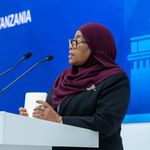
President Samia Suluhu Hassan with Russian President Vladimir Putin during the St Petersburg International Economic Forum (SPIEF 2026), held at the ExpoForum Convention Centre on the outskirts of St Petersburg, Russia, on June 5, 2026. PHOTO | STATE HOUSE.
St Petersburg. President Hassan has dismissed suggestions that her state visit to Russia signals a shift in Tanzania's foreign policy orientation, insisting that the country remains committed to its long-standing principle of non-alignment.
Speaking during an interview with Tanzanian journalists on the sidelines of the 29th St Petersburg International Economic Forum (SPIEF 2026) on Friday, June 5, President Hassan said Tanzania does not choose between East and West but works with all countries in pursuit of national development.
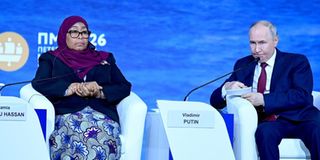
"We work with everyone. We don't choose who to work with. By coming to Russia, we are simply expanding the scope of those with whom we closely cooperate," she said.
Her remarks come amid speculation that choosing Russia for her first state visit after re-election reflected a move away from Western partners towards Eastern powers.
President Hassan rejected the suggestion, arguing that Russia is not a new partner but one of Tanzania's oldest allies.
She said that the then Soviet Union recognised Tanganyika's independence in 1961 and became the first country to recognise the union between Tanganyika and Zanzibar that formed the United Republic of Tanzania in 1964.
According to her, relations between the two countries date back to the liberation struggles in Africa, when the Soviet Union supported the training of African leaders and experts.
"Russia is not a new friend. It is a traditional friend that has stood with Tanzania for many years," she said.
President Hassan said Tanzania's foreign policy remains rooted in non-alignment and constructive engagement with all nations regardless of geopolitical divisions.
She cited China's longstanding role in infrastructure development, India's position as one of Tanzania's leading trade and investment partners, and cooperation with Japan, Europe and the United States across multiple sectors.
"Europe remains a major source of investment capital, while the United States is our leading source of tourists and development support," she said.
She said that major strategic projects, including the liquefied natural gas (LNG) project and mining ventures, involve investors from Europe and the United States.
"When we talk about LNG and natural gas, we are working with Europe and America. Kabanga Nickel also involves American investment," she said.
President Hassan said maintaining relations with a wide range of countries was essential for safeguarding Tanzania's interests in an increasingly complex global environment.
The President was in Russia for a three-day state visit at the invitation of Russian President Vladimir Putin.
During the visit, she held bilateral talks with President Putin at the Kremlin, where the two leaders discussed ways of strengthening cooperation in trade, investment, education and energy.
She also laid a wreath at the Tomb of the Unknown Soldier in Moscow in honour of the millions of Soviet citizens who lost their lives during the Second World War.
While in Russia, President Hassan received an honorary doctorate from Peoples' Friendship University of Russia (RUDN University) and participated in SPIEF 2026, one of the world's largest economic forums.
Addressing global investors at the forum, she presented five strategic investment opportunities in Tanzania, namely the Bagamoyo Special Economic Zone, mining and mineral beneficiation, tourism, fertiliser manufacturing and nuclear energy development.
President Hassan said Tanzania was implementing reforms aimed at improving the investment climate, with foreign direct investment inflows rising from nearly $3 billion in 2021 to about $5 billion in 2025.
"Tanzania is open for business. Tanzania is ready for new ideas and innovation," she told delegates.
She also attended the Tanzania-Russia Business Forum, where she urged investors to support Tanzania's ambition of becoming a $1 trillion economy under Vision 2050.
Despite the growing diplomatic engagement, trade between Tanzania and Russia remains modest.
Official figures show that bilateral trade increased from $178.8 million in 2020 to approximately $307.5 million in 2025, while Tanzania's exports to Russia rose from $7.5 million to $29.5 million over the same period.
Russia's largest investment in Tanzania is the $1.2 billion Mkuju River Uranium Project in Ruvuma, which is being developed by Mantra Tanzania Ltd, a subsidiary of Russia's state nuclear corporation, Rosatom.
Register to begin your journey to our premium contentSubscribe for full access to premium content