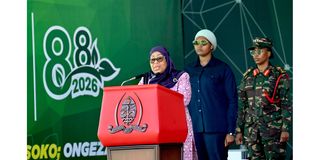
Dodoma. President Samia Suluhu Hassan has closed the Agricultural and Livestock Exhibition week, issuing three key directives for immediate implementation.
The directives require the Ministries of Agriculture, Livestock and Fisheries to work with the Prime Minister’s Office Regional Administration and Local Government (PMO-RALG) to effectively resolve ongoing conflicts between farmers and herders across the country.
Other instructions involve expanding exhibition zones to the Southern regions and ensuring agricultural innovations displayed to farmers are practical and suitable for adoption in daily production.
Unlike last year's exhibition, when she granted a two-day extension, President Hassan said on Saturday, August 8, 2026, that this year's expo officially closes, ordering everyone to return to work tomorrow at their respective duty stations without delay.
"I direct these ministries, alongside the PMO-RALG, to resolve farmer-herder conflicts. Although they have declined, they persist. We cannot tolerate fighting instead of creating wealth," said President Hassan during her speech.
She noted that agriculture has grown and gained global recognition, promising that within two years, growth will average 9.4 percent in official international performance reports.
The president also directed that farmers be assured of markets for agricultural, livestock and fisheries products to motivate production, citing Sukuma youth in the Lake Zone who entered sea cucumber trading after the lucrative market was officially opened.
She approved the Agriculture Minister's request for annual Farmers' Day climax celebrations to be held at John Malecela Nzuguni grounds in Dodoma, while launch events rotate among regions each year.
On peace, President Hassan urged Tanzanians to safeguard peace and deny opportunists room to undermine security, stressing that development requires stability and lasting harmony.
Agriculture Minister Daniel Chongolo said following trials under Building Better Tomorrow (BBT) initiatives, projects would be expanded to local councils.
Mr Chongolo said initial BBT projects target youth in 18 councils across different regions, following successes at Chinangali and Mlazo/Ndogowe centres in Chamwino District.
However, the Minister said that, to motivate oilseed farmers, the government had banned cooking oil imports except during periods of verified domestic supply deficits.
"Your Excellency, we launched a special strategy banning edible oil imports unless there are supply deficits," Mr Chongolo told the President.
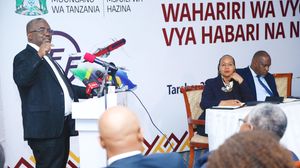
According to the Minister, Tanzania requires 700,000 tonnes of cooking oil, while domestic production is only 306,000 tonnes, forcing the country to spend heavily on imports.
In another proposal, Mr Chongolo asked President Hassan to approve rotating Farmers' Day launches among regions while permanently retaining the climax celebrations at John Malecela Nzuguni grounds, Dodoma.
Livestock and Fisheries Minister, Dr Bashiru Ally, said that despite progress in the sector, illegal vigilantism and taking the law into one's own hands remained deeply troubling.
"We allocated ample grazing land, and the manifesto targets six million hectares by 2030. This is a great achievement, but I am dismayed by people taking the law into their own hands, sparking farmer-pastoralist conflicts in several areas," said Dr Bashiru.
The Minister highlighted gains in the livestock sector, noting that the overall value of livestock increased from Sh26.5 trillion in 2020/21 to Sh35.216 trillion in the 2024/25 financial year.
Other achievements include controlling livestock diseases, enabling Tanzania to export meat to foreign markets, notably goat and sheep meat to Saudi Arabia.
Regarding fisheries, he said increased domestic fish consumption had created a growing local market across the country.
Dr Bashiru added that 703 fish farming cages worth Sh17.68 billion had recently been distributed to citizens to boost aquaculture production.