Sustainable development goals and statistical data processing
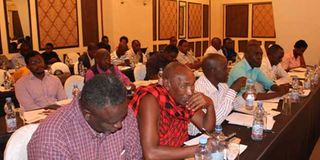
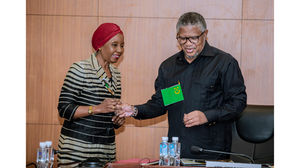
Members of the Civil Society Organizations (CSOs) attending the Policy Forum Annual General Meeting in the city. PICTURE By Louis Kolumbia
What you need to know:
But, they also took the opportunity to commend the government for its sound resource mobilization used for funding development projects – even as they stressed the need for increased resources allocation in rural areas to reduce glaring disparities in urban-rural development.
Dar es Salaam. Civil Society Organizations (CSOs) in Tanzania have expressed concern on the role of the Statistics Act-2013 in assessing implementation of the UN-backed Sustainable Development Goals ‘Agenda-2030’ (SDGs-2030) in the country.
But, they also took the opportunity to commend the government for its sound resource mobilization used for funding development projects – even as they stressed the need for increased resources allocation in rural areas to reduce glaring disparities in urban-rural development.
Addressing the ‘Policy Forum Annual General Meeting’ (PF-AGM) held in Dar es Salaam recently, stakeholders expressed worries that the law restricted individuals and CSOs from collecting and disseminating data and other statistical information for public consumption without the express permission of the country’s National Bureau of Statistics (NBS)!
Apart from considering the Statistics Act-2013 a stumbling block to stakeholders’ engagement in SDGs implementation assessment, they also believe that there’s room for participation by the general public in getting involved in issues of statistical/data collection and dissemination.
Debating a presentation at the forum titled ‘SDGs Implementation and Monitoring at sub-National Level,’ the network coordinator at the United Nations Development Programme (UNDP), Mr Emmanuel Nnko, said CSOs still have time to ensure that they actually participate in evaluating SDGs implementation processes.
“Since the process of formulating regulations involves stakeholder participation – including participation by CSOs – we need to make best use of the opportunity to ensure that CSOs are given enough space to monitor and evaluate implementations of the SDGs,” Mr Nnko said.
Mr Reynald Raymond Maeda of the United Nations Association of Tanzania (UNA-Tanzania) said the law doesn’t restrict participation by CSOs and the public in general. They are only required to obtain prior approval to do so from the NBS. Indeed, the Bureau has only 38 per cent capacity to collect and disseminate the data.
According to Mr Maeda, the law highlights areas in which other stakeholders can participate in the collection and dissemination of data and other information.
“Stakeholders engagement will depend on regulations. But, since the country has the baseline, implementation strategies and SDGs targets, then it stands to be assessed,” he said.
In an earlier presentation titled ‘Improved mobilization of domestic resources and improved service delivery: bridging the gap,’ stakeholders commended the fifth-phase Tanzania government of President John Magufuli (November 5, 2015—) for its success in increasing resources mobilization.
In that regard, an advocate from the Aquinus Attorneys (AA) firm, Mr Dominic Ndunguru, said “Tanzania’s realization of SDGs implementation depends on the extent to which citizens pay taxes. Therefore, the government should mobilize more resources through taxation.”
However, the lawyer said it is important for the government to ensure that its citizens benefit from the taxes they pay through the provision of improved social services – and that revenue losses are curbed.
According to Mr Ndunguru, Tanzania loses considerable sums in public revenues through illicit financial outflows by – among others – foreign mining companies, as well as through little use of Electronic Fiscal Devices (EFD) in collecting taxes, and the failure to officially ‘recognize and tap the informal sector of the economy.
“The informal sector could add up to 40-60 per cent of public revenues to government coffers if formalized and properly handled,” he said.
On the other hand, the ‘Hakielimu’ manager for Research, Innovation and Policy Analysis, Mr Mwamwezi Makumba, said stakeholders embarked on the resource mobilization debate because much was yet to be done in the area, with a view to fund development projects.
“Donor-dependence should be avoided in the country’s efforts to realize the SDGs. It’s because of donor-overdependence that development projects suffer immensely when their funding pledges by donors are delayed or restricted,” Mr Makumba said.
The Oxfam research and policy advisor, Mr Dastan Kweka, supported the idea, suggesting that more mobilized resources should be invested in rural areas in order to address the glaring development inequalities between rural and urban Tanzania.
“Agriculture – which largely supports the rural population – should be prioritized in the country’s rural investment plans because once people’s incomes are boosted through improved agricultural activities, the costs-sharing idea will be meaningful to the people in implementing the development projects that are significant in realizing the SDGs,” Mr Kweka said.
He was supported in this by Mr Sultan Mhina, a gender consultant from the Tanzania Gender Networking Program (TGNP) who suggested that the provision of social services to rural communities should be improved.
Describing the prevailing situation in rural Tanzania as “alarming,” Mr Mhina said “schools and healthcare centres are located far away from most of the villages – thus forcing schoolchildren and the sick to walk long distances in seeking education and medical attention!
“A recent TGNP study established that both schools and health centres lack safe and clean water with schools also facing shortages of teachers and latrines.”
According to Mr Mhina, healthcare centres are routinely blamed for discriminating against patients, have perennial drugs shortages, and are targets of complaints that they arbitrarily penalize expectant women who give birth at home. In the event, he urged that these challenges be urgently addressed and surmounted.
Noting that “rural communities are the most disadvantaged in the country,” the TGNP gender consultant required “strong engagement on issues of resources mobilization; debates on resource mobilization should be staged in the respective areas before proceeding to the national level.”
For his part, the ‘Open Mind-Tanzania’ (OMT) director for research, information and publications, Mr Respicius Shumbusho, said “human capital, social capital and water should be included on the list of mobilized resources.”
He suggested that “a conducive environment should be created for the prosperity of corporate social responsibility (CSR) after the multinational companies have closed their operations in the country.
“People in rural areas should be educated to recognize, and have a sense of project ownership, instead of believing that development projects in their areas are owned by central or local government authorities,” he said.
An assistant programme officer from the Legal and Human Rights Centre (LHRC), Mr Fundikira Wazambi, said that, since the Tanzanian economy is said to be among the fastest-growing economies in Africa today, the time has come for that ‘growth’ to be translated into tangible improvement in the people’s living conditions through effective poverty alleviation initiatives.
Mr Wazambi was supported in this by Mr Gabriel Ole Tuke, a program coordinator at the ‘SWEAT Development Program,’ who opined that, “in order for Tanzania to move forward, it needs harmonization and consensus in resource mobilization, allocation and evaluations.
Finally, a program manager from the ‘Tanzania Brighter Future Community,’ Ms Irene Kyamba, commended the stakeholders meeting because participatory projects execution, monitoring and evaluation is crucial in realizing the SDGs.