Tanzania seeks green finance boost through Global Green Growth Institute membership
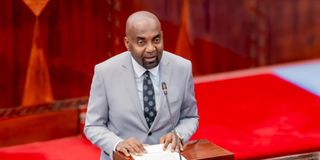
Minister of State in the Vice President’s Office (Union and Environment), Hamad Yussuf Masauni, addresses Parliament in Dodoma during debate on Tanzania’s accession to the Global Green Growth Institute (GGGI). PHOTO | COURTESY
Alfred Zacharia is a business reporter for The Citizen and Mwananchi newspapers.
Mwananchi Communications Limitted
Dodoma. Parliament has approved the country’s accession to the Global Green Growth Institute (GGGI), a move the government expects will help it attract climate finance, develop green investment projects, and strengthen expertise in managing environmental programmes.
Minister of State in the Vice President’s Office (Union and Environment), Mr Hamad Yussuf Masauni, made the revelation in Parliament on Thursday, September 3, 2026.
He said the GGGI membership would give Tanzania access to technical support and financing opportunities as the country seeks to balance economic expansion with environmental protection and climate resilience.
“GGGI is an international institution that enables member countries to implement development plans based on green economic growth to achieve sustainable development goals and the objectives of the Paris Agreement on greenhouse gas emissions reduction,” said Mr Masauni.
The proposal comes at a time when Tanzania is increasingly linking environmental sustainability with its long-term economic strategy.
The country’s Development Vision 2050 places climate resilience and environmental conservation among its strategic priorities, while the government has been promoting green transformation, clean energy, and climate-related investment.
For Tanzania, one of the most significant potential gains from GGGI membership is not simply environmental expertise but improved access to capital.
Mr Masauni said membership would strengthen the country’s ability to identify and prepare environmental and climate projects, while helping domestic institutions obtain the accreditation needed to access international environmental and climate funds.
It could also expand opportunities for green bonds and concessional loans, areas that are becoming increasingly important as developing countries face growing financing needs for climate adaptation and low-carbon infrastructure.
“GGGI was established to cooperate with member countries in preparing environmental conservation and climate-change projects, supporting domestic institutions to obtain accreditation in managing funds from international environmental and climate-change funds, and facilitating investment in green bonds,” he said.
The significance for Tanzania is that many climate projects fail to move beyond the planning stage because governments and institutions struggle to develop projects that meet the technical and financial requirements of international financiers.
GGGI membership, therefore, could help bridge part of that gap by combining project preparation, institutional capacity building, and access to green finance.
Mr Masauni said the benefits would extend beyond environmental programmes to employment, investment, and Tanzania’s international standing.
He said the country expected membership to increase employment opportunities for Tanzanians, improve the skills of local professionals, and strengthen Tanzania’s diplomatic influence in political, economic, and environmental affairs.
“Membership will increase the availability of employment opportunities for Tanzanians,” he said, adding that it would also strengthen research and improve the experience and productivity of local experts in green growth.
That economic dimension is significant because the government is increasingly treating environmental policy as part of its development agenda rather than as a separate conservation issue. Earlier this year, Mr Masauni said environmental sustainability and climate resilience were central to the implementation of Vision 2050.
The government has also identified areas such as clean cooking, carbon trading, environmental restoration, and climate-resilient development as potential areas for investment and economic opportunity.
According to the government’s submission, Tanzania intends to join GGGI as a participating member rather than a contributing member.
The distinction matters because the treaty defines a contributing member as one that makes a contribution of at least $15 million over three years or $10 million over the first two years of membership.
A participating member is one that does not meet that contribution threshold.
The government says Tanzania would nevertheless assume certain obligations under the agreement. These include granting privileges and immunities to GGGI if the organisation establishes an office in the country, in accordance with the treaty and applicable law.
The accession process requires a country to submit an instrument of accession to the GGGI Director-General. Under the treaty, membership takes effect 30 days after the instrument is deposited.
Tanzania’s proposed accession would also bring it closer to a growing African network within GGGI.
Rwanda, Kenya, and Uganda are already members, while other African countries have either joined or expressed interest in joining the organisation.
For Tanzania, regional participation could provide opportunities to exchange experience on climate finance, green infrastructure, and policy reforms at a time when East African economies are facing similar pressures from climate change and the transition towards cleaner forms of production.
GGGI’s broader role is to help developing and emerging economies design and implement green-growth strategies, making the organisation potentially relevant to Tanzania’s ambitions to attract investment while maintaining environmental sustainability.
Mr Masauni told Parliament that Tanzania would not be able to enter reservations to the treaty because Article 23 prohibits reservations when signing or ratifying the agreement.
He said the proposed accession was consistent with Tanzania’s existing commitments under international environmental agreements, including the United Nations Framework Convention on Climate Change, the Convention on Biological Diversity, and the United Nations Convention to Combat Desertification.
“Considering the benefits that the United Republic of Tanzania will obtain from ratifying the agreement, the Parliament of the United Republic of Tanzania resolves to ratify the Agreement on the Establishment of the Global Green Growth Institute,” said Mr Masauni.
The proposed membership, therefore, represents more than another international environmental commitment.
For Tanzania, the bigger test will be whether membership can translate into a stronger pipeline of investable green projects, greater access to affordable climate finance, and practical opportunities for businesses and communities to participate in the country’s green transition.