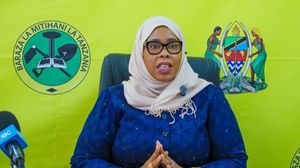
The Minister of State in the President’s Office [Planning and Investment], Prof Kitila Mkumbo, speaks with Mpoki Thompson (not pictured), Executive Editor of Mwananchi Communications Limited, during an exclusive interview. PHOTO | SAID KHAMIS
Dira 2050 targets a one-trillion-dollar economy and a per capita income of $7,000 by 2050. What annual growth trajectory is required to achieve this, and what structural shifts must happen in the next five years to put Tanzania on that path?
To fully appreciate Dira 2050, it is important to understand its core purpose. The vision seeks to define the kind of Tanzania the country aspires to become by 2050. It is anchored on four overarching principles: inclusivity, justice, prosperity for all, and self-reliance.

Achieving these aspirations requires a strong foundation. As such, Dira 2050 places emphasis on good governance, peace, security and stability. Without this firm foundation, it would be impossible to realise the broader objectives of the vision.
The vision is further guided by three key pillars. The first focuses on building a strong, inclusive and competitive economy. The second aims to enhance human capabilities and advance social development, while the third pillar centres on environmental integrity and climate change resilience.
Dira 2050 outlines four main goals supported by 17 specific targets. The foremost target is to transform Tanzania from its current lower-middle-income status into an upper-middle-income country by 2050.
Progress towards this goal will be measured primarily through economic indicators, including expanding GDP from about $95 billion to $1 trillion, increasing per capita income to $7,000, and eliminating extreme poverty. At its core, the vision places people and the economy at the centre of development.
Success will ultimately be measured by the wellbeing and development of Tanzanians, reflecting a people-centred approach to national transformation.
What measures are in place to ensure ordinary Tanzanians feel the impact of $1 trillion GDP, and what lessons have we learnt from the dismal success of Development Vision 2025?
Pillar two of Dira 2050 focuses on human development, specifically the strengthening of human capabilities and social development. The guiding principle is that everything the government does must ultimately translate into tangible improvements in people’s lives.
Significant progress was achieved under the first Development Vision (2000–2025), despite multiple challenges. Tanzania’s GDP per capita rose from $453 to about $1,273, while total GDP expanded from $13 billion to $95 billion.
However, the country fell short of some of its economic targets, largely due to delayed implementation. Although the vision was approved in 2000, its execution only began around 2010/2011, mainly because the operational plan was not developed at the same time.
This time, the approach is different. Alongside the vision, Parliament has now approved the operational plan, ensuring timely and coordinated implementation. A key question is how future economic growth will directly improve people’s lives.
According to the framework of Dira 2050, the answer lies in major reforms in skills development and human capital. Priority areas include social development—particularly education, health and social security—as well as logistics and infrastructure, which are essential for inclusive growth.
Crucially, the vision places renewed emphasis on sectors that directly involve the majority of Tanzanians. Agriculture, which remains largely subsistence-based, is identified as the leading sector for transformation.
The next phase will focus on commercialisation and value addition, enabling agriculture to drive income growth and employment at scale.
One of the key lessons from the past, the vision acknowledges, is that sectors driving economic growth did not sufficiently engage the wider population. Dira 2050 seeks to correct this by aligning growth-driving sectors with those that employ and impact the majority of citizens.
While major investments have been made in ports, rail, and power, infrastructure gaps and inefficacies persist. This limits economies of scale and industrial clustering. What is being done to assure investors of a conducive business environment?
The current five-year development plan is anchored on four major reform areas, one of which focuses on energy, logistics and infrastructure. It is important to note, however, that Tanzania has made significant progress in infrastructure development over the past two decades, even as notable gaps remain.
Despite reforms, Tanzania still faces high energy and logistics costs, multiple taxes, levies, and fees. How is the government addressing the high cost of doing business?
We have been implementing the national strategy for improving business and investment climate, popularly known as the blueprint for regulatory reforms.
We are in the process of producing the second version of the blueprint, which will include radical reforms in a number of areas. Findings show that we have too many regulatory authorities and businesses are overly regulated.
We will take measures to ensure that we reduce the burden of regulatory authorities on businesses. We will also ensure that the authorities only charge fees to enable them to do their operations and not to generate profits.
The president formed a commission to conduct a comprehensive review of our tax system, and the report has been finalized. This report will go a long way to improve our tax system.
However, we should also acknowledge that over the past 10 years, Tanzania’s environment for doing business has improved radically, placing us among the top 10 best countries in Africa. Our aim is to be among the top three by 2030.
How are you addressing regulatory unpredictability?
We have undertaken major legal reforms, and we now have a new Tanzania Investment and Special Economic Zones Act, which is the major law when it comes to investments. The government is going to propose a new law. We will come up with a bill called Business and Investment facilitation Act. This Act will establish a supreme body to oversee all business and investment affairs in Tanzania.
How do we ensure rule of law and separation of powers prevail?
Tanzania is a country that respects the rule of law and will continue to do so. Government operates strictly within the framework of existing laws, and its role is to implement legislation passed by Parliament. There is no situation in which a government can simply decide not to enforce a law.
If concerns arise, they must be addressed through the proper legal channels, including returning the matter to Parliament. Tanzania will therefore continue to uphold and respect the rule of law.
How does the government work with the private sector in ensuring that Dira 2050 is realised?
The engine for implementing this vision is the private sector. We need the private sector to mobilise capital and finance a wide range of development projects.
By 2030, an estimated Sh477 trillion in investment will be required to realise the vision, with about 70 percent expected to come from the private sector. This means we must protect, nurture, develop and truly value our private sector. The President has entrusted me with the responsibility of being the custodian of the private sector, and I want to assure businesses that we will work together as genuine partners.
There will be a new approach to how government engages with the private sector. We will move away from being mere opinion providers to becoming solution providers. This will be a joint effort, built on partnership and shared responsibility.
Are we reviewing the PPP approach, which has faced criticism from the public?
Tanzania has a long history of socialism, a period in which the government did almost everything, including selling beer. As a result, our private sector is relatively young, and our approach to economic activity remains deeply influenced by a socialist mindset. We still tend to view businesses with a degree of suspicion.
This means that, as government, we must continue educating ourselves. There are still officials within the public sector who have lingering questions and reservations about engaging with the private sector.
At the same time, we must also continue educating the public. That said, there are genuine concerns that must be addressed honestly. We need to be clear about what we gain from foreign investors.
In most cases, they bring capital, technology and experience in running complex operations. Foreign investors come to Tanzania to do business and make a profit, and that should not be a source of anxiety, they are simply seeking a return on their investment.
Ultimately, however, no country is developed by foreign investors alone. Development is driven by its own citizens. This is why we must deliberately build and strengthen local investors so that they can work in tandem with foreign partners.
It is also why there are strategic sectors where the majority ownership should remain Tanzanian, such as the media industry.
Doesn’t limiting majority shareholding by foreigners affect investment in media industry?
There are challenges, but the government’s intention is noble. Just imagine a media industry owned entirely by foreigners, it would be deeply problematic. I acknowledge that challenges exist.
In the short term, the government must play its part by ensuring that it pays for advertising services it consumes. However, in the long run, the government should not be the primary customer of the media. A sustainable media industry must be driven mainly by the private sector.
How does the government address tax and levies concerns raised by the private sector?
The tax review period runs from December to May, during which there is extensive engagement with the private sector. By the time the Minister of Finance presents the Finance Bill in June, much consultation and negotiation will have taken place.
This process involves compromises on both sides, often with the government making concessions. However, the government still needs tax revenue to operate, and not all proposed taxes will be welcomed by the private sector. With donor funding declining, the ministry of Finance increasingly relies on local resource mobilization, making these discussions crucial for sustaining government operations.
The Vision talks about broadening the tax base. Will this translate into higher taxes for businesses and SMEs, or will the government commit to reducing nuisance levies that investors complain about?
The main focus is formalisation. Currently, almost 80 percent of businesses in Tanzania operate in the informal sector, which limits the tax authorities’ direct access to them. Our goal is that by 2030, at least 50 percent of businesses will be formalized.
For instance, agriculture contributes 26 percent of Tanzania’s GDP, yet only a small fraction of those in the sector pay taxes. This is because the industry is largely informal and therefore almost untaxed.
Going forward, the emphasis will be on volume. Even small contributions from a large number of taxpayers can add up to a significant total. At present, Tanzania has about 2 million registered taxpayers out of a population of over 60 million, and a workforce of around 33 million people.
Tax measures targeting the creative industry were introduced. Why were these regulatory steps taken before the government had created an enabling environment for the industry to grow?
For a long time, Tanzania’s creative industry was treated like an informal sector. Today, however, it is the fastest-growing sector in the country, expanding at around 17 percent. The government has now mainstreamed the industry, recognising it as a key economic sector.
Efforts are being scaled up to develop this sector, not only because of its significant economic potential, but also because it provides employment opportunities for many young Tanzanians. Regarding taxes, we have listened to the concerns, and the Ministry of Finance will take action going forward.
With Tanzania’s population projected to exceed 100 million by 2050, and job creation struggling to keep pace, is the country adequately prepared to manage the social pressures and potential instability that may arise from rising unemployment and underemployment?
Population growth in Tanzania is both a blessing and a potential challenge if not managed properly. Currently, 76 percent of the population is under 35, with a workforce of around 33 million, of whom 24 million are aged between 15 and 39.
However, the population growth rate remains high, with a fertility rate of 4.8 children per woman, above the African average of 3.2, a level that poses long-term social and economic challenges.
The most effective way to manage rapid population growth is through education. Tanzania is investing heavily in this area. From 2028, every child will be required to complete Form Four, making secondary education universal.
Keeping children in school longer is the best way to reduce fertility rates, as they are likely to have just two to three children. In addition, there is a strong focus on skills development to ensure graduates have the competencies needed to thrive in a rapidly changing global economy.
The goal is to produce global citizens who can work anywhere in the world, positioning Tanzania as a potential supplier of skilled labour to countries in Asia and Europe.
The question of whether Tanzanians should master English has long been a subject of national debate. How important is this?
Language proficiency is critically important. Tanzanians must be conversant in at least two languages: Kiswahili and English. It does not matter which language is used as the medium of instruction; what matters is that all necessary steps are taken to ensure Tanzanians are fully competent in both.
Proficiency in these languages is not just an academic issue, it is a strategic economic priority. Our education system should be intentionally designed to produce language-competent citizens, as bilingual capability is essential for competitiveness in a globalized labour market.
Regarding Tanzania’s startup ecosystem, which currently lags behind regional peers and other African markets, the government is taking steps to improve access to capital. Discussions are at an advanced stage, and a technical team has been assigned to analyse and advise on the best mechanisms.
It is expected that before the end of this year, the government will roll out a comprehensive framework to facilitate capital availability for startups, SMEs, and young entrepreneurs.
What is the government doing to improve remittances?
Several factors have limited remittance flows from Tanzanians abroad, including cultural considerations. Unlike neighbours such as Uganda, Kenya, and Rwanda, where many citizens prefer to stay and work abroad, Tanzanians often return home, which means the number of Tanzanians living overseas is relatively small.
Historically, this area was not formalized, and data on the diaspora was not systematically tracked, unlike in neighbouring countries. To address this, each Tanzanian embassy and high commission has been tasked with registering nationals in their respective countries.
As a result, there are now Tanzanians who have established themselves abroad, and this trend is gradually increasing. Beyond cultural factors, the regulatory environment has also limited diaspora participation in economic activities.
To address this, the government plans to adopt a system granting Tanzanians abroad a special status, enabling them to invest at home on equal terms with residents.
The government has heard the genuine concerns of its diaspora.
On the question of dual citizenship, it remains controversial. Citizenship is a God-given right, and no one should be deprived of it simply because they chose to move abroad in search of better opportunities.
What is the one big threat that could derail Dira 2050?
Continuing with “business as usual” will not achieve Vision 2050. The vision requires a mindset change and cultural re-orientation, we must change the way we approach development.
The targets we have set are ambitious but achievable, yet they cannot be reached at a slow pace; we need to move with urgency.
It is also critical to stop promoting the idea that the government will provide everything.
Development is a collective endeavor, and all citizens must play their part.
Register to begin your journey to our premium contentSubscribe for full access to premium content