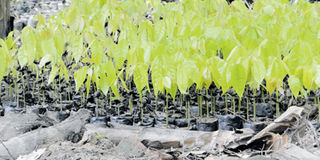
A local organisation involved in organic farming, Envirocare, promotes organic cocoa production in Kilimanjaro and Morogoro regions. This project was implemented from 2011-2014. PHOTO | ENVIROCARE
What you need to know:
A person behind this noble idea is educated and she holds a secure employment within the government. She is an expert in organic agriculture and can produce healthy food for her family. But this was not enough for Dr Sofia Mlote. She decided to pass her knowledge to other people, starting with her neighbours in Segerea, where she lives.
Dar es Salaam. As the country marshals resources to battle lifestyle diseases – hypertension, cancer and diabetes to name a few - a group of women in Segerea has taken the war on a different path through promoting organic farming.
A person behind this noble idea is educated and she holds a secure employment within the government. She is an expert in organic agriculture and can produce healthy food for her family. But this was not enough for Dr Sofia Mlote. She decided to pass her knowledge to other people, starting with her neighbours in Segerea, where she lives.

Dr Mlote told The Citizen that quest to see a health nation was one of the things, which pushed her to use her knowledge to assist other people.
“I was educated by this nation free of charge. I thank Mwalimu (Julius) Nyerere for that. Why shouldn’t I use the knowledge I gained to assist my fellow Tanzanians? I have a debt and this is the way I am paying it,” she says in an interview conducted at her office in Temeke Veterinary, one arm of the Ministry of Agriculture, Fisheries and Livestock Development.
Dr Mlote is among the several women in the country picked by the Tanzania Media Women Association (Tamwa) to showcase their contribution to society. Dr Mlote has used her knowledge to teach a group of 27 women on organic agriculture. They are now in final stages of registering their group so that it can formally be recognised.
“In our area we regard Mama Mlote as a saviour because she has opened a new world to us. In the past, I did not believe that agriculture can transform lives of an urban dweller. We used to plant flower gardens around our homes, but if you come to my home today you will not find a flower, but a vegetable garden, which gives me healthy food as well as income, as little as it may be,” says Ms Jesca Nyanda, a resident of Kinyerezi, who has been trained by Dr Mlote.
She further says she embarked on a journey to train her neighbours because she believes that organic agriculture has the potential of redeeming the country economically – not through selling of its products only. She says organic agriculture has the potential of redeeming the country’s economy because of its secret in health and environmental conservation.
“If we produce organic food we will be assured of health people who, in turn, form the nation’s workforce,” she says.
Dr Mlote is also the national chairperson for Tanzania Association of Women Leaders in Agriculture and Environment (Tawlae). So, she says, that position forced her to reach out to a wider community in many ways.
“As a leader, I was supposed to live by example. I started practising organic agriculture, but I saw that was not enough because doing it alone would have a little impact on the community. I lead by example, but I pulled other people to also practise what I do,” she says.
Tawlae brings together women professionals in agriculture and the environment with the purpose of ensuring that they link expertise, which the professional have to what farmers at the grassroots do.
Expensive bill
Dr Mlote says as a nation today Tanzania spends a lot of money on treating people affected by what is popularly referred to as lifestyle diseases. But most of these people do die, depleting the nation of the much needed workforce. But, with organic farming, you will have less heart diseases, cancer, diabetes and other lifestyle diseases.
On the other hand, traditional agriculture has become a source of environmental degradation and destruction. People clear forests for farms, which they abandon after a few seasons and a move to another area. Traditional agriculture also needs a lot of water, while in organic farming, you only need little water through drip irrigation.
“I don’t buy vegetables because I know that what is sold in the market is harmful. I produce my own vegetables and every resident of Dar es Salaam can do that. We will tremendously decrease health implications affecting many people today,” she says. Dr Mlote says her efforts received a boost in 2014 during a visit of the then Spain Vice President who, through Tawlae Patron, Dr Gertrude Mongella, invited a number of women to Spain to learn more in organic agriculture. She said about 15 people, five people professionals, five farmers and five journalists, all women, went to Spain.
“After that trip I decided to start training my neighbours. I posted a notice on our WhatsApp group and since then, every Saturday, from 10 to 11 in the morning, we meeting for training on organic agriculture. We started with 40 people, but some of them have dropped and we have remained with 27 people,” he says.
It is this training, which motivated Ms Jesca, who is now entrenching herself in organic farming.
“If it were not for Dr Mlote, I would not have been, who I am today,” she says.
Expert opinion
Mr Constantine Akitanda … hails the group for what they are doing. He says organic agriculture is not only important to ensure the health of society, but it is also lucrative economically.
“There is more than $85 billion all over the world today, which chases crops produced organically. This is a huge amount of money, which has created high demand. Therefore, these women should know that there is a ready market for their produce,” says Mr Akitanda.
But he advises the group that after completing their registration, they should also register their activities to Tanzania Organic Agriculture Movement (Toam).
“In our country it is Toam, which certifies crops produced organically. With Toam certification, they can easily find lucrative markets for their produce… In fact, they will be overwhelmed because demand for such crops is so high,” he says.
Though initially organic agriculture needs sort of heavy investment, but it is very rewarding. One doesn’t need a large tract of land to produce organically.
According to Dr Mlote, she has only a small tract of land around her home, where she is producing enough. Organic farming also doesn’t need a lot of water. Ms Jesca says that through drip irrigation, a glass of water is enough to water a tomato seedling in a day.
Challenges
Although crops produced organically has high demand overseas, but its market locally is very limited. Many people fail to buy organically produced crops because they are a bit expensive.
“But this is just a myth. If people were aware of real costs of eating crops, which have been cultivated using chemicals, they would understand that organic crops are their real saviour,” says Dr Mlote.
There is also a problem in dealing with crop diseases and pesticides. There is little research on ‘organic pesticides’, which can be used.
Nevertheless, Dr Mlote says she has established a number of ‘organic pesticides’, which she uses, whenever her crops are attacked by pests of diseases.
“I use crops to fight crop pests… I use garlic, pepper or yogurt to fight against pests in my farm,” she says.