The judges said there was no dispute that at the time the conflict arose, Mr Kisena was managing director of Udart, chief executive officer of Simon Group Limited, and at the same time a director of the Dar es Salaam Transport Company.
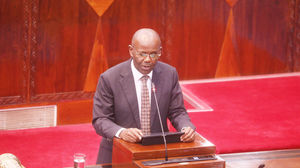
Dar es Salaam. The Court of Appeal of Tanzania has overturned the conviction and quashed the sentences imposed on former Udart managing director Robert Kisena and his two co-accused, ordering their immediate release.
Mr Kisena and his colleagues, Mr Charles Newe, who was also a director at Udart, and Tumaini Kulwa, who served as cashier at the company, had earlier been convicted of economic sabotage offences and sentenced to three years in prison alongside fines.
According to the ruling, Mr Kisena was sentenced to three years in jail and ordered to pay Sh200 million in fine.
Mr Newe received the same sentence of three years and a Sh200 million fine, while Kulwa was sentenced to three years in prison and fined Sh100 million.
The sentence had been delivered on December 22, 2023, by Judge Elinaza Luvanda of the High Court of Tanzania.
However, on Tuesday, March 10, 2026, a panel of three justices of the Court of Appeal overturned the judgment.
According to the ruling by the panel comprising Justices Augustine Mwarija, Panterine Kente, and Zainab Muruke, the appellants had initially been convicted of economic sabotage offences, including money laundering.
According to the charge sheet containing 15 counts, which the accused denied, the offences were allegedly committed between May 25 and July 10, 2016, while they were carrying out their duties.
The judges said there was no dispute that at the time the conflict arose, Mr Kisena was managing director of Udart, chief executive officer of Simon Group Limited, and at the same time a director of the Dar es Salaam Transport Company.
For the second appellant, Mr Newe, there was also no dispute that he was a director at Udart, an executive at Simon Group, and a director at UDA, while the third appellant served as cashier at Udart.
Referring to the earlier judgment that convicted them, the judges said the first and second appellants had been found guilty on counts 1, 2, 6, 11, 12, 13, and 14 relating to money laundering, while the third appellant was convicted on counts 3, and 14.
For counts one and two, the appellants were sentenced to three years in prison, while for counts 6, 11, and 12, the first and second appellants were ordered to pay a fine of Sh100 million or serve five years in jail.
For counts 13 and 14, all the appellants were ordered to pay a fine of Sh100 million each or serve five years in prison.
For causing loss to the government, they were all sentenced to three years’ imprisonment.
The High Court under Judge Luvanda ordered the sentences to run concurrently, but the fines were to be paid consecutively, a ruling the appellants were dissatisfied with and therefore challenged at the Court of Appeal.
Prosecution evidence
During the proceedings, prosecution witnesses attempted to establish, among other things, that there was no dispute over ownership of shares in UDA and Udart, which they claimed were entirely owned by the government.
The appellants, however, maintained in their defence that UDA was jointly owned by Simon Group, which held 51 percent of the shares, and the government through the Treasury Registrar, which held 49 percent.
However, the judges said it was not disputed that UDA was the majority shareholder in Udart, the company operating the bus rapid transit system across various parts of Dar es Salaam.
Because of disagreement between the prosecution and the appellants regarding ownership of UDA and Udart, the trial judge spent considerable time determining whether the appellants had any involvement in the funds alleged to have been stolen or laundered.
Ultimately, Judge Luvanda accepted the prosecution’s position that there was essentially no dispute regarding ownership of shares in UDA and Udart and that the appellants had no shares in the funds alleged to have been stolen or laundered.
Based on additional evidence presented in support of the prosecution’s case, the High Court judge concluded that counts 1, 2, 6, 11, 12, 13, and 14 had been proved beyond reasonable doubt and proceeded to convict the appellants.
Grounds of appeal that freed them
Among the 12 grounds of appeal, the court observed that the first and second grounds alone were capable of determining the entire appeal, despite the respondent, the Republic, also appealing against the sentences imposed by the High Court.
Under those grounds, the appellants argued that the judge erred in refusing to halt the proceedings when a dispute emerged over ownership of shares between Simon Group Limited and the Treasury Registrar concerning control of UDA and Udart.
The main argument was that since the matter involved share ownership, the court, being a criminal court, lacked the authority and jurisdiction to determine such a dispute, which falls under civil rather than criminal jurisdiction.
Lawyers for the appellants, Deusdedit Luteja and Nduruma Majembe, argued that because a dispute existed over Simon Group’s shareholding in UDA and Udart, the judge had no jurisdiction to determine issues essentially related to a civil dispute.
On the other hand, State Attorney Patrick Mwita, who led a team of five government lawyers representing the Republic, acknowledged there was a dispute over UDA ownership but maintained there was no dispute concerning Udart.
He argued that it was undisputed that Udart was owned 99 percent by UDA while Simon Group held only one percent, stressing that share ownership was not the real issue but rather that Udart had suffered financial loss.
Regarding the appellants’ claim that the offences arose from contractual relations between Udart and Longway Engineering Limited, which they own, the government lawyer said no such contract existed between the two entities.
Judges’ ruling
In their ruling published on the court’s website on Wednesday, March 11, 2026, the Court of Appeal judges said that after hearing arguments from both sides, the issue for determination was whether the evidence presented involved a dispute over share ownership.
“The issue to be determined is whether there was a dispute over ownership of shares in UDA and Udart and whether there was a breach of contract between Udart and Longway Engineering Limited, and if so, whether the judge was correct,” said the judges.
They said evidence from the fourth prosecution witness and the first appellant, Mr Kisena, as reflected on page 4624 of the judgment, showed that the trial court was not the appropriate forum to determine share ownership between Simon Group and the Treasury Registrar.
However, during the proceedings, the trial judge rejected lawyer Majembe’s argument that the charges against his clients concerned a share ownership dispute, instead taking the view that the matter only concerned the distribution of shares.
“According to the judge, the share distribution had no relationship whatsoever with the criminal charges facing the appellants,” the justices said.
“Based on the evidentiary issues the trial judge chose to follow, we do not agree with the argument by Mr Mwita that there was no dispute over share ownership in this matter,” added the judge.
“There is no doubt from the overall evidence throughout the trial that share ownership lay at the centre of this dispute. This fact is reinforced by the effort the trial judge undertook in analysing the evidence before concluding there was no dispute,” insisted the justice.
The appellate judges said it was clear that the trial judge failed to properly consider evidence showing a dispute over share ownership, which should have been resolved through civil proceedings before the criminal case proceeded.
For those reasons, the Court of Appeal quashed the convictions of Mr Kisena and his co-accused, set aside the sentences imposed on them, and ordered their immediate release from prison unless they are held on other criminal charges.