WWF to invest Sh150 billion in 2026–2030 strategic plan
Dar es Salaam. The World Wildlife Fund (WWF) has announced plans to invest Sh150 billion under its 2026–2030 Strategic Plan, reinforcing its long-term commitment to environmental conservation and sustainable development in Tanzania.
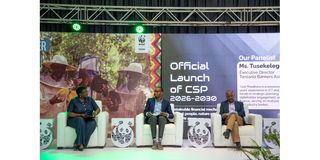
The Country Strategy Plan III (CSP III) 2026–2030 was officially launched on February 25, 2026 at Mlimani City in Dar es Salaam. The event highlighted achievements recorded under previous strategies, including progress in forest and wildlife conservation, community empowerment, and the promotion of sustainable livelihoods.
Speaking at the launch, WWF Tanzania Country Director Amani Ngusaru said the new five-year plan will prioritise community-led environmental conservation.
“Today we are launching WWF’s strategic plan for the next five years, covering 2026 to 2030. This is our third strategic framework since WWF began structured programming in Tanzania. The first plan covered 2015 to 2020, followed by the 2021 to 2025 strategy. This new phase will strengthen efforts to conserve the country’s natural resources,” said Country Director Ngusaru.
He explained that while earlier programmes focused largely on wildlife and forests, WWF has since recognised the importance of managing key landscapes as integrated ecosystems.
“In the coming five years, we will maintain our focus on priority landscapes, while adopting a stronger community-led approach. Conservation must empower local communities to set their own priorities and manage resources beyond national protected areas,” he said.
Country Director Ngusaru added that the strategy will support community-based forest management, noting that many forests are owned and managed by local communities who serve as custodians of these resources.
“Over the next five years, WWF expects to invest Sh150 billion, equivalent to approximately Sh25 billion annually, to achieve these objectives. We carry a significant responsibility to mobilise these resources and are engaging stakeholders to work collectively in support of government priorities and the President’s conservation agenda,” he said.
Prior to the official launch, a high-level panel comprising leaders from the finance sector, academia and conservation institutions examined sustainable financing mechanisms for environmental initiatives.
During the discussion, Forest Landscape Restoration Africa Initiative Lead Dr Severin Kalonga underscored the importance of resilience amid climate change and global economic uncertainty.
“For countries such as Tanzania, where communities depend on land, forests, water and marine resources for their livelihoods, protecting and restoring these ecosystems is central to national development. The environment and the economy are interdependent. When ecosystems deteriorate, household incomes decline and poverty increases. Investment in conservation is an economic safeguard for present and future generations,” said Initiative Lead Dr Kalonga.
He emphasised that effective policies and financial systems must prioritise environmentally responsible projects that actively involve communities, protect biodiversity, restore habitats and improve the wellbeing of women and young people.
“If conservation is treated as a pillar of development, Tanzania can strengthen its national resilience and ensure that natural resources continue to deliver long-term benefits,” he said.