Deepening financial crisis at the EAC demands salary cuts and sanctions on non-paying states
By Benjamin Andongolile
Difficult times demand difficult decisions. The worsening financial crisis within the East African Community (EAC) now requires bold, immediate and arguably uncomfortable measures if the regional bloc is to survive.
With the Community reportedly struggling to pay February salaries and to finance basic operations, it is clear that fiscal discipline must replace business as usual.
One practical response would be to align employee salaries with actual revenue inflows, ensuring that compensation reflects financial realities.
Such a move would signal shared sacrifice at a moment when the organisation faces one of the gravest crises in its history.
Internal communications circulating within EAC institutions suggest that the Community has reached a critical liquidity shortage.
A leaked memorandum dated 24 February 2026 from the Clerk of the East African Legislative Assembly (EALA) warned members that funds were insufficient to meet salary obligations and clear outstanding commitments.
This represents a dramatic escalation of long-standing financial strain and raises the spectre of institutional paralysis.
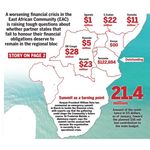
Financial data paint an equally troubling picture. Partner states have accumulated arrears of approximately $54.8 million in contributions to the main EAC budget.
Of roughly $56 million assessed for the 2025/2026 financial year, only about $21.4 million had been remitted by late January, barely 38 percent compliance.
Total outstanding obligations across multiple financial years now stand at an estimated $89.3 million, reflecting chronic delays in member-state payments.
Non-compliance varies significantly. Burundi reportedly owes around $22.7 million, while the Democratic Republic of Congo has accumulated arrears of roughly $27.7 million.
South Sudan owes approximately $21.8 million and Somalia about$10.5 million.
By contrast, the three founding members, Tanzania, Kenya and Uganda, continue to meet their obligations, while Rwanda remains the only later entrant consistently honouring its contributions.
This inevitably raises an uncomfortable question: is expansion strengthening or suffocating the EAC? And who, precisely, should shoulder the salaries of EAC officials and EALA members from non-paying states?
The strain extends beyond the Secretariat. Contributions to the Inter-University Council for East Africa remain only partially fulfilled, with outstanding balances exceeding $18 million.
Similar arrears affect the Lake Victoria Fisheries Organisation, where compliance stands at roughly two-thirds of required payments. The financial stress appears systemic rather than incidental.
At the heart of the debate lies the cost of maintaining a highly paid regional bureaucracy at the Secretariat in Arusha.
Critics argue that the current administrative structure is financially unsustainable, particularly when the organisation cannot reliably meet salary obligations or fund planned activities.
Reports indicate that the EAC is among the highest-paying public institutions in the region, with some senior officials earning up to $20,000 (about Sh50 million) per month, supplemented by housing allowances, education benefits, travel privileges and comprehensive medical insurance.
Members of EALA are also among the region’s best-remunerated public officials, often earning significantly more than Members of Parliament in their home countries.
The disparity between EAC salaries and national public service pay structures is striking. In Tanzania, senior government officials typically earn between Sh4 million and Sh7 million per month.
Comparable gaps exist in Kenya and Uganda, while ministers and legislators in Rwanda, Burundi, South Sudan and Somalia operate within national salary frameworks well below the EAC scale.
In several cases, ministers earn less than half the monthly income of senior EAC officials.
Such disparities raise serious questions of equity. Governments operating under tight fiscal constraints at home are expected to finance a regional bureaucracy whose compensation levels appear detached from domestic economic realities.
Regional integration should not become a pathway to privileged remuneration insulated from the conditions facing ordinary citizens.
Defenders of the current structure argue that the EAC follows an international civil service model designed to attract highly qualified professionals from across the region.
Yet the Community differs fundamentally from global institutions, which rely on predictable multilateral funding. The EAC depends primarily on contributions from developing member states.
It is therefore time to consider a salary ceiling, ensuring that no official earns more than a defined multiple of the highest-paid civil servant within partner states.
Such reform would reduce administrative costs and reinforce the principle that the Community exists to serve its citizens, not itself.
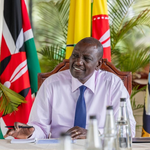
The emergency summit of EAC Heads of State, convened in March 7, 2026, by Kenyan President and EAC Chairperson William Ruto, must confront the persistent non-payment of statutory contributions.
Without decisive political intervention, the Community risks prolonged instability that could erode decades of integration efforts.
Several accountability measures merit consideration. Representatives from states that fail to remit contributions could be barred from receiving Community-funded salaries or allowances.
Leadership positions within the Secretariat might be restricted to candidates from compliant countries.
Allowing officials from heavily indebted states to occupy senior posts effectively obliges compliant members to finance their remuneration, a situation many view as inequitable.
A review of the contribution formula may also be necessary, ensuring payments reflect economic capacity.
Larger economies such as Kenya, Tanzania and Uganda might contribute proportionately more, potentially accompanied by governance reforms granting greater decision-making influence commensurate with financial responsibility.
Operationally, aligning salaries with actual revenue inflows, including temporary adjustments during periods of shortfall, could stabilise finances while demonstrating institutional accountability.
The current crisis has exposed structural weaknesses that can no longer be ignored.
Without reform, public confidence in the EAC will continue to erode as citizens question why generous executive packages persist while essential programmes are curtailed.
Regional integration remains a worthy and necessary ambition for East Africa, promising expanded trade, improved infrastructure and deeper political cooperation.
Yet that vision depends on sustainable institutions underpinned by fiscal responsibility.
The East African Community now stands at a critical crossroads. Its leaders must choose between decisive reform and gradual institutional decline.
The message from this crisis is unmistakable: unless urgent measures are taken to enforce contributions, rationalise salaries and strengthen accountability, one of Africa’s most ambitious regional projects risks a future defined not by integration, but by insolvency.
Benjamin Andongolile is a social and political analyst based in Mwanjelwa, Mbeya