STRONG directive? No; how about a STRONGLY WORDED directive?
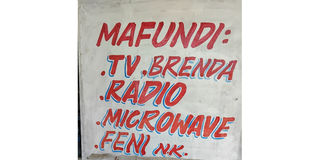
We captured this one in Dar’s Kinondoni District. This signpost is meant to invite the public to bring for repair their electronic equipment. The mafundi (artisans) here are good at fixing, among other equipment, BLENDERS (not “brendas”). Trust signwriters! PHOTO | AMS
A strong directive? How do we measure the strength of a directive? At the expense of being accused of fussiness, we aver to say that using the adjective “strong” to define a directive is least appropriate—rather incredulous!
We’ve before us a January 10 copy of Bongo’s senior-most broadsheet, whose Page 2 is carrying a story entitled, ‘Kairuki issues ultimatum on personal data registration.’ Reporting on an order by Minister for Communication and Information Technology Angellah Kairuki, our scribbling colleague writes:
“In a STRONG directive, Kairuki instructed the Personal Data Protection Commission to begin preparations immediately for compliance audits across the country.”
A strong directive? How do we measure the strength of a directive? At the expense of being accused of fussiness, we aver to say that using the adjective “strong” to define a directive is least appropriate—rather incredulous! When a minister issues an order, we don’t need to excessively qualify it. Calling it, simply, a directive, would be good enough!
However, if you consider it necessary to add weight to the Honourable Minister’s order, we’d suggest his sentence to read thus: “In a STRONGLY WORDED directive, Kairuki instructed the Personal Data Protection Commission to…”
Page 5 of the broadsheet is filled with an assortment of pictures, one of which has a caption written thus: Deputy Minister for Foreign Affairs and East African Cooperation James Millya receives A QUR’AN from the Amir and Chief Missionary of the Ahmadiyya Muslim Community in Tanzania, Sheikh Khawaja Muzaffar Ahmad, in Dar es Salaam recently…”
A Qur’an? Oh, no! Why, because there’s only one Qur’an—THE QUR’AN—which is the book comprising messages from Allah Himself as revealed to His Prophet, Muhammad (peace be unto him—PHUH).
Which is to say, what the Amir presented to Minister Millya is A COPY of the Qur’an. Yes, just like one could be gifted with, not a Bible, but A COPY of the Bible.
And now, a look at Bongo’s huge and colourful broadsheet of Friday, January 16, whose Page 2 has a story whose headline reads, ‘Kilimanjaro due to welcome some 30,000 Form One students this year.’ In Para 2, the scribbler writes: “The Kilimanjaro Regional Commissioner, Nurdin Babu, said he conducted inspections across the region from January 5 to 10, 2026 to personally verify…”
January 5 to 10, 2026? Telling the dates 5 to 10 are those of 2026 suggests that the scribbler doesn’t want his readers to imagine he’s talking of an inspection that took place in January 2025! It’s sheer waste of print paper space—or, an underestimation of our readers’ intelligence!
In Para 5, the scribbler reports further on what RC Babu said in regard to this year’s Form One in Kilimanjaro schools: “He also directed ward education coordinators to hold preparatory meetings for school openings and to plan the RECEPTION of new students.”
Reception of new students? Well, well…we aver our colleague set out to say: “…ADMISSION of new students.”
In the last para-but three, the scribbler writes: “In Moshi municipality, parents were OBSERVED accompanying children to school with FULL school SUPPLIES, signaling strong community engagement…” Duh!
Let’s not fuss and simply provide a rewrite: “In Moshi municipality, parents were SEEN accompanying children to school with ALL THEIR school REQUIREMENTS…”
Finally, a gem from the huge Nairobi tabloid that commands a sizeable readership in Bongo. Deep inside its LifeStyle pullout, there’s a story entitled, ‘We took what the thieves left behind and changed our lives.’
In the first paragraph of the last column of the interesting human-interest story, the scribbler reports: “As time went by, a homeless person noticed there were people living within the church compound and decided to BORROW food.”
Borrow food? A-a! Things you borrow are only those belonging to someone else which you take and use with the intention of returning them.
Food can’t be one of such things. We BEG FOR food when we’re starving and have no money to buy the same. You borrow someone’s car when yours has broken down.
Ah, this treacherous language called English!
Send your photos and linguistic gems to email [email protected] or WhatsApp on Tel No 0688315580