What Tanzania’s Sh62.3 trillion Budget must now prove

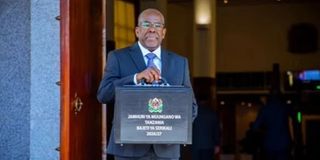
Minister for Works, Abdallah Ulega. PHOTO | COURTESY

On June 22, as Parliament closed debate on the 2026/27 budget, Works Minister Abdallah Ulega found himself defending the existence of roads.

MPs had questioned whether borrowed development money was showing up as infrastructure.

His answer was blunt: every shilling is visible on the ground, in the roads, at airports, and along rail corridors that citizens use daily.

That brief exchange captured the real test facing Tanzania’s first FYDP IV budget. Not whether the numbers are large – at Sh62.34 trillion, they are, 10.3 percent above last year – but whether the financing behind them survives scrutiny.

Let’s start with the financing, because the architecture is more aggressive than the headline suggests.

The budget carries a deficit of Sh7.71 trillion, financed by Sh15.54 trillion in new borrowing: Sh6.56 trillion domestic, Sh6.55 trillion external concessional, and Sh2.43 trillion external commercial, alongside Sh7.84 trillion set aside to repay maturing loans.

Read plainly, Tanzania is borrowing roughly double its deficit to keep existing debt serviced while still funding new development spending.

This is not unusual for a developing economy mid-transformation. It is, however, exactly the structure that invites the question MPs asked: where does the money actually land?

This is where politics matters more than mathematics. A government can present a coherent Medium-Term Debt Management Strategy – Tanzania has one, running 2025/26 through 2027/28 and still face a credibility gap if the asset trail behind the borrowing isn’t legible to the people voting on it, let alone to the development finance institutions deciding whether to extend the next concessional tranche.

Ulega’s insistence that loans are “what have made it possible for citizens to see and use these projects every day” was not bureaucratic deflection.

It was the government recognising that bankability is no longer just a balance-sheet question, but a question of demonstrable delivery.

For institutional capital, this lens matters more than the deficit-to-GDP ratio. DFIs and concessional lenders price not just sovereign risk but execution risk: the probability that financed projects clear procurement, construction, and operational milestones on schedule.

 A Parliament willing to interrogate its own ministers on exactly this point is, paradoxically, a point in Tanzania’s favour, provided the answers keep holding up.

Which brings us to the second test, set not by Parliament but by the market itself. The Tanzania Private Sector Federation and the Confederation of Tanzania Industries broadly welcomed this budget’s reforms: VAT refunds within 30 days, extended capital goods deferment, a twelve-month tax holiday for newly registered presumptive taxpayers.

 CTI called it balanced and growth-oriented, but the sharpest verdict came from the room, not the press release: University of Dar es Salaam economist Abel Kinyondo noted that Tanzania’s $91.8 billion economy needs growth of roughly 10 percent annually to reach Dira 2050’s  $1 trillion target. This budget delivers 6.3 percent, up from 5.9 percent, which is a real improvement, but one that closes perhaps two-thirds of the distance the Vision requires.

Having crafted this Vision and watched it take shape from close enough to know its arithmetic, I would put it more sharply than the polite consensus in the room allowed: the gap between 6.3 and 10 percent is not a rounding error to be absorbed by optimistic compounding over twenty-five years.

It is the central planning question FYDP IV must answer in its next four years, not its last. Vision documents are written in the imperative tense; budgets are written in arithmetic.

The task of every budget between now and 2030 is to narrow that gap, visibly, year on year, and not simply to gesture at the destination.

None of this is a verdict against the budget. Compliance is genuinely improving as the TRA collected 105 percent of its 2025/26 tax target, and the financing is sensibly diversified across concessional, domestic, and commercial sources rather than concentrated in any single channel.

What investors and partners should take from this cycle is narrower: Tanzania is asking to be judged on delivery, not announcement. Ulega said as much himself, even if he didn’t intend the broader implication.

For sovereign funds, DFIs, and multinationals weighing the next allocation to East Africa’s most consistently growing large economy, the question is no longer whether Tanzania has a credible fiscal frame, because it does.

 The question is whether the next budget closes the growth gap further than this one did, and whether the asset trail behind the borrowing remains as visible in twelve months as the minister insists it is today.

Tanzania has set its own test, and the next twelve months will tell us whether it passes.

Amne Suedi is the Managing Director of Shikana Investment and Advisory, Honorary Consul of Switzerland in Zanzibar, and Chair of the Switzerland-Tanzania Chamber of Commerce