Business leaders identify reform areas to support $1 trillion goal
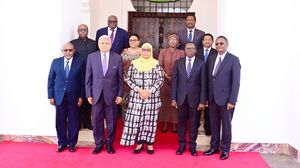
The Tanzania Private Sector Foundation and the PPP Centre Tanzania recently co-organised and hosted a capacity-building workshop for industry leaders and chief executives from private sector organisations. PHOTO | COURTESY
Dar es Salaam. The business community has identified priority reform areas aimed at supporting Tanzania’s ambition to build a $1 trillion economy by 2050.
The private sector is expected to shoulder more than 70 percent of the implementation costs of the National Five-Year Development Plan (2026/27–2030/31), making its effective participation critical to achieving the country’s long-term economic targets.
The secretary general of the Tanzania Institute of Quantity Surveyors (TIQS), Mr Mrisho Saidi, said unless challenges affecting key sectors such as forestry, maritime transport and local contractor participation are addressed, the country may struggle to reach the targeted milestone within the stipulated timeframe.
He was speaking recently at a Public–Private Partnership (PPP) capacity-building meeting themed 'Navigating PPP Projects and Frameworks in Tanzania', organised in collaboration with the Tanzania Private Sector Foundation.
The forum also reviewed the implementation of the PPP Act No. 4 of 2023 and assessed progress on projects currently in the pipeline.
“The government should strengthen coordination between central authorities and sector ministries to enhance the implementation of strategic infrastructure projects through Public–Private Partnership arrangements,” he said.
He noted that stronger institutional alignment would help reduce disputes, delays and uncertainties that often undermine investor confidence and slow the implementation of major development projects.
“Without clear coordination among implementing institutions, major projects risk delays, disputes and reduced investor confidence,factors that could slow progress towards the country’s long-term development ambitions,” he added.
Mr Saidi also raised concern over the continued dominance of foreign contractors in major public infrastructure projects, warning that allocating a significant share of the national development budget to external firms contributes to capital flight and weakens the local investment multiplier effect.
According to him, retaining a larger portion of project value within the domestic economy would strengthen local financial systems, expand employment opportunities and accelerate the growth of indigenous construction firms.
He urged the government to introduce practical operational guidelines that prioritise technology transfer and ensure that a greater share of project funds circulates within local banks and institutions.
“Achieving Tanzania’s ambitious economic targets will depend not only on attracting investment, but also on empowering local experts and contractors to play a leading role in national development,” he said.
Meanwhile, the chief executive officer of Africa Forest Company Limited, Mr Hanta Rwegoshora, called on the government to reduce regulatory barriers that continue to discourage investment in the forestry sector, particularly as Parliament deliberates on the national budget for the upcoming financial year.
He said investors in forestry projects frequently face unnecessary charges and administrative bottlenecks, discouraging long-term commitments despite the sector’s strong environmental and economic potential.
Mr Rwegoshora also urged the government to engage forestry experts to conduct a comprehensive assessment of forests owned by both the state and village authorities in order to develop a clear strategy for enhancing private-sector participation in sustainable forest management.
He emphasised the importance of investor-friendly reforms as the PPP law undergoes review, noting that forestry investment requires substantial capital but offers significant long-term benefits, particularly in supporting climate change mitigation and sustainable resource use.
He added that establishing designated investment forests, alongside a supportive policy framework, would attract greater private-sector participation and strengthen the forestry value chain nationwide.
Meanwhile, the executive secretary of the Tanzania Shipping Agents Association, Mr Abel Uronu, urged the government to introduce stronger incentives in strategic sectors such as maritime transport and tourism to enable more Tanzanians to participate in large-scale investment projects.
He said improving the investment environment by reducing costs and partially sharing risks would help attract additional capital and accelerate the country’s economic transformation towards its 2050 target.
The executive director of the Public–Private Partnership Centre (PPPC), Mr David Kafulila, said the government would take into account stakeholders’ recommendations to advance implementation of its long-term economic agenda.
He said green financing remains one of the least utilised investment areas despite offering significant opportunities for accessing affordable development finance. “Green financing is a promising area that has not yet been fully utilised in terms of investment.
It presents many opportunities for accessing concessional funding. I urge investors to consider it as a catalyst for accelerating the country’s economic growth,” he said.
Kafulila added that investment in carbon trading is another emerging area with strong potential that investors should explore as Tanzania positions itself to benefit from global climate financing mechanisms.
He also advised investors to familiarise themselves with the PPP legal framework to build confidence and avoid uncertainty when undertaking major projects.