Commission identifies five root causes of Oct 29 election violence
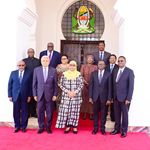
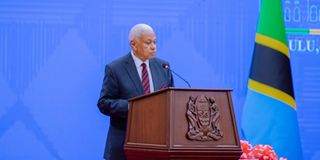
Chairperson of the Presidential Commission of Inquiry into incidents during and after the October 2025 General Election, Retired Justice Mohamed Chande Othman, presents the report at State House in Dar es Salaam on Thursday, April 23, 2026, during the official handover of the findings on post-election violence following the October 29, 2025 General Election. PHOTO | COURTESY
Josephine Christopher is a senior business journalist for The Citizen and Mwananchi newspapers
Mwananchi Communications Limitted
Dar es Salaam. Tanzania’s Commission of Inquiry into the post–October 29, 2025 election violence has identified five key underlying causes of the unrest, citing deep-seated political tensions, socio-economic pressures, governance weaknesses and international dynamics as the main drivers of the crisis.
Presenting the final report today, April 23, 2026, at the State House on Thursday, Commission Chairperson Retired Chief Justice Mohamed Chande Othman said the violence could not be attributed to a single incident, but rather a convergence of structural and immediate factors.
“We are dealing with both long-standing issues that have persisted over time and immediate triggers that ignited tensions on the ground,” Justice Othman said as he handed over the report to President Samia Suluhu Hassan.
The submission marks the end of a 153-day nationwide inquiry conducted across 21 districts in 11 regions.
Justice Othman revealed that the Commission analysed 450 still images and 880 video clips submitted as evidence, some of which were widely circulated during and after the violence.
“While a portion of the digital material was authentic, we also found evidence of manipulation, including the use of artificial intelligence to alter or fabricate content,” he said.
He cited cases where images allegedly showing mass graves and bodies in blue bags were found to have been misrepresented, with some material traced to unrelated international conflict zones and reused in the local context.
“This kind of digital distortion significantly influenced public perception and, in some cases, escalated tensions,” he added.
Justice Othman said the Commission distilled five main “sources” of violence after analysing testimonies from 31 locations and thousands of submissions nationwide. He emphasised the distinction between “sources”, which are long-term structural issues, and “triggers”, which are immediate catalysts.
“The violence we witnessed was not spontaneous. It was the result of accumulated grievances interacting with immediate triggers,” he said.
The first category identified relates to political governance and electoral disputes. Justice Othman said witnesses repeatedly raised concerns over constitutional reforms, the electoral system, internal party conflicts and the independence of electoral institutions.
“Questions around electoral credibility and political competition featured prominently in nearly all regions we visited,” he said.
The second cause is socio-economic pressure, with the Commission pointing to rising living costs, unemployment and tax-related grievances.
“We heard consistent concerns about the cost of living, lack of employment opportunities, and a taxation system many citizens described as burdensome and unfriendly,” he noted.
The third category relates to governance, ethics and accountability. Justice Othman said the Commission received extensive testimony on corruption concerns, loss of public trust, and reports of disappearances.
Police data presented to the inquiry showed that over the past three years, 758 cases of disappearance, alleged abduction, or self-disappearance were recorded.
“Of these, 113 individuals were found, eight cases are under active investigation and 445 people remain unaccounted for,” he said.
Authorities told the Commission that some cases were linked to domestic disputes, debt avoidance, superstition, criminal activity, revenge, or voluntary disappearance due to personal or legal pressures.
The fourth cause identified was weak local governance and service delivery.
“We observed a pattern of delayed responses to citizen complaints and weak implementation of recommendations from previous commissions,” Justice Othman said.
The fifth and final category concerns international geopolitical dynamics.
“In today’s world, national interests increasingly shape international engagement. These dynamics can indirectly influence internal political and economic stability, especially in resource-rich developing countries,” he said.
Justice Othman said the Commission’s work represented one of the most extensive fact-finding exercises in the country’s history.
“We received testimony through multiple channels, including in-person hearings, affidavits, SMS, WhatsApp messages, emails, and structured questionnaires,” he said.
In total, the Commission recorded 1,323 in-person testimonies, 553 affidavits, more than 33,000 SMS submissions, over 23,000 WhatsApp messages, 557 emails, and nearly 5,000 questionnaires, alongside expert input from security organs, religious leaders, medical practitioners, and current and former officials.
He noted that some political parties invited to present evidence did not appear before the Commission.