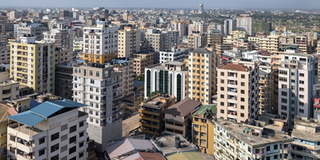
Dar es Salaam. Tanzania’s commercial capital has strengthened its position as East Africa’s high-cost rental hub, overtaking traditional regional giants such as Nairobi in prime property premiums.
According to the 7th edition of the Africa Real Estate Report 2026/27, launched last month by global property consultants Knight Frank, a ‘selective recovery’ is driving value growth across the continent.
The report, titled The Ultimate Guide to Africa’s Real Estate Markets, highlights a performance-led cycle in which the Democratic Republic of Congo (DRC) has emerged as the regional leader in rental costs.
Tanzania and Kenya rank among Africa’s top 15 markets, while Zambia and South Africa represent high-performing locations in the Southern African region.
Dar es Salaam’s dominance is particularly evident in premium residential areas.
Prime properties in Oyster Bay and Masaki command monthly rents of $3,500, comfortably exceeding Nairobi’s $3,100 average.
By comparison, Kinshasa’s prime four-bedroom villas attract a staggering $8,000 monthly due to a persistent shortage of internationally compliant Grade A stock.
"Kinshasa remains a landlord’s market," the report notes, citing demand that consistently outstrips available supply.
This shortage sets a high regional benchmark, while locally the momentum remains equally strong.
"Tanzania’s real estate market in 2026 is on a steady growth trajectory," the report states.
"Investment activity remains concentrated in Dar es Salaam, Dodoma, and Zanzibar, where opportunities span commercial, residential, and industrial assets," according to the document.
Major infrastructure projects, including the Standard Gauge Railway (SGR) and improvements to the Port of Dar es Salaam, are key catalysts.
"Recent improvements in port efficiency and cargo-handling capacity are reinforcing demand for logistics space," the report says.
This is creating ripple effects across residential and office sectors as multinational firms benefit from improved trade corridors.
Rental charges are further influenced by strong demand for specific locations, with the report observing that: "Premium coastal properties, particularly on the Msasani Peninsula, achieve rents of over $3,500 per month, reflecting their superior location and amenities.”
There is a clear shift towards gated communities and luxury apartments as tenants prioritise security and lifestyle choices. The industrial and logistics sector remains a ‘standout performer’, with prime warehouse yields reaching 10 percent, matching the DRC and Zambia in investment appeal.
"The industrial and logistics sector remains one of the strongest-performing asset classes," notes the report’s expert insight.
In the office sector, a ‘flight to quality’ continues to sustain high prices.
"Occupiers are placing greater emphasis on building quality, operational efficiency, and reliability of essential services, including backup power," the report explains.
While the market is slightly tenant-favourable, prime Grade A rents remain stable at $13 to $15 per square metre (psm), with Masaki reaching up to $20 psm.
Retail maturity is also evident, with malls such as Mlimani City and Morocco Square commanding rents of up to $40 psm.
According to the report, success now favours precision over scale: "Success in the upcoming period will favour developers and investors who deliver quality, flexibility, and specialisation."
Maskani Real Estate Tanzania owner, Mr Paul Msabaha, said the sector needed a more efficient system to connect property seekers with owners.
As infrastructure and policy reforms continue, Dar es Salaam is set to remain East Africa’s most expensive residential hub for the foreseeable future in the region.
Register to begin your journey to our premium contentSubscribe for full access to premium content