Those rules exist like terms printed on a real lifeboat ticket, promising that if the boat leaks, if the waves rise too high, you have a right to expect the captain to act.
Imagine this. You have spent your life rowing steadily in rough waters, carrying your family, your community, your responsibilities.
You trusted that the lifeboat would stay sturdy, that the person in charge, the captain, would keep it afloat, guiding you safely to shore when storms hit.
As a good person that you are, you believed in the promise written on your ticket, the rules of the voyage, that the boat’s leadership would ensure smooth sailing, safety, and protection even at the end of your journey or when a storm hits.
But then, just a few meters from the shore, the boat starts leaking. You notice the captain and officers nodding off, ignoring the cracks, and hoping no one notices.
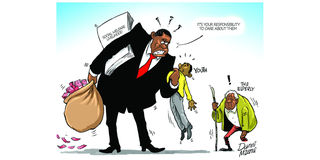
You call out, but they shrug, telling you that one of your family members should take care of things because in other boats, things are like that.
“That’s just how it works,” they say, as though the fact that you bought the ticket, paid your dues, and trusted them means nothing.
The ticket you hold is not a suggestion. It is a guarantee. The voyage rules clearly state that every passenger is entitled to safety, support in times of weakness, and care when they can no longer row for themselves.
Those rules exist like terms printed on a real lifeboat ticket, promising that if the boat leaks, if the waves rise too high, you have a right to expect the captain to act.
But instead of fixing the leaks, the captain lets the water in, telling you to rely on your own family.
But some of your family members scramble to bail out water with empty buckets, while others argue about whose turn it is to row, and the captain’s crew continues to snooze.
Some passengers fall behind, some get tired, and some simply resign themselves to the slow rise of water around them.
This is captain’s negligence in action, a system designed to protect, leaving the most vulnerable to fend for themselves while the one entrusted to steer the boat naps on duty.
The consequences are obvious.
Elderly passengers struggle to access care. Families are forced to cover burdens that should have been guaranteed as part of the journey.
Support programs are announced with grand fanfare, only to vanish before they reach the passengers who need them most.
Delivering only a fraction of the protection promised on the ticket is not efficiency. It is betrayal.
And yet, we keep rowing quietly. We watch as the captain dozes, hoping that somehow the leaks will stop themselves.
We assume that the ticket alone will carry us safely.
But tickets do not repair boats.
Rules do not bail water. Promises do not patch cracks.
Survival depends on action, on vigilance, on refusing to drift while someone else pretends to hold the lifeline.
It is time to wake up. The ticket you hold, the agreement of this voyage, is more than paper. It is a demand for accountability.
Care for vulnerable passengers is not charity. It is part of the captain’s duty.
Protection during storms is not optional. It is built into the responsibility of leadership.
If the captain cannot fulfill these duties, passengers must speak up, organize, and insist that the boat be steered properly.
Its safety depends on integrity, responsibility, and action. If we let negligence go unchecked, the waves will not wait.
Do not let the captain’s slumber dictate your fate. Stand up. Demand action. Hold the ticket high. Wake up.