Children’s screen time can impact their quality of life
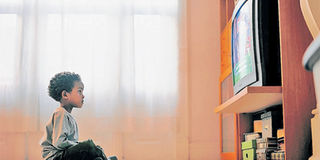
A child watching TV.Findings of many studies show that sleep terrors, nightmares, sleep talking and tiredness on waking up was associated with long exposure to Tv. PHOTO|THE DAILY BEAST
What you need to know:
People have been arguing about the negative impact of the advancing technology, yet, major debate is being focused on morals, communal life and education.
In recent years, we have witnessed a major revolution in electronics and technology. But what we haven’t realised is that this phenomenon is gradually changing every sphere of man’s life—especially health.
People have been arguing about the negative impact of the advancing technology, yet, major debate is being focused on morals, communal life and education.
However, here in Tanzania, there isn’t much being talked about in the health perspective—especially the impact of watching television (TV), playing video games and the use of cell phones.
TV, computers, smartphones, tablets, video games and other electronic media devices have become increasingly available and accessible to children and adolescents.
The exposure to these devices means increased number of hours spent on surfing on internet, watching TV, or playing video games.
I have read a number of studies done in different countries, which show varying levels of exposure to these devices and how this impacts health.
With the advancing technology, the devices have become more portable in the sense that children can carry them anywhere. This has also made parental control much difficult and far less manageable.
Impact on quality of sleep
Some parents are using TV for consoling their children and some use it for babysitting. Some parents use TV as sleeping aid—but we need to also look at the other side of the coin—especially the impact of this on the quality of sleep and relaxation.
Recent studies have shown that time spent on these devices has the reciprocal relationship on the quality of sleep that a child or adolescent get.
The use of multiple devices, such as, TV and video games indeed worsens the effect of quality of sleep.
There have been explanations regarding the possible mechanisms on how this can cause impaired sleep quality—most of them being, displacement of sleep initiation due to prolonged and late-night TV viewing.
However, light emitted from TV screen and other devices may affect the natural rhythm of sleeping circle.
Human beings have a sleeping circle that is scientifically known as ‘circadian rhythm’ with different phases in it.
Each phase in the ‘circadian’ is essential in ones’ life. This is essential for prospective health of an individual.
Some studies have recommended 8 hours sleep as the healthier sleeping time.
In early childhood, sleep is essential for progressive brain development, maturation of different parts of the brain, hence the loss of quality sleep is of concern.
The lack of sufficient or disruption of the sleep ‘circadian’ has significant effect on the neurocognitive development of these children.
The first three years of life are most significant period for the child’s development; the brain is growing faster than any other part of the body.
Cognitive development theory asserts that children’s cognitive capacities at different stages determine if and how they understand issues.
During this period, the child’s brain is more receptive to positive influences and more vulnerable to negative ones than it will be in the later years.
Young children and screen time
Although watching TV is a passive activity, understanding requires skills, in the first few years of life and many of these skills are not developed.
To a baby, a TV is a stream of 2 dimensional pictures that change about every 6 seconds and have no apparent connection to each other.
A six months old baby understands little of what is on the screen, TV colours and sounds may capture his/her attention for brief moments.
Findings of many studies show sleep terrors, nightmares, sleep talking, and tiredness on waking up was associated with long exposure to TV.
Some children have been experiencing difficulty in initiating and maintaining a sleep; a technical term for this is ‘insomnia’, a medical condition.
TV program content is also an issue to children’s education, studies have shown the exposure to age inappropriate TV contents increases with age.
The emotional component of a child or an adolescent is also affected, as explained above, in this period, children develop in different spheres of their life.
In that case, the disruption of the normal sleeping patterns means disrupting normal developmental steps hence expose the child in unexpected behaviours emotionally.
The consistencies of emotional disturbances shown from children’s early exposure to electronics are; aggression, attention problems, externalising behaviours, classroom engagements and emotional instability.
Another phenomenon explained with this is ‘passive TV watching’, that‘s to say when parents are forced to watch TV when its child’s bed time—all being done to protect a child from inappropriate content.
This also has shown to have effect on the sleep quality of the child. Media affects children and adolescents not only by displacing time they spend on it but also influencing beliefs and behaviours.
According to social learning theory, children and adolescents learn by observing and imitating what they see on the screen, particularly when these behaviours seem realistic or are rewarded.
Conclusively, uncontrolled electronic use has more than the moral concerns. Circumstances that diminishes the parental control over electronics should be dealt with since there is no way one can put an end to the advanced technology but one can better the use of the technology.
The author is a medical doctor and research expert on reproductive and adolescent health at Marie Stopes.