Sad tales of poor health services in Nkasi District
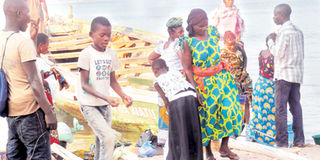
Mvuna isaland residents disembark from a canoe,the island's only means of transport. PHOTO|ELIAS MSUYA
What you need to know:
While the country’s 2007 health policy requires a dispensary to have at least 20 health workers, one dispensary in Nkasi District is manned by three workers. Nkasi is on the country’s list of areas with health workers shortage
This is a sad story of health services delivery at Mvuna village, an Island in Lake Tanganyika; where residents have to contend with the shortage of health workers and ill-equipped health facilities.
At the village, part of Nkasi District in Rukwa Region, tales of villagers making long treks to find a hospital as they navigate the waters of Lake Tanganyika have become part of life.
Yet, Mvuna Island is part of the 13 hamlets of Mandakerenge village with a population of 4,600 people who depend on the one dispensary.
In Nkasi District, one dispensary is manned by three health workers, data from District authorities show, but according to Tanzania’s Health Policy of 2007, every dispensary must have at least 20 health workers.
At Mvuna village, Juma Kakozi narrates how his family lost four children due to treatable illnesses, blaming it on the shortage of health workers and basic health services.
In a recent interview with Your Health, Kakozi, the father of eight children recalls four scenarios when his family grappled with lack of transport facilities as they made efforts to rush their ailing children to distant health facilities on another Island.
“We live on the Island. At different times, we lost four children as we were rushing them to a dispensary in Mandakerenge, on another Island,’’ he says.
“My son was too ill. But we managed to arrive at Mandakerenge Island. Unfortunately we were told by health attendants that they could not help us. They instead advised us to take him to Kirando village,” he recalls, sadly.
“The hospital in Kirando is located on the mainland. We couldn’t make it in time. We lost him,” says Kakozi.
Given the lack of a health facility in the area, families have no choice but to have large families since they have no access to family planning services. Kakozi and his wife for example have eight children.
Since they are still young and are not using any family planning method, chances are high that they will have more children in future. And none of their children goes to school because there is no school on the island.
In other scenarios, he says, three of his children died due to illness in the same circumstances, a few months later. But Mr Kakozi says that some of the problems were attributed to financial challenges that his family was facing.
It costs up to Sh80,000 to ferry a patient from Mvuna village to Mandakerenge dispensary or Kirando Hospital. And for Kakozi, the cost was too high for him and the family at that time.
Kakozi’s wife, Regina says that during the election campaigns in 2015, politicians promised to provide health services in their area, but two years down the line, there are no signs of improvement.
Residents re-locate to find healthcare
As Your Health surveyed the village, one brick-layered building captured its attention. It’s a temporary building without doors and windows.
Elias Mlea, a village hamlet chairman, says the building is currently the only place where health services can be provided, albeit not to the extent that would solve the villagers’ health problems.
The building was put for emergency services just in case of disease outbreaks, such as cholera, says Mlea.
Other residents in the village have decided to relocate their families to other villages in pursuit of better living conditions and places with basic health services.
One of the residents, Elizabeth Yamsebo, says, “We have sent our nine children to another place in Kalungu village so that they could go to school and get health services.”
“We, as parents have remained here in Mvuna to carry on with fishing activities. If someone falls sick here, we must fuel boats to rush to another Island for health services,’’ she explains.
Regina says, “When the time of delivery comes close, pregnant women usually relocate to Mandakerenge or Kirando so that they can access maternal health services,” she adds.
Efforts have been made by the local authorities to ensure that a health facility is constructed in the area but to no avail, says one local leader, Jonah Mwaliwa.
But the problem is not limited to Mvuna village alone. Information obtained from the district authorities paints a gloomy picture.
On the Islands of Lake Tanganyika, including Mandauhuru and villages like Mkinga and Kalungu, the story of health services is not a promising one.
Some of the hamlets are not reachable by road. It’s only by boats or forging the way on foot. This includes, Ntanga, Mageuzi, Azimio, Uhuru, Umoja, Jembe ni mali, Mwendapole, Mbereketwa, Juhudi, Majao, Kamsokaya and Mwila.
The North Nkasi Member of Parliament, Mr Ally Keissy says he is aware of the health situation; however, he is banking on the efforts by the government and political leaders to deal with the matter.
Health facilities shortage
Data obtained from Nkasi district council show a shortage of 52 per cent of dispensaries, having 44 dispensaries out of in the 90 villages of the district.
Apart from dispensaries, the district lacks 21 health centres having 53 out of 74 that are required.
Furthermore, the district has no hospital but it depends on the Mission hospital located there.
In terms of health workers, data shows there is a shortage of 74 percent in which 353 workers cover the gap of 1,345 who are needed.
Within the available 353 attendants, only 198 are trained professionals, equals to 56 percent.
Nkasi district has the ratio of three attendants per dispensary and the ratio of 19 attendants out of 35 in health centres. But the requirements are that every dispensary must be served by 20 attendants
The district hospital has 80 attendants but the need is 200.
The Nkasi District Executive Director, Julius Kaondo says the problem of health services in Nkasi District has a long history, dating as far back as the era of independence.
“It is true that we don’t have a hospital, but we have a health centre. In case of wards and villages, we have directed leaders to construct health centers and dispensaries. They must now lay the groundwork for constructing them,” he says.
He suggests that the islands which depend on fishing for their economy have been given 20 per cent of fishing revenue to contribute to social services developments.
In terms of maternal health, he says the women who deliver in health centres have been increasing from 48.5 per cent to 84 per cent in 2015.
According to the Minister of Health, Community Development, Gender, Elderly and Children, Ummy Mwalimu, Rukwa is among the nine regions which have been put on the list of areas with shortage of health workers.
She tells Your Health that the government has employed 258 medical doctors in the 2016/17 financial year that will be distributed to the regions and districts including Nkasi.
Also she says, there are 3,200 health posts of which the employment procedure was expected to be completed on September 30. The minister also pointed out on the 52,000 civil servants posts, some that are meant for the health sector.