High operating costs hit city commuter train, reveals operator
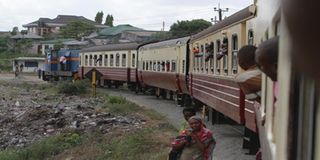
A commuter train chugs along in Dar es Salaam. Calls have been made to subsidise the train that ferries between 4,800 and 5,000 passengers daily at a fare of Sh400 a ride PHOTO | FIdelis felix
What you need to know:
That makes the possibility of running the project popularly known as the “Mwakyembe Train” sustainably doubtful.
Dar es Salaam. Traffic jams in Dar es Salaam cost the economy some Sh4 billion a day. Man-hours are wasted and fuel is used excessively. Even the city commuter train service designed to help residents is operating at a loss of Sh2 million daily.
That makes the possibility of running the project popularly known as the “Mwakyembe Train” sustainably doubtful.
It is understood that wagons used by the commuter are inappropriate for short distance and they are too heavy to be run by one engine. Each wagon, according to experts, weighs 30 tonnes before carrying any person.
“One engine cannot pull nine wagons. The wagons are not meant for commuter train; they are for long distance travels,” Tanzania Railway Limited (TRL) managing director Kipallo Kisamfu told BusinessWeek last week. Due to the heaviness of the wagons, two locomotives are used at once to pull nine wagons. According to Mr Kisamfu, each wagon consumes at least 900 litres of fuel every day.
“If we had proper trains to provide commuter services, the fuel consumed could be little; the wagons would not be as heavy as the ones we are using now which forces the engines to consume more fuel,” said Mr Kisamfu, himself an engineer.
An improper turnaround for the commuter train contributes to the loss, according to Transport ministry expert Hassan Shaban. Without the proper turnaround, the commuter train is forced to use two locomotives: one at the front and the other at the back. That increases operational costs.
“Both locomotives work at one time and more fuel and lubricants are used,” said Mr Shaban.
Because it is not meant for commuter services, the train requires a lot of employees to open and close doors, sell tickets and announce every stage it had reached.
At least four drivers are required each day to run the commuter train, instead of only two.
There is a shift for drivers. Two have to operate in the morning and two in the evening. “According to the labour laws, one person is required to work for not more than eight hours. You can’t overwork a driver from 4:00 am until night.”
“But with modern technology, only two drivers operate: one in the morning and one in the evening. Appropriate commuter trains have automatic doors which are assessed by the driver who can open and close them. There is no need for many workers, a situation that brings operating costs down,” said Mr Kisamfu.
Dependency on subsidy
The former Tanzania Zambia Railway Authority deputy managing director, Dr Damas Ndumbaro, said it was not surprising for the commuter train to operate at a loss because that was the situation worldwide. “If you observe the performance of commuter trains worldwide you will realise that 90 per cent of them depend on government subsidy,” he said.
He called on the government to subsidise operations of the commuter train due to its importance to economic growth.
The money spent to subsidise is less than the loss incurred in traffic jams and which the government can incur when people working in small and medium enterprises fail to arrive at their work places on time.
“Data shows that Dar es Salaam loses Sh4 billion due to traffic jams daily….You cannot compare this money to the Sh2 million that the government spends each day to subsidise operations of the commuter rail service,” he said.
Britain’s Institute of Economic Affairs – a think tank – estimates that some six billion sterling pounds (over Sh15 trillion) of taxpayers’ money is spent on subsidising the rail sector each year.
In the US, the National Railroad Passenger Corporation, Amtrak, is estimated to have received nearly $40 billion (about Sh64 trillion) in taxpayer subsidies since its founding in 1971, and has never made a profit.
It was basing on such a background that a law was enacted in 2008 that obliges various states in the US to share the costs of running the trains with Amtrak as a way of reducing federal support for the corporation.
A February 2013 update by the Oxford Economic Group showed that Japan, France, Germany, China and South Korea were scrambling for a stake in a project to build a high-speed rail system which will link Johannesburg and Durban. There was no proof that the venture will operate profitably.
Mr Philippe Roch, the director of Alstom Transport South Africa, is on record as having once queried whether the Johannesburg-Durban route would be profitable without government backing.
His doubts were based on the fact that the Gautrain, South Africa’s only current high-speed rail line, which links Johannesburg and Pretoria, is subsidised by the state, partly due to lower than expected passenger figures.
The train needs to carry 110,000 passengers per day to break even, but it carries some 38,000-40,000, local media said in August. The government is subsidising the rail at a cost of R300 million ($33.5 million) per year.
“Considering what is happening elsewhere in the world, I see no reason why the government should stop subsidising the railway transport…we should not even think about increasing fares,” said Dr Ndumbaro, a lawyer.
The duty of the government, he said, was to purchase required equipment so as to reduce operating costs and make the commuter train more efficient.
National Institute of Transport rector Zacharia Mganilwa, said it was not a surprise for commuter trains to receive government subsidies to stimulate the economic growth.
“The problem is that politicians interfere in technical issues. I am surprised to hear people saying the commuter train operates at losses because such losses do not make news to those of us who work in this field…people should only talk after making research on how commuter trains operate internationally,” said Dr Mganilwa.
According to him, if you compare an economic impact of congestion in the city and the subsidy, one will automatically believe that it is good for the government to subsidise the commuter train.
“Even in the coming Bus Rapid Transit project, it is a must for the government to subsidise it either by tax exemptions or by any other means…If that is not done, the fares to be set will not make an economic sense to many,” he said.
Dr Mganilwa urged TRL to use high technology to run commuter train services rather than outdated technologies.
He said, for example, the ticketing system could be electronic so as to reduce manpower which in turn will reduces the running costs.“The government can put automatic machines at every stage, like those present at airports in which at these stages a passenger can get a ticket automatically,” he said.
According to him, the use of outdated locomotives increases the operating costs as the fuel spent on one trip from the city centre to Ubungo can be used for up to three trips if appropriate locomotives are used.
New sets
However, Mr Kisamfu said for the commuter train to operate effectively it needed at least four sets of modern commuter trains which are commonly known as diesel multiple units (DMUs).
“We can’t tell exactly when we will receive these DMUs but the issue is included in the Big Results Now. We expect to purchase modern commuter trains in the near future,” he said.
Mr Kisamfu said DMUs were easy to operate and cost-effective. “Each wagon has a small engine which consumes very little fuel. They have automatic doors. That means they do not require any one to open or close them. So with DMUs, we don’t need many employees,” he said.
Moreover, with DMUs wagons can be reduced or increased in every trip depending with the number of passengers present at a time.
Recently it was reported that the 12-kilometre commuter train services had become a burden to the government because a loss of Sh2 million was incurred daily.
According to TRL public relations manager Midladjy Maez, since the commuter train services started late October 2012 a loss of Sh668 million had been incurred due to higher operational costs and the minimal revenue. Transport minister Harrison Mwakyembe told Parliament recently that the commuter services were launched partly to supplement TRL’s dwindling revenue after the suspension of up country trips.
The commuter train, according to Dr Mwakyembe, has been accounting for 50 per cent of TRL earnings.
The commuter train ferries between 4,800 and 5,000 passengers daily at a fare of Sh400 each, according to Mr Maez.
Rail benefits
Experts say many benefits of rail travel come from reducing road externalities — such as pollution or safety hazards — that are harder to calculate in strict financial terms.
Recent research by a team led by economist Rafael Lalive of the University of Lausanne in Switzerland revealed that increasing rail service frequency by 10 per cent reduced road accidents by 4.6 per cent.
Similarly, increased passenger rail service reduced car and motorcycle use by 3 per cent on commutes and leisure trips alike.