More banks to follow Twiga Bancorp path as NPLs bite
What you need to know:
NPL is the sum of borrowed money upon which the debtor has not made his scheduled payments for at least 90 days. An NPL is either in default or close to defaulting.
More banks to follow Twiga Bancorp path as NPLs bite
Dar es Salaam. At least three more banks are most likely to go Twiga Bancorp’s way if nothing is urgently done to contain their levels of nonperforming loans (NPLs).
NPL is the sum of borrowed money upon which the debtor has not made his scheduled payments for at least 90 days. An NPL is either in default or close to defaulting.
Government-owned Tanzania Women Bank (TWB), privately-owned Ecobank Tanzania and Efatha Bank which is linked to Efatha ministry and foundation, are some of the financial entities that could soon follow in the fate of Twiga Bancorp if their management teams do nothing to contain their NPL ratios, The Citizen’s analysis shows.
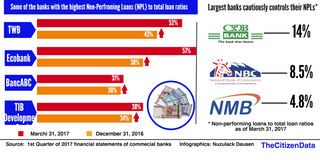
The three banks have accumulated NPL ratios that exceed 50 per cent of their total gross loans, with that of Efatha reaching 63 per cent.
Bankers believe that an NPL that exceeds 15 per cent of a commercial bank’s total gross loans may indicate a point of no return.
And, in its 9th edition of Tanzania Economic Update, the World Bank raised an alarm over rising NPLs – which had reached an average of 9.5 per cent in 2016 from 6.4 per cent in 2015.
It specifically mentioned the government-owned TIB Development Bank which had an NPL ratio of 38 per cent during the first quarter of 2017.
However, commercial banks’ financial results for the first quarter of 2017 show that the situation is even more nerve-racking and daunting in Efatha, TWB and Ecobank Tanzania.
Twiga Bancorp story
Twiga Bancorp - which came into existence in 1992 as a wholly-owned subsidiary of the formerly state-owned National Bank of Commerce (NBC) before a change of mandate - was put under the Bank of Tanzania’s statutory management last year due to lack of capital and increasing NPLs.
Though the BoT’s own Banking and Financial Institutions (Capital Adequacy) Regulations, 2014 increased the minimum core capital for commercial banks to Sh15 billion from the previous Sh5 billion, Twiga Bancorp had no capital but had instead accumulated a staggering debt of Sh21 billion.
Its NPL ratio had reached 34 per cent as of early 2015.
Speaking on his first year anniversary as Head of State in November last year, President John Magufuli took a swipe at politicians from both CCM and the opposition, accusing them of being the ones behind an escalation in NPLs in commercial banks.
In apparent reference to Twiga Bancorp, President Magufuli said he smelt a rat during his early days in office when he realised that the state-owned financial entity was sinking.
“If you search through the loan portfolios for most of the struggling banks, you will realise that most of the bad loans have been issued to politicians from both CCM and the opposition….I want you, journalists, to dig deeper into this issue so they can be ashamed of what they are doing,” he said.
Tanzania Women’s Bank
The establishment of a special bank to cater to women’s financial needs in 2007 put Tanzania on the world map regarding how the country cares about women. Besides, the intention that TWB would ultimately float its shares to the public and list on the Dar es Salaam Stock Exchange (DSE) rekindled the hope that the bank would be professionally run.
If what the then minister for Community Development, Gender and Children, Ms Sophia Simba, said in Parliament during the 2015/16 budget meeting had anything to go by, then TWB had hit the ground running before politics founds its way into the entity.
Requesting Parliament to approve Sh31.421 billion for her ministry’s 2015/16 financial year, Ms Simba said TWB, which opened for business in July 2009, operated successfully during all the past years and that it registered a profit before tax of Sh141 million in 2014.
She said, though with a capital base of Sh8.746 billion, the bank – which is owned largely by the government and other 160 small investors - issued Sh12.469 billion loans to some 10,847 entrepreneurs in 2014/15.
That was enough to entice the then member of the Parliamentary Committee on Community Development, Agness Hokororo to urge the government to recapitalise TWB to meet the BoT minimum capital threshold.
“The committee wants the government to disburse all the money that this Parliament has approved for the TWB during the past few years,” she said, outlining a number of misplaced pledges by the government to inject more capital into the financial entity.
Errors
Fast forward to 2017, a report by the Controller and Auditor General (CAG) shows that TWB has lost a mandate of operating as a bank as its capital has fallen below the legal threshold.
In his latest report – which was released in Parliament last month - the CAG, Prof Musa Assad, revealed a number of flaws in TWB’s financial books, including the fact that it disbursed Sh655 million as loans without confirming the existence of its borrowers. Besides, securities for the loan amounting to Sh200 million had not been registered with appropriate authorities.
“I also noted that loans of Sh330 million were issued to customers whose collateral was not valued while Sh335 million was loaned to borrowers whose business licences had expired,” reads part of the report.
It may not be amazing therefore that in its financial results for the first quarter of 2017, TWB reported NPL ratio of 52 per cent from 43 per cent in December 2016.
The bank, which holds shareholder funds of Sh5.128 billion – contrary to the Sh15 billion capital as required under the Banking and Financial Institutions (Capital Adequacy) Regulations, 2014 – has issued loans, advances and overdrafts totaling Sh14.13 billion as at March 31, 2017.
Ecobank Tanzania
Though its balance sheet remains promising, the level of NPL ratio remains shockingly high at Ecobank Tanzania.
Much as its international footprint should have given the bank a lot of professional breathing space and best practice to effectively determine who deserves the loans and who does not, Ecobank Tanzania’s NPL ratio rose to 57 per cent as at the end of March 31, 2017 from 38 per cent in December 2016.
The bank – which opened its business in Tanzania in 2010 – registered a loss of Sh4.755 billion during the first quarter of this year, as net interest income and earnings from fees and commissions dropped.
With NPL to total gross loans ratio of 31 per cent, BancABC is also in the company of financial institutions that have highest ratios in loans that are either in default or close to being in default
Lacklustre start
Most banks ended the first quarter of 2017 on a lacklustre note as they concentrated on internal consolidation while battling NPLs.
For the National Microfinance Bank (NMB), the NPL ratio dropped from 4.8 per cent at the end of December 2016 to 4.6 per cent in the first quarter of 2017.
The bank posted a profit of Sh40.9 billion during the first quarter, from a total annual profit of Sh153.8 billion in 2016. CRDB Bank maintained its NPL ratio relative to its total gross loans at 14 per cent. However, its net income dropped from Sh34.282 billion during the first quarter of 2016 to Sh26.188 billion during the first quarter of 2017.
As for NBC, its operating income (before tax) dropped to Sh877 million during the first quarter of 2017 from Sh2.439 billion during a similar period in 2016 while a net income fell from Sh1.5 billion to Sh517 million.
NBC managed to decrease NPLs from Sh76.787 billion as of December 2016 to Sh69.8 billion during the first quarter of 2017, to reduce the ratio from 9.1 per cent to 8.5 per cent.
Barclays, which registered a loss of Sh9.8 billion during 2016, woke up to register a Sh4.1 billion profit before tax during the first quarter of 2017.
Similarly, the bank’s NPL ratio dropped from 12.4 to 11.9 per cent during the first quarter.
Standard Chartered Bank did well during the first quarter of 2017, with its net income (after income tax) growing to Sh9.6 billion from Sh5 billion during a similar period last year.
However, its NPL ratio grew by a marginal 0.1 to reach 9.1 per cent during the first quarter of 2017.
KCB’s NPL ratio dropped to 7.6 from 8.2 per cent as its net income rose to reach Sh2.4 billion during the first quarter from Sh1.4 billion during a similar period last year.
Bankers say with most of their customers – scattered across agriculture, real estate, trading and manufacturing sectors – facing a difficult economic environment last year, the only available option was to delay their debt repayment schedules.
“This was particularly due to the economic challenges that most customers faced last year. With the economic hardships, some customers failed to repay the loans as planned,” NMB managing director Ineke Bussemaker told The Citizen.
Her CRDB counterpart, Dr Charles Kimei, shared similar sentiments. “We had to provide for an increased amount in NPLs as some of our customers - mostly in agriculture, trading and in tourism - faced a challenging business environment,” he said as he released the bank’s audited financial results for the 2016 calendar year about three weeks ago.
The hardships were mainly a result of a lack of spending by the public sector which – in poor economies – is supposed to be aiding the growth of the private sector.