Reasons behind education woes in Zanzibar

What you need to know:

Zanzibar’s five-year poor performance in Form Six exams is due to shortage of teachers and classes as well as lack of selfawareness among students
Education stakeholders have attributed Zanzibar’s five-year poor performance in form six exams to shortage of teachers and classes as well as lack of self-awareness among students.

Data obtained from the National Examination Council of Tanzania (Necta) show that with 48 per cent, schools based in Zanzibar have dominated the list of the five worst performing schools during the 2014-2018 academic years.

Shortage of teachers and classrooms has led to over-crowding in classes where one classroom can have up to 150 pupils hence ineffective teaching, posing a big challenge to the attainment of quality education.

Zanzibar Head of Secondary Schools Association (Zahossa) and the ministry of Education and Vocational Training pledge to work round the clock to solve the multiple challenges.

This year, Island regions, including Zanzibar West, North Pemba and South Pemba were the three last ranked regions placed at 27th, 28th and 29th respectively.

Ms Asya Issa, Secondary schools education director in the ministry of Education (Zanzibar), acknowledges the challenges facing schools in Zanzibar and is optimistic that efforts being put to solve such challenges will reap rewards. .

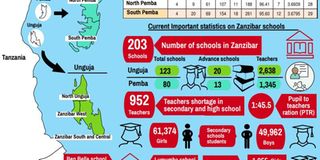
Zanzibar has a shortage of 952 secondary school teachers. As a result, secondary schools in Zanzibar have 5,324 teachers teaching a total of 114,946 students, with those of form five and six being 3610.

Zanzibar has 203 secondary schools, 20 being Form Five and Form Six schools.

Founded in 1924, Ben Bella secondary school is among the schools which have been affected by challenges in the education sector.

The Unguja-based girls’ school has appeared three times in the list of the five worst performing schools in the Form Six final exams in the last five years.

Ben Bella headmistress Zainab Mgunda says Pupils to Teachers Ratio (PTR) at her school indicates that one teacher teaches up to 150 students.

“For effective teaching, you need a reasonable class size of 45 students as recommended by the government, but due to shortage of classes it was in the past not unusual here to find a form six class of 150 students,” she says.

Ms Mgunda says teachers often struggle with large class sizes. “Low student to teacher ratio allows the teacher to better manage the class. In a large classroom setting behavioral problems can rapidly escalate,” she says.

Pulling itself out of the worst five performing schools is an improvement, thanks to academic camps that were meant to bring together students for discussion few months before the beginning of the National exams.

Ms Mgunda is optimistic that more improvement will be recorded in next year’s examination results, banking her hopes on the current classroom size.

“As of now, teachers to students’ ratio stands at 1:30. This is partly because majority of students shifted to other schools due to various reasons,” she explains.

The reasons among others include unpromising performance of Ben Bella and severe regulations, including suspension and expelling, which were set up by the school to control lazy and undisciplined students.

As it stands, Ben Bella has 46 teachers teaching 850 students of form 1-6.

The number of teachers for Form Five and Six classes with about 100 students stands at 10 against the demand of 11 teachers.

To address the challenge of congestion in a single class, she says, plans were underway to build more classes.

“Plan to increase classes is on our radar. We wrote a letter to Mjimkongwe Executive Director to request for a plot to build more classes and it’s being worked upon,” says Ms Mbwana.

Lumumba, one of the best secondary schools in Zanzibar, also faced similar hurdles, saying that high student to teacher ratio was hampering performance.

However, despite high pupils to teacher’s ratio (PTR) of 1: 70, the co- education school with 27 teachers teaching 850 students of Form One to Six, is performing better.

“Despite high PTR, we are performing better though not to our potential, thanks to teachers and students’ commitment in teaching and studying respectively,” says Mr Mussa Mussa, the school’s headmaster.

“There are many social benefits to small classroom sizes, including developing better cooperative spirit and unity.

“Smaller classrooms have a more homogenous environment and unified solidarity, providing the best environment possible for all students to excel,” he says.

As it happens, Lumumba, with 11 teachers teaching science subjects, has 125 and 172 Form Five and Form Six students respectively.

It had 17 division one, 49 division two, 45 division three and zero division four in the 2018 Form Six national examination results, according to Mr Mussa.

Mussa says the 59 year-old school secured fourth position out of 20 schools, behind Sos, Feza and Suza secondary schools and produced the best student in the combination of PCM countrywide.

“We don’t have that big challenge of inadequate number of teachers compared to other schools. We are among a few schools with special talented, so the government treats us with special care. Thanks to the government’s positive reaction whenever it comes to a request for teachers,” says Mr Mussa.

“There is greater academic success when there is more one-on-one attention provided to each student and that is what we do,” he says, adding, “We take high performing students and put them in group discussions with the least performing students so that the latter can be assisted by the former.”

Mr Mussa also cites motivation to teachers who finish syllabus earlier than expected as a contributing factor to the good performance of Lumumba.

Also teachers are being rewarded unspecified amount for each ‘A’ students get in the national exams in their respective subjects.

In an endeavor to narrow the existing space of teacher’s shortage, the ministry of education is taking teachers from Nigeria to volunteer, according to Ms Issa.

In a space of four years dating back to 2015, about 50 teachers from Nigeria were hired.

Local media had in the past quoted the Island government as saying that Zanzibar has also benefitted from voluntary teachers from Voluntary Service Oversees-UK, Peace Corps-USA, JICA-Japan and KOICA of South Korea.

“We have been doing all that we can to help students perform well in all subjects especially science subjects,” Ms Issa says.

Zahossa secretary general, Fadhil Mshamba, says following poor performance in some schools, they were forced to come up with qualifying exams for Form Five students before entering Form Six.

Also to address the challenge, he says, in 2016 they had to establish academic camps system for Form Four and Six students few months before the exams.

“Students were not too keen on their studies due to globalization. Now they have no choice but to concentrate due to the current situation,” says Mr Mshamba.