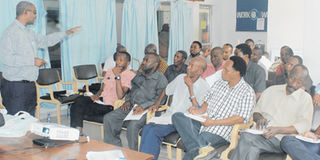
Dr Christopher Nzava address ambulance drivers during a training session at Amana Hospital last week. PHOTOI ELIZABETH TUNGARAZA
What you need to know:
However, while they are in a rush to save the life of a patient who needs an emergency healthcare, be it an expectant mother or a newborn baby, ambulance drivers have to exercise great care to ensure that they reach their destination on time in their quest to save lives while ensuring the safety of other road users. This task is not easy in big cities with full of reckless commuter bus drivers, motorists and motorcycle taxi drivers as it is the case in Dar es Salaam.
Giving way to an ambulance whenever motorists see them or hear their sirens is part of community responsibility. However, due to some unavoidable circumstances, sometimes ambulance drivers find it hard to maneuver their way through a thick traffic jam during peak hours in our roads, especially big cities like Dar es Salaam.
However, while they are in a rush to save the life of a patient who needs an emergency healthcare, be it an expectant mother or a newborn baby, ambulance drivers have to exercise great care to ensure that they reach their destination on time in their quest to save lives while ensuring the safety of other road users. This task is not easy in big cities with full of reckless commuter bus drivers, motorists and motorcycle taxi drivers as it is the case in Dar es Salaam.
Ambulance drivers, dispatchers/supervisors and escort nurses have the obligation to ensure that patients are safe and comfortable during the journey and arrive on time at the hospital for their appointments or emergency treatment.
In trying to ensure that patients reach health facilities safe and on time, Comprehensive Community Based Rehabilitation in Tanzania (CCBRT) and Dar es Salaam Regional Health Management Team (RHMT) conducted a training course for ambulance drivers, dispatchers/supervisors and escort nurses in a bid to improve the effectiveness of existing emergency ambulance transport in the city in terms of shortening service time and improving patients’ care during ambulance transport.
The initiative, undertaken with the financial support of Canadian government through Global Affairs Canada, is part of CCBRT’s efforts to strengthen comprehensive maternal and newborn healthcare in Dar es Salaam. The special-tailored awareness raising initiative was part of implementation of programme for making motherhood safe in Tanzania. The RHMT has engaged ambulance drivers in the training workshop as part of an effort to curb high maternal and newborn mortality rates in Dar es Salaam.
Petri Blinkhoff, a Senior Technical Advisor Public Health at CCBRT believes that by strengthening the role of ambulance drivers, dispatchers/supervisors and escort nurses in the continuum of care for mothers and newborn, the initiative helps strengthen a functioning referral system and therefore generally improve the quality of care especially in times of emergency.
The two-days training, which took place at Amana Hospital in Ilala District, Dar es Salaam on Tuesday and Wednesday engaged some 40 ambulance drivers who work for hospitals and health facilities in Ilala, Temeke, and Kinondoni municipalities. The drivers were equipped with necessary knowledge in order to make the emergency referral transport system in Dar es Salaam more efficient, effective and reliable in order to save the lives of the newborn and mothers.
The awareness training had been tailored to equip the drivers with necessary knowledge on the standard operating procedures for transporting emergency cases; dealing with health facilities, providers and patients; the dos and don’ts of basic first aid; infection prevention including cleaning and decontaminating the vehicles; road safety rules, customer service and professionalism as well as essential knowledge on maternal and newborn emergency transportation.
According to Blinkhoff, the duty of saving lives of Tanzanian mothers and newborn is everyone’s responsibilities and in order to achieve this, he said, a multi-sectoral effort is needed with the region’s departments of the health, roads and the Police Force working together to solve infrastructure problems.
“An ambulance is more than just a means of transportation from point A to point B. With an effective emergency transport system, Tanzania can minimize the avoidable factors contributing to maternal and newborn mortality and morbidity,” said Blinkhoff.
Available statistics show the magnitude of the problem. Despite commendable efforts in place, Tanzania has failed to achieve her target of reducing maternal mortality rate to 193 per 100,000 live births by December 31, 2015.
However, according to the UN report, maternal mortality rate has significantly declined from 870 per 100,000 live births in 1990 to 454 per 100,000 live births in 2010, according to Tanzania Demographic Health Survey.
Furthermore, statistics recorded in the 2012 National Census Report show that maternal mortality rate dropped to 432 per 100,000 live births while the 2013 UN Report showed further reduction of maternal mortality rate to 410 per 100,000 live births.
While the country has achieved the MDG 4 target of reducing under 5 mortality rate, from 166 per 1,000 live births in 1990 to surpass the set 54 per 1,000 live births, it lag behind with curbing the neo-natal mortality rate which stands at 45 per 1,000 live births, according to the 2013 UN Report. Neo-natal deaths make 40 per cent of all under-5 deaths. In 2008 the target was to achieve neo-natal mortality rate of 19 per 1,000 live births by 2015, according to One Plan, 2008.
Speaking during the training, police inspector Yohana Mjema told the drivers that the aim of the training is just to remind them how they should do so that to save the lives of patients especially when they carry a pregnant woman.
He appealed to them to ensure that they communicate with traffic police officers before and after leaving to a certain point to pick up a patient as this will help the traffic police officers to clear the road and allow them to pass without any barriers.
“I understand that all of you know your duties very well but we are here to remind you on how you can rush a patient to the hospital without causing accident and at the same time saving the lives of the ones who are in the ambulance including you,” he noted.
Christopher Mzava, the Regional Emergency Coordinator at Amana Hospital told the ambulance drivers to respect and value their job, urging them to shun behaviours which might endanger the lives of patients during the course of their duty.
“We all have an important role to play and we depend on each other in execution of our tasks. We have to ensure that every important item is in place in the ambulance, things like oxygen, fuel just to mention a few. Having everything in order is like a half way to victory,” he told participants.
One of the participants, ambulance driver, Shukuru Hussein, said the training has equipped them, among other things, with necessary knowledge and understanding on basics of obstetric emergency case transport as well as on standard operating procedures as they apply to their specific role.
“We are confident that we would be able to demonstrate our ability to implement infection prevention and control as stipulated in the standard operating procedures,” said Hussein.
“I’m happy now I’m aware of the dos and don’ts of the basic first aid as well as how to avoid infection and how to decontaminate the vehicle and keeping accurate records before and after an emergency trip,” he said.
For his part, Nia Waziri, ambulance driver, sees reckless driving on the part of other motorists and motorcycle taxi drivers as a major challenge they face while on the road. He appealed to drivers to avoid using mobile phones while driving.
He urged other road users to give way to ambulances whenever they see them or hear their sirens as by doing so they will be contributing in saving the patients.