Djibouti president wins election with 97.8 pecent of vote
Djibouti's President Ismael Omar Guelleh casts his ballot during the Presidential elections at the City Hall polling centre in Ras-Dika district of Djibouti City in Djibouti April 10, 2026. PHOTO | REUTERS
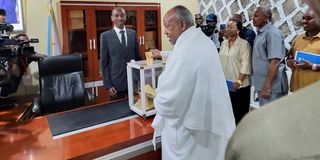
Nairobi. Djibouti's President Ismael Omar Guelleh has won re-election with 97.8 percent of the vote, state-owned Radio Television Djibouti said on Saturday, handing him a sixth term that extends his 27-year rule over the small but strategically located East African country.
Guelleh posted an image of himself with the French word "RÉÉLU" on X, which translates to "re-elected".
The country of less than 1 million people sits on the Gulf of Aden at the entrance to the Red Sea and hosts U.S., Chinese, French, Italian and Japanese military bases. Since 2023, several commercial ships damaged in attacks by Yemen's Houthi militants have docked in the country.
Victory for the 78-year-old Guelleh, who was handpicked in 1999 to succeed his uncle Hassan Gouled Aptidon and whose party dominates national institutions, was never in doubt.
Last October, parliament voted to remove the 75-year age limit for presidential candidates and also scrapped a referendum previously required to approve a new constitution.
Two main opposition parties boycotted election
In Friday's vote, Guelleh faced a lone opposition candidate, Mohamed Farah Samatar, from a small party with no representation in parliament.
Two of the main opposition parties have boycotted elections since 2016, accusing election authorities of lacking impartiality.
Data from state-owned media showed that there was voter turnout of 80.4 percent. In the last election in 2021, Guelleh won with over 97% of the vote.
In contrast to several other Horn of Africa nations, Djibouti has been relatively stable in recent years, and Guelleh's government has invested heavily in port infrastructure to become the main gateway to landlocked Ethiopia.
But human rights groups accuse the Djiboutian authorities of repressing political opponents, activists and journalists. The government has denied allegations of widespread abuses and rejected criticism of the electoral process.
In 2020, security forces quelled rare anti-government street protests, which erupted after the arrest of a former air force pilot who had denounced alleged corruption and clan-based discrimination.