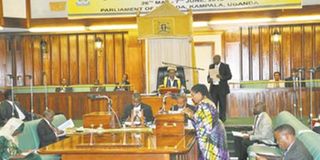
The chairperson of the EAC Committee on Communication, Trade and Investment, Ms Angela Kizigha, addresses a budget session of the Eala, which ended this week. PHOTO/COURTESY, EAC SECRETARIAT
What you need to know:
The 2013/14 budget will also fund completion of the negotiations of the EAC Monetary Union protocol and finance its implementation.
Arusha. The East African Legislative Assembly (Eala) on Thursday approved the East African Community (EAC) budget of $131,806,032 targeting, among other things, to consolidate implementation of the Common Market protocol.
The 2013/14 budget will also fund completion of the negotiations of the EAC Monetary Union protocol and finance its implementation. Other focus areas of the budget are investment promotion and private sector development; co-operation in cross-border infrastructure; and enhancing the extractive and processing industries.
Targeted too by the new financial plan are implementation of the critical activities of EAC Food Security and the mainstreaming of policies, programmes and projects related to gender.
Also passed on Thursday was the Appropriation Bill 2013 and the Supplementary Appropriation Bill 2013, the EAC Secretariat said in a media dispatch on Friday.
The object of the Appropriation Bill, 2013, is to make provision for the appropriation out of the budget for the specified amount of money for the services and purposes of the Community for the financial year ending June 30, 2014.
The chairman of the EAC Council of Ministers, Mr Shem Bageine, moved the motion for amendment to the budget allocated to Eala increasing the specified amount by $776,050 to enable the assembly undertake additional sittings.
The Budget is allocated to the Organs and Institutions of the EAC as follows; the Secretariat ($69,787,824), Eala ($13,806,032) and the East African Court of Justice ($4,279,489). The Inter-University Council for East Africa will get $9,692,785 while $3,203,042 is earmarked for the Lake Victoria Fisheries Organisation.
The budget speech was presented last week by Mr Bageine, who is also Uganda’s minister of State for East African Affairs.
Presenting the estimates, Mr Bageine said that among the identified priority areas, were interventions in the Customs Union leading to establishment of a single customs territory.
He observed that the single customs territory “will crystallize the gains of integration characterized by minimal internal border controls and a more efficient institutional mechanism in clearing goods.”