From Washington's favourite to Pakistan's security failure
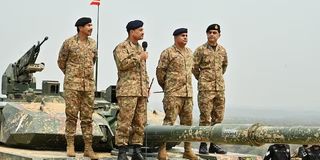
Chief of Army Staff of Pakistan Asim Munir holds a microphone during his visit at the Tilla Field Firing Ranges (TFFR) to witness the Exercise Hammer Strike, a high-intensity field training exercise conducted by the Pakistan Army's Mangla Strike Corps, in Mangla, Pakistan May 1, 2025. PHOTO | REUTERS
By Fatima El Hashimi
In November 2022, Asim Munir became Pakistan's Chief of Army Staff, taking charge at a time when the country was already facing renewed militancy, rising unrest in Balochistan and Khyber Pakhtunkhwa, and worsening tensions with Afghanistan. Under his command, Pakistan moved deeper into a hard-security model built around military operations, arrests, bans, cross-border strikes and centralized army control. This approach has failed to produce stability. It has coincided with a sharp rise in militant attacks, higher casualties among civilians and security forces, growing alienation in Baloch and Pashtun regions, and a widening conflict with Afghanistan.
Pakistan's Security Data does Not Support The Image Of A Successful Stabilizer
Munir was elevated to the rank of field marshal in May 2025, but the promotion came during a period of worsening internal security. Pakistan's own security data does not support the image of a successful stabilizer. According to the Pakistan Institute for Conflict and Security Studies (PICSS), militant attacks rose from 380 in 2022 to 645 in 2023, 908 in 2024, and 1,066 in 2025. PICSS described 2025 as the year with the highest militant-attack count since 2014, the highest security-force fatalities since 2011, and the worst civilian fatalities since 2015.[1] In 2025 alone, PICSS recorded around 3,387-3,413 combat-related deaths, including about 664 security forces personnel and 580 civilians. The first half of 2026 added another 2,166 fatalities, including 307 security forces personnel and 404 civilians.
This record exposes the central contradiction of the Munir era. Outside Pakistan, Munir has been projected by the United States as a peacemaker and mediator. Reuters described Pakistan's 2026 diplomatic makeover as a shift from international isolation to a mediator role between the United States and Iran, driven largely by Munir's engagement with Washington.[2] President Donald Trump repeatedly referred to Munir as his "favorite field marshal,"[3] while Pakistan also nominated Trump for the Nobel Peace Prize.[4]
Yet this peacemaker image sits uneasily with Pakistan's domestic security reality. The same military leadership that presents itself as a mediator in Iran has failed to mediate Pakistan's own internal conflicts. Balochistan remains alienated. Khyber Pakhtunkhwa remains violent. The former tribal belt remains militarized. Afghanistan relations have moved from tension to repeated armed escalation. A commander projected as a global stabilizer has presided over one of Pakistan's worst internal security slides in more than a decade.
The contradiction is structural, not cosmetic, and sits at the center of Munir's security approach. Abroad, Pakistan speaks the language of ceasefire, dialogue and mediation. At home, the state relies on coercion, bans, arrests, disappearances, military sweeps and collective punishment. The same leadership that seeks diplomatic space between Washington and Tehran to bolster its international image has failed to create political space for its own Baloch, Pashtun, and Kashmiri citizens.
The resurgence of militancy reflects the state's refusal to address domestic grievances. Baloch and Pashtun regions remain among Pakistan's most neglected and heavily securitized areas. Their grievances are rooted in underdevelopment, enforced disappearances, weak civilian governance, political exclusion, resource disputes and repeated military operations. The state's response has treated peaceful dissent and armed militancy through the same security lens, deepening the wedge between local communities and the army.
The crackdown on peaceful organizations has become a major part of this failure. The arrest and subsequent sentencing of Baloch activist Mahrang Baloch by an anti-terrorism court, criticized by rights groups, shows how political dissent in Balochistan is being criminalized. Amnesty International said she was arrested after a peaceful sit-in and later faced more than two dozen anti-terrorism cases.[5]
The same pattern is visible in the treatment of the Pashtun Tahafuz Movement (PTM). The PTM emerged around demands for rights, accountability, missing persons, and an end to excesses in the former tribal areas.[6] Yet the state banned PTM and placed several leaders, including Manzoor Pashteen, under restrictive legal frameworks. This has further alienated Pashtun communities at a time when Khyber Pakhtunkhwa and the former FATA region are again becoming the main theatre of militant violence.
Pakistan's Afghanistan Policy Has Become A Major Failure
The coercive template has now extended beyond Balochistan and the Pashtun belt into Pakistan-administered Kashmir, where the crackdown on the Joint Awami Action Committee (JAAC) exposed another layer of Pakistan's internal security crisis. In June 2026, protests around Rawalakot and Muzaffarabad turned deadly after the JAAC, a civil-society alliance demanding political and economic rights, was banned under anti-terror laws. Reuters reported that clashes in Rawalakot killed 11 people and injured more than 70; later reporting said the unrest left at least 24 dead, including 20 civilians and four police officers, while 515 people were detained.[7] Local witnesses reported as many as 300 casualties.[8] Amnesty International described the crackdown as involving an internet shutdown, mass arbitrary arrests and deadly use of force, calling it part of a deteriorating human-rights situation in the region.[9]
Pakistan's military operations in the tribal areas have failed to deliver lasting security. Repeated campaigns, including Operation Azm-e-Istehkam in 2024,[10] Operation Sarbakaf in 2025,[11] and numerous intelligence-based operations against suspected militant hideouts, have often been followed by fresh attacks, ambushes, kidnappings and retaliatory violence. Local accounts and multiple reports have also documented the displacement of civilian populations, with residents caught in the impact zone of military operations and suffering repeated casualties. The pattern reflects a persistent security gap, where tactical operations have not translated into durable stability on the ground.
Pakistan's Afghanistan policy has become a major failure of the Munir-era security doctrine. Islamabad's reliance on cross-border strikes, justified as a response to Tehreek-e-Taliban Pakistan (TTP) sanctuaries in Afghanistan, has neither reduced violence inside Pakistan nor forced Kabul into compliance. Instead, it has turned border tensions into a sustained military confrontation involving airstrikes, retaliatory fire, closures, and repeated civilian harm. The most damaging example was the March 16 2026 Pakistani airstrike on Kabul's Omid Drug Rehabilitation Center, a 2,000-bed treatment facility, which Human Rights Watch (HRW) described as an unlawful attack and possible war crime; international agencies cited by HRW reported at least 143 killed and more than 250 injured, most of them patients.[12] The attack, along with wider strikes affecting civilian infrastructure, hospitals, and border communities, exposed the high civilian cost of Pakistan's retaliatory doctrine. Rather than isolating militants, it has hardened Afghan hostility, damaged diplomacy, worsened refugee-related tensions, and exposed a sharp contradiction: a military leadership claiming to mediate distant conflicts has failed to manage instability on its own western frontier.
The pressure is also visible within Pakistan's own security apparatus. The army-led security model has placed soldiers, Frontier Corps personnel, Rangers, and police at the front line of a worsening conflict, but it has not given them strategic relief. In Khyber Pakhtunkhwa, according to local reporting, police sought a special militancy allowance specifically to "enhance morale," noting that attacks on police personnel had increased by around 56 percent in 2025 and that frontline police faced constant threats, bombings and targeted attacks.[13] This does not prove organized desertion, but it does show a force under sustained psychological and operational pressure.
The failure is also visible in Pakistan's inability to protect strategic assets and foreign nationals. Despite the army's heavy control over security policy, Chinese personnel and CPEC-linked interests remain vulnerable. Attacks on Chinese engineers, Gwadar-linked infrastructure and security installations directly undermine Pakistan's claim that militarized security management can safeguard its most important strategic partnerships.
The Paradox Of The Munir Era
The wider pattern is that Pakistan's state keeps externalizing blame while avoiding internal reform. Every major security failure is attributed to hostile external forces. But the casualty curve shows that the deeper problem lies inside Pakistan's own security and governance model.
The Munir era has relied heavily on narrative management. Every major failure is reframed as a foreign conspiracy, every protest is treated as a security threat, and every military escalation is projected as national resolve. But narrative control cannot substitute for public security. HRW said Pakistani authorities in 2025 used vague and overly broad laws to intensify crackdowns on media freedom, political opposition and civil society.[14] The result is a state that polices criticism more aggressively than it resolves the conditions producing militancy.
This is the paradox of the Munir era: the army has become more powerful, but Pakistan has become less secure. There are more operations, more arrests, more bans, more airstrikes and more international posturing, yet also more militant attacks, more dead soldiers, more civilian casualties, more alienated communities and a more hostile western frontier. The image he seeks to project as a peacemaker abroad contrasts sharply with his record as a failed stabilizer at home.
Fatima El Hashimi is a Moroccan researcher and journalist.