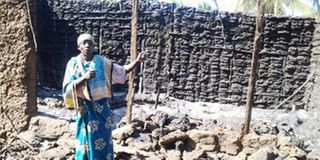
A woman at Magomeni Street in Mtwara shows The Citizen reporter her charred house which was torched after the eruption of violence sparked by a disagreement between the government on the construction of a gas pipeline from Mtwara to Dar es Salaam. PHOTO | ELIAS MSUYA
What you need to know:
Mtwara politicians, who formed an alliance to coordinate the demonstrations against the State’s plan to build a natural gas pipeline, accuse the government of political blindness and failing to read warning signs that show there is a wind of change blowing as far as people’s civic awareness is concerned.
Mtwara. The disruption of peace in Mtwara and the chaos that ensued following the tabling of the Energy and Minerals ministry budget was the direct result of a government that ignores the importance of listening to wananchi and engaging the electorate in negotiations, dialogue and public awareness, stakeholders have said.
And it calls to question the extent of government respect for the electorate and shows where its interests lie in democratic Tanzania.
Mtwara politicians, who formed an alliance to coordinate the demonstrations against the State’s plan to build a natural gas pipeline, accuse the government of political blindness and failing to read warning signs that show there is a wind of change blowing as far as people’s civic awareness is concerned.

Mr Selemani Litope is the secretary general of an alliance of eight political parties that organised the demonstration in Mtwara in December last year. These parties included NCCR Mageuzi, TLP, UDP, ADC, DP, APPT Maendeleo, SAU and Chama cha Ukombozi wa Umma (Chauma).
According to Mr Litope, allegations that opposition against the gas pipeline originated from political parties that formed the alliance were wrong.
“This is a very funny line of argument...which has been used by the regional government as an excuse, both for failing to engage the people and secondly for wanton crackdown and witch-hunting,” Mr Litope told The Citizen.
The fact of the matter is that the alliance seized on the people’s sentiments. Mtwara residents, individually or collectively, had misgivings about the whole issue of transporting natural gas to Dar es Salaam.
These sentiments were aggravated by a historical perspective that southern regions are forgotten by the government when it comes to sharing the national cake. According to Mr Litope, the region’s infrastructure is dilapidated and social services are almost non-existent.
Mr Litope explains that what the alliance of eight political parties did was to coordinate the protests to bring sanity.
In fact, Mr Litope says, everything started in earnest in November last year during meetings conducted by the ministry of Energy and Minerals to collect people’s views on the draft Natural Gas Policy.
People studied the draft policy and found that there was nothing in it for them. They questioned it publicly and when they failed to get satisfying answers they boycotted the meetings. In some instances they tore down the documents and left meetings prematurely.
Government’s first mistake
The government ignored people’s dissatisfaction with the draft natural gas policy and went ahead with plans to adopt it. This was a big mistake according to Mr Litope. People felt the government did not care about their sentiments.
Tension started to build up and since then there was talk of finding ways to make the government hear Mtwara residents’ voices loud and clear.
“We feared the worst could happen and we wanted the protests to be conducted in a civilized manner,” he noted. “And the public rallies that we conducted on December 27, last year, were well organised and peaceful.
The demonstrations that day saw a massive turnout and went according to plans.
Processions started some few kilometres outside the town on the road that leads to Msimbati, a village that hosts natural gas wells.
The protesters were scheduled to pass through the regional commissioner’s office where demonstrators would hand the RC petitions that expounded on why they opposed the construction of the natural gas pipeline from Mtwara to Dar es Salaam.
Government’s second mistake
The regional commissioner, Mr Joseph Simbakalia, refused to receive protesters and allegedly insulted them, calling them “nonsense.” People did not take Mr Simbakalia’s attitude kindly.
And the region has been degenerating into chaos since December, last year, which have so far left three people dead (according to police sources), many injured and hundreds of millions of shillings of property destroyed.
The December 27 public rally ended peacefully.
“Mr Simbakalia didn’t know what he was doing at the time because his statement ellicited more anger from wananchi who turned out at the demonstrations which was followed by a meeting held at Mashujaa grounds,” said Mr Litope.
Violent protests erupted in the next month, in January this year, in Masasi District and ended with scores of people injured and several houses and offices belonging to CCM leaders and the police burnt down.
As the situation threatened to degenerate, Prime Minister Mizengo Pinda made an emergency visit to the area to calm the situation.
In a reconciliation meeting that brought together regional and civic leaders, clerics and representatives from youth groups and political parties - and which was chaired by Mr Pinda - Mr Simbakalia eventually apologised to wananchi.
But the damage was already done and violent protests that were associated with vandalism and torching of houses went on thereafter in Liwale and Tandahimba in the region.
The source of these violent protests was not the natural gas pipeline as many may be led to think. Analysts said what the people needed was a spark to ignite their anger.
In Masasi the riots started after a traffic police officer allegedly harassed a motorcycle (bodaboda) taxi operator. In Tandahimba, the issue was the low returns the farmers receive when they sell their cashew nuts through the warehouse receipt system. And in Liwale, the cause of the riots was not even clear.
However, the worst was what happened in Mtwara town on May 22 the day the ministry of Energy and Minerals tabled the budget. The three day-violent protests ended with at least three people dead, according to police sources. But human rights groups and Mtwara residents claim that at least 12 people died of gun wounds. One of those who died from the violence included a pregnant woman.
Government’s third mistake
In a follow up to the riots in Mtwara, the government has been selling the argument that some politicians and political parties are solely to blame for the chaos because they were behind the protests against the gas pipeline. The failure by the government to own up to the crisis was another mistake.
The vice chairperson of the alliance of eight political parties, Mr Abdallah Uledi, says by blaming the Opposition political parties whether those that are part of the alliance or those outside the it the government is showing weak leadership and avoiding responsibility.
“In trying to search for a solution for the crisis, the same government has widely consulted clerics and other religious leaders, representatives of youth groups, elders and politicians. This does not seem to support their (government’s) assertion that politicians are solely to blame for the chaos,” Mr Uledi said.
Both Mr Uledi and Ms Fatma Sinani, a cadre of the NCCR Mageuzi in Mtwara, said that by refusing to admit that it made fundamental mistakes by failing to engage the people, the government was mystifying the crisis at the expense of peace and security in the region. This will complicate issues further and could make Mtwara a volatile region.
Government’s strategy in handling the Mtwara crisis is better expressed by Mr Simbakalia. “This [the protests against the pipeline] has got nothing to do with gas. Why should they go on destroying people’s property and infrastructure?
They even attempt to destroy Ligula hospital. What has all these got to do with the construction of the natural gas pipeline?” Mr Simbakalia queried in a press conference after the May 22 riots.
Is the government running away from its own shadow?
Some of Mtwara residents are blaming the government for being the cause of the gas crisis.
“When some political parties formed an alliance and started to sensitise people they were granted permission to hold public rallies as well as demos...but now that things have gone wrong, the government starts to blame politicians...where have they been during the whole crisis?” queried a trader who preferred to remain anonymous.
The gas pipeline
Tanzania secured a loan to the tune of $1.2 billion from the Exim Bank of China to finance the pipeline linking Mtwara gas fields with Dar es Salaam.
The construction of the 532-kilometre long pipeline, with a 36-inch main line and one 24-inch spur line, was officially inaugurated by President Jakaya Kikwete in November 8, 2012.
The pipeline will have a capacity of 784 MMcf/d of gas, to be used for the production of 3,900 MW of electricity in Kinyerezi area in Dar es Salaam.
Proven to be commercially viable, the natural gas reserve currently stands at 40 trillion cubic feet. This could double by 2015 according to experts.
Some of the big oil and gas companies have been exploring gas in the Indian Ocean as well as in the deep seae. Some of them include Statoil of Norway, BG Group of England, Petrobras of Brazil, Shell of the Netherlands, ExxonMobil of the US and Ophir from the UK.