Ardhi University unveils AI solutions to fight counterfeit drugs, expand financial access

Ardhi University (ARU) students showcase various artificial intelligence (AI) powered innovations designed to address health, financial inclusion, environmental, and maternal care challenges during the ongoing Nanenane International Agricultural Exhibition in Dodoma City. PHOTO | RACHEL CHIBWETE
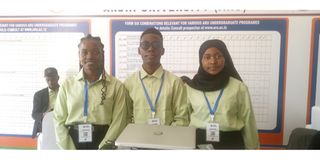
Dodoma. Ardhi University (ARU) has showcased modern innovations bringing hope to drug users by tackling counterfeit medicines, alongside wider health, environmental, and financial inclusion solutions using artificial intelligence (AI) at the ongoing Nane Nane International Agricultural Exhibition in Dodoma.

Speaking to The Citizen’s sister newspaper Mwananchi on Tuesday, August 4, 2026, ARU student, Ms Zakia George, said among those innovations is the MedVerify system, aimed at helping citizens verify medicine authenticity and obtain accurate information regarding usage before taking it.

She said the system was designed due to the increase in counterfeit and unsafe medicines that have been causing severe harm to patients, including failure to treat illnesses and loss of life.

"We saw it as essential to have a system enabling every citizen to verify medicine quality and accuracy before consumption. Currently, the system is at the development stage, but it is expected to commence official use upon completion," said Ms George.

Besides that system, third-year Bachelor of Science in Information Systems Management student, Mr Selestine Kabelele, presented the Voicepay mobile application enabling visually impaired people to perform financial transactions using voice.

Mr Kabelele said the system was developed using artificial intelligence that recognises user needs, enabling them to conduct transactions and check mobile money account balances.

He said it is currently in testing stages and expected to officially launch within the next few months.

"We want to ensure everyone participates in the digital economy. Visually impaired people have faced barriers in financial services, so this system will help eliminate that challenge," said Mr Kabelele.

On his part, third-year Bachelor of Science in Information Systems Management student, Mr Golden Haule, said he designed two AI-powered systems: Uzazi Salama AI and an air quality measurement system.

He said Uzazi Salama AI helps pregnant women access nutritional and health advice tailored to their pregnancy stage, conduct symptom analysis, and get prompt emergency assistance when facing complications.

Mr Haule said the system allows users to transmit their location so nearby hospitals receive emergency alerts, whilst enabling direct communication with ambulance services.

"We designed this system to reduce challenges facing expectant mothers, particularly those living far from health facilities. The system provides dietary advice, symptom analysis, and enables rapid assistance during emergencies," he said.

Regarding the air quality measurement system, Mr Haule said it uses solar-powered sensors to measure levels of various gases, including carbon dioxide and nitrogen dioxide, subsequently analysing that data to display via a mobile application and website.

He said the system also uses AI to provide recommendations on protecting oneself against air pollution impact, usable by citizens, industries, and environmental authorities to obtain real-time information for decision-making.

"This system will help citizens know the quality of air they breathe daily and actions to take. It will also benefit industrialists monitoring air quality trends around their premises, assisting them in making environmental improvements," he said.

On her part, head of innovation, research, and technology unit at Ardhi University, Ms Eunice Likotiko, said the exhibition has provided an opportunity to showcase research and innovations created by students in collaboration with university lecturers and experts.

She said among other showcased innovations is technology for producing plastic using fish and rice waste, a step aimed at contributing towards environmental conservation and industrial development.

"Ardhi University possesses modern laboratories, experts, and an environment enabling students to design technologies providing solutions to challenges in Tanzania and the world at large," said Ms Likotiko.

She said the university will continue investing in research and innovation to increase science and technology's contribution to national development.