Authorities look beyond Dar as manufacturing value hits Sh6 trillion

Dar es Salaam. The government has stepped up efforts to facilitate  industrial development beyond Dar es Salaam after the value of selected manufactured products rose by 37.4 percent to Sh6.06 trillion in the quarter ending March 2026.

The increase, from Sh4.41 trillion recorded during the corresponding quarter last year, signals strong expansion in manufacturing, but also highlights the continued dominance of Dar es Salaam as the country’s main industrial hub.
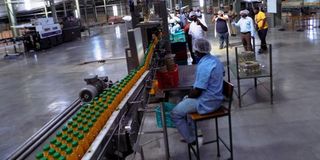
According to Bank of Tanzania (BoT) data, Dar es Salaam accounted for Sh2.7 trillion, or 44.6 percent, of the total value of selected manufactured products during the quarter.

The minister of Industry and Trade, Judith Kapinga said the government’s ambition was not to force industries out of Dar es Salaam, but to develop competitive industrial centres in other parts of the country based on available resources and economic opportunities.

“The objective is not simply to relocate industries from Dar es Salaam. The objective is to open up other parts of the country and create the conditions for industries to emerge and grow where it makes economic sense,” she said.

The figures, however, show that manufacturing growth is increasingly spreading to other parts of the country.  The Central Zone recorded the fastest growth, with the value of selected manufactured products more than tripling to Sh826.2 billion from Sh248.7 billion a year earlier.

The South Eastern Zone followed with a 30 percent increase to Sh1.08 trillion, while the Lake zone recorded a 29.7 percent rise to Sh445.1 billion. Manufacturing value in the Southern Highlands increased by 27.7 percent to Sh300.4 billion.

The Northern Zone was the only one to record a decline, with manufacturing value falling by 5.7 percent to Sh706 billion from Sh748.3 billion.

Dar es Salaam, meanwhile, recorded a 34.8 percent increase, suggesting that industrial decentralisation is taking place alongside continued expansion in the commercial capital rather than at its expense.

Ms Kapinga said infrastructure development would be central to the government’s efforts to make other regions more attractive to manufacturers.

“We have put in place a number of plans and investments aimed at opening up different regions of the country for industrial development.

This includes the construction of the Standard Gauge Railway (SGR), improvements to our ports, the strategy to upgrade the road network and the expansion and improvement of airports,” she said.

For manufacturers, she said, the location of a factory was closely linked to the cost and reliability of transporting raw materials and finished products.

The government is consequently developing a national infrastructure map to identify gaps and guide future investments, she added.

The strategy is particularly relevant to Tanzania’s efforts to promote resource-based industrialisation, where processing is carried out closer to the source of raw materials.

Ms Kapinga said the government wanted regions with minerals, agricultural produce and other resources to have the infrastructure and other conditions required to attract investment.

“We want industries to be established where the resources are. If a region has minerals, agricultural products or other resources that can support manufacturing, we need to create the supportive elements that will allow investors to establish industries there and add value locally,” she said.

Assistant lecturer at the University of Dar es Salaam Business School, Godsaviour Christopher,  said Dar es Salaam’s dominance was rooted in genuine commercial advantages that could not be eliminated through policy alone.

The city has the country’s main seaport, extensive road and rail connections, financial services, a large consumer market and relatively better access to utilities and skilled labour, Mr Christopher, who is also a business consultant, said.

“Manufacturing remains heavily concentrated in Dar es Salaam and a few nearby coastal regions because these areas enjoy advantages that are difficult for businesses to ignore,” he said.

Mr Christopher said decentralisation should therefore focus on building comparable industrial ecosystems in other regions rather than relying solely on incentives to persuade companies to relocate.

“Targeted tax incentives for investors and stronger vocational training programmes in regional areas would further encourage industries to move closer to local resources and labour,” he said.

He added that spreading manufacturing beyond major cities would create jobs, reduce regional inequalities and unlock the economic potential of underserved areas.

Ms Kapinga said reliable electricity would also be essential to attracting and retaining manufacturers outside established industrial centres.

The government is also seeking to strengthen small and medium-sized industries and increase their participation in manufacturing and value chains, as part of efforts to broaden the country’s industrial base.