Childhood lost: Children forced into labour at small-scale mines

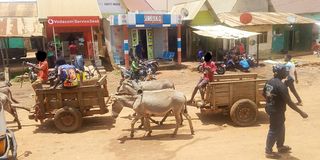
Children in Lwamgasa, Geita Region, ride on carts drawn by donkeys as they transport gold bearing rocks from small scale mines to crushing sites. PHOTO | ROSEMARY MIRONDO

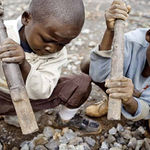
Geita. A 14-year-old boy in Kwa Emmanueli, Lwamgasa, spends his days under the scorching sun crushing gold-bearing rocks instead of attending school.

The teenager, whose name has been withheld to protect his identity, earns between Sh2,000 and Sh5,000 a day alongside his 19-year-old brother. The money helps them survive after their family fell apart.
“Our mother left us. Our father broke his leg and returned to our ancestral village,” the boy said. “My elder brother and I crush stones while my 17-year-old brother works in a cybercafé. We work so that we can find food and clothes.”

His younger brother, aged 17, said education had become an impossible dream.

“I work in a computer shop and earn about Sh2,000 a day to support myself and my siblings,” he said.

The eldest brother works around a mining shaft. Together, the three boys struggle daily to secure basic necessities, their childhood replaced by relentless labour.

Their story reflects a growing reality in Lwamgasa, a bustling gold-mining settlement in Geita Region, where efforts to remove children from mining pits have achieved some success, but child labour continues in activities linked to the mining value chain.

While licensed mining sites are increasingly fenced and monitored, children remain heavily involved in transporting, crushing, washing and selling gold-bearing ore outside the mines.

A different face of child labour

Arriving in Lwamgasa from Katoro, visitors are greeted by a busy gold market, roadside shops, food stalls and drinking establishments.

Beyond the commercial centre lie artisanal mining areas and numerous informal processing sites where ore is crushed, ground and washed in search of gold.

It is here that children can still be found working.

During a visit by The Citizen in March 2026, children aged between 13 and 17 were observed carrying sacks of ore, breaking stones and washing gold-bearing materials.

Younger children played nearby, often without adult supervision.

Although Tanzania has strengthened enforcement against child labour in mining, poverty and weak parental support continue to push children into hazardous work.

The practice contravenes Section 5(1) of the Employment and Labour Relations Act, Cap. 366 (Revised Edition, 2023), and the Law of the Child Act, both of which prohibit persons under the age of 18 from engaging in hazardous occupations such as mining.

The country has also adopted policies and action plans aimed at eliminating the worst forms of child labour, particularly in mining, agriculture, fishing and domestic work.

Labour officers, social welfare officials, local government authorities, police and mine inspectors are all mandated to enforce the laws.

Authorities defend enforcement efforts

Commissioner for Minerals, Dr AbdulRahman Mwanga, said the government had intensified efforts to eliminate child labour in mining areas through inspections and strict enforcement.

“We conduct regular inspections and prohibition measures, and we are very serious about this issue. We work closely with social welfare officers, district commissioners and village governments. As a sector, we have already established systems to remove children whenever inspections are carried out,” he said.

Dr Mwanga stressed that children are not permitted to engage in any mining activity.

“Even if the activity is initiated by a child’s parents, involving children in mining remains illegal. Any mining pit owner operating without a licence is acting unlawfully, while licensed operators understand clearly that engaging in such practices can lead to immediate suspension of their licences,” he said.

He added that licence holders risk permanent revocation if found violating the regulations.

“If we catch anyone breaching these rules, we revoke their licence for life,” he said.

Hunger driving school dropouts

Despite these measures, many children interviewed cited hunger and poverty as the primary reasons for abandoning school.

One 14-year-old boy said he left school because his family could not afford food.

“I would go to school hungry, struggle to concentrate and return home to find nothing cooked. When the hunger became unbearable, I had no choice but to quit,” he said.

The boy dropped out while in Standard Six.

At Mwaloni, a 15-year-old who earns money grinding stones described a similar experience.

“I grind stones and fill sacks. For every sack I complete, I am paid Sh2,000, which helps me buy food,” he said.

Having left school in Standard Four, he admitted he now struggles to read and write.

“I asked my mother to take me back to school, but she said she could not afford it.”

Another 14-year-old, who left school in Standard Five, said uncertainty had replaced ambition.

“I have no dreams for the future at the moment. Only God knows,” he said.

A 13-year-old boy carrying a sack of ore said he hoped to earn Sh1,000 from selling it.

“I need the money to buy school shorts,” he explained.

Families trapped by poverty

Many parents say survival has become their overriding concern.

Adventina Bundala said she was forced to withdraw her daughter from school after giving birth to twins.

“My husband had already left, so I became the sole provider,” she said.

Her daughter, then aged nine, stayed home to care for the younger children while she searched for gold-bearing stones to sell.

“Hopefully, when the children grow older, we will find a way to return her to school,” she said.

Another parent said she returned home after searching for work elsewhere only to discover that her 13-year-old child had dropped out of school because there was no food.

“These children spend their days crushing and washing stones simply to survive. It takes away both their childhood and their education,” she said.

Not all young workers have abandoned their aspirations.

A 17-year-old who completed Standard Seven said he earns up to Sh20,000 a day grinding stones and is saving money to enrol at the Vocational Education and Training Authority (Veta).

“Part of the money helps my parents, and the rest I save because I want to become an electrician,” he said.

Another 14-year-old, responsible for caring for younger siblings while his parents travelled, earns Sh2,000 for every sack of ore he transports.

He said he previously washed stones using mercury but stopped after developing a fungal infection on his fingers.

Mothers working alongside children

The harsh realities of poverty are also evident among women working at processing sites.

Joyce Malomo was seen carrying her three-month-old baby while breaking stones.

The child was born with a leg deformity and requires specialised treatment.

“The father abandoned us,” she said. “Hospital treatment is free, but the equipment needed costs Sh200,000. I have no one to leave the baby with, so I bring her here while I work.”

Several other women were observed working amid clouds of dust while caring for infants and young children.

Mines tighten controls

Managers and security personnel at licensed mines insist that children are no longer allowed inside mining operations.

At Mpandachalo Gold Mine, Chief Inspector of Mines January Mwendo said strict controls had been implemented.

“The mine is fenced and secured. Supervisors ensure that nobody under the age of 18 is employed,” he said.

Mine owner Hamisi Mbaga said security personnel verify workers' identities and ages before they are allowed entry.

“Supervisors confirm that every worker meets the minimum age requirement of 18 years,” he said.

At Miembeni Gold Mine, security guard Revocatus John said child labour had largely shifted away from mining pits.

“We do not allow minors inside the mine,” he said. “However, I have noticed children, especially boys, carrying gold-bearing sand from one area to another.”

He urged authorities to strengthen efforts to ensure all school-age children remain in education.

Community leaders raise alarm

Local leaders say child labour remains a serious concern despite awareness campaigns and enforcement measures.

Balozi Sylvester Omolo of Gombani CCM Hamlet said poverty continues to drive children out of school.

“We have sensitised parents, but many are under severe economic pressure,” he said.

According to him, children aged between 12 and 15 are commonly engaged in carrying sacks of crushed ore and washing stones for payment.

“Mines are fenced and access is restricted, but some children still participate in activities surrounding the mining operations,” he said.

He noted that some of the affected children are orphans or come from households where parental support is absent.

To reduce absenteeism, schools in the area provide porridge and food support programmes.

Yet, for many families, the immediate need for food outweighs the long-term value of education.

A hidden shift

Interviews with mine operators, government officials, parents and children suggest that enforcement efforts have significantly reduced the presence of minors inside licensed mining sites.

However, child labour has not disappeared.

Instead, it appears to have shifted into the informal economy surrounding the mines, where children crush rocks, transport ore, wash gold-bearing materials and trade mining sand for small amounts of money.

For many of these children, the issue is not simply weak enforcement but chronic poverty, family breakdown and the daily struggle to find food.

Until those underlying causes are addressed, the fences around mining pits may keep children out of the shafts, but they will not necessarily keep them away from the gold economy that continues to shape their lives.