Crackdown launched in Tanzania as police target bodaboda operators taking the law into their own hands

Dar es Salaam. A troubling trend has emerged where, following an accident involving a bodaboda, colleagues gather claiming the victim was denied justice on the road and begin taking the law into their own hands, a habit the Police Force has warned against and called for an immediate end to.

The gathering of bodaboda drivers after accidents occur has begun sparking fear across certain regions nationally, with incidents of motorists being assaulted, vehicles damaged and set ablaze linked to retaliatory anger on behalf of their peers.
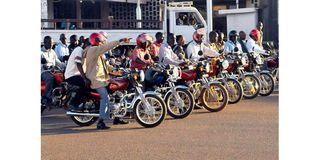

In several instances, shortly after an accident occurs, word spreads amongst bodaboda drivers and their colleagues arrive in large numbers at the scene.

Instead of awaiting police investigation and legal processes, some begin pressuring or attacking the motorist involved in the accident, with anger additionally shifting onto their vehicle.

This situation has caused some accidents to become more than traffic incidents, as they turn into a source of violence, property destruction and anxiety for citizens present at the location.

In August 2026, in Musoma District, Mara Region, a group of bodaboda drivers burnt a saloon car linked to an accident that caused the death of their fellow driver.

On June 1, 2026, in Kigoma Region, bodaboda drivers burnt a cargo lorry after it allegedly caused the death of their colleague in Ujiji area, Ushirika Street.

In February 2024, a Saibaba Express company bus travelling from Dar es Salaam towards Arusha was set on fire by a group of bodaboda drivers in Mtonga Ward, Korogwe District, Tanga Region, following an incident involving their colleague.

Bodaboda accidents

According to figures from the 2024 Road Safety Incidents Report, motorcycles were involved in 2,799 accidents during that year.

Among those, 435 bodaboda accidents were reported to have caused 378 deaths and 395 injuries.

Furthermore, between January and June 2024, motorcycle accidents reached 259, up from 216 during the same period in 2023, representing a 19.9 percent increase.

This trend demonstrates that despite bodabodas being a crucial source of employment for many youths, the road safety challenge remains substantial.

‘No permission to take law into hands’

On August 19, 2026, Dar es Salaam Special Zone Police Commander, Mr Jumanne Muliro, stated that actions by certain motorcyclists burning or damaging vehicles and looting items after accidents constitute criminal acts.

“Actions by certain motorcyclists burning or striking vehicles and looting items inside those motor vehicles immediately after accidents are criminal acts, intolerable and contrary to the country’s laws,” he stated.

Mr Muliro explained that the accident occurred on Kilwa Road after a vehicle travelling from Uhasibu towards Zakhem hit and injured a bodaboda driver, Mr William Ashery, positioned in front of the vehicle.

He noted the cause of the accident was allegedly the bodaboda driver shifting from one side of the road to another carrying two passengers without taking precautions.

Following the accident, several bodaboda drivers gathered and began assaulting the motorist, setting fire to and destroying the vehicle alongside looting items inside it.

“The Police Force has begun arresting individuals allegedly involved in these acts and has already detained 18 suspects alongside 23 motorcycles, including some abandoned by the motorcyclists after fleeing when they sensed potential arrest by police,” he said.

In another incident, Mr Muliro stated that on August 15, 2026, in the Kanisani area, a group of bodaboda drivers allegedly assaulted the driver of a saloon car.

Mr Muliro stated that the Police Force will continue taking action against those engaging in such acts, whilst urging bodaboda drivers to refrain from taking the law into their own hands and allow authorities to handle accidents according to the law.

Speaking separately to The Citizen’s sister newspaper Mwananchi, several bodaboda drivers stated that their solidarity stems from challenges encountered on the roads, especially when feeling undervalued by heavy vehicle drivers.

A bodaboda driver at Buguruni stand in Dar es Salaam, Mr Lukasi Mgalula, stated that differences in vehicle size make some of them feel mistreated.

“On the road, the large vehicle owner disrespects the small vehicle owner, but the small vehicle owner refuses to be disrespected. Ultimately bodaboda drivers face disrespect, so they decide to unite to support one another in self-defence against oppression,” he said.

However, Mr Mgalula noted that despite those challenges, the law must be followed.

“Many bodaboda drivers face significant oppression on the road due to small vehicles, causing them to unite in doing this. Crucially, laws should simply be followed regardless of vehicle size, then all this will cease,” he said.

Motorists complain

A lorry driver with DCG Company in Dar es Salaam, Mr Henry Songolo, stated that some motorcyclists lack caution by squeezing into narrow spaces between moving lorries, increasing accident risks.

A trader from Tabata, Ms Lulu Charles, stated that some motorcyclists use narrow pedestrian pavements, resulting in them causing accidents.

“Some motorcyclists, even car drivers, use pedestrian pavements, causing inconvenience and endangering people using those paths when colliding or scraping,” she said.

She stated that if a car and motorcycle collide, violence erupts, causing fear among citizens present at the location.

“And unfortunately, these motorcycle drivers are often the ones causing accidents, yet refuse to admit being the source, so you find them gathering and harassing car drivers, regardless of whether it is a small or large vehicle,” stated Ms Charles.

Spreading anger

Psychology expert, Mr Charles Kalungu, stated these incidents are driven by a state he calls ‘infectious ignorance’, where individuals join group actions without understanding the event’s cause.

“What occurs during these incidents, even if you interview someone angrily attacking a vehicle, you might find they do not know how the accident happened. This also stems from a negative mindset among bodaboda drivers feeling neglected or oppressed due to their transport vessels, increasing anger and bitterness,” he stated.

Mr Kalungu noted the solution involves leaders engaging bodaboda drivers in dialogue to shift that mindset rather than fuelling anger and bitterness.

Police Force statement

An Inspector with the Police Force Traffic headquarters, Mr Dumu Mwalugenge, stated that bodaboda drivers, like other road users, possess rights to use roads, but have obligations to follow all traffic and national laws.

He noted that alongside traffic laws, bodaboda drivers should avoid criminal offences.

“Laws state that when an accident occurs, the primary duty is providing aid to injured persons if present and notifying police. Taking the law into hands, either by striking or harming a fellow driver or burning a vehicle, is an offence by law,” he said.

Mr Mwalugenge added that this constitutes a criminal offence even if someone believes the suspect caused the accident, clarifying that deciding who is right or wrong belongs solely to the court.