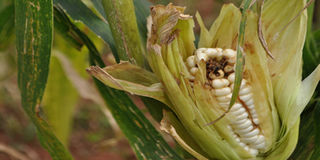
East Africa is still struggling to eradicate the maize lethal necrosis disease (MLND), which has ravaged the crop in the northern regions of Tanzania and other East African countries since 2013.
What you need to know:
The Permanent Secretary in the Ministry of Agriculture, Livestock and Fisheries, Dr Florens Turuka, said although intensive research was underway on how to contain it, the disease still poses a major threat to maize production in the region.
Arusha. East Africa is still struggling to eradicate the maize lethal necrosis disease (MLND), which has ravaged the crop in the northern regions of Tanzania and other East African countries since 2013.
The Permanent Secretary in the Ministry of Agriculture, Livestock and Fisheries, Dr Florens Turuka, said although intensive research was underway on how to contain it, the disease still poses a major threat to maize production in the region.
“MLND can wipe out maize field by 100 per cent. The only thing our farmers have to do to contain it for the moment is to uproot the affected maize and to plant improved maize seeds,” he said here at the weekend.
He was officially gracing the Agribusiness Expo 2016 organized by the Eastern Africa Grain Council (EAGC) in collaboration with the Arusha-based Selian Agricultural Research Institute (Sari).
The PS added that the maize disease, which was identified in East Africa in 2012, should not discourage the grain farmers because, for the Tanzanian case, it has not spread to the southern regions, the country’s bread basket for maize, and was largely still confined to the northern zone.
The southern highland regions, however, are reported to have been highly infested by the Maize Streak Virus, which has been attributed to the tendency by the farmers to recycle the same seeds for planting without following the expert advice to plant improved varieties.
Dr Turuka decried low productivity of maize and other cereals in East Africa, saying the situation was worrying in Tanzania where the yields range between 500 and 700 kilogrammes per acre and 200kg to 300kg for legumes such as pigeon peas. The PS himself an agricultural expert, attributed the low production to failure to embrace modern farming technologies, including the use of recommended fertilizers and application of pesticides, poor market linkages, dependency on rain-fed agriculture and the high costs of agricultural inputs for some growers.
He said with the application of relevant extension services, the improved maize, pigeon peas, wheat, barley and bean seeds propagated at the Selian Institute can yield up to 2,500 to 3,200 kgs per acre. He challenged the farmers to follow the advice of the experts working at the institution which is specialises in dryland agriculture.
He lauded the Nairobi-based EAGC for creating a value-chain for the smallholder farmers in the region, noting that this will enable them to commercialize their agriculture. He called on the Council not to relent in linking the grain farmers to the markets within the region and beyond.
For more news get your copy of The Citizen read online through www.epaper.mcl.co.tz